The behaviourist approach
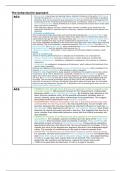
A01: • Behaviourism, also known as learning theory, started in America in the early 1900s mainly
through the ideas of John Watson.The behaviourist approach is only interested in studying
behaviour that can be observed and measured. It is not concerned with investigating men-
tal processes of the mind because these were seen as irrelevant. There are 3 main assump-
tions of behaviourism- nearly all behaviour is learnt, animals and humans learn in the same
ways, the mind is irrelevant.
• They describe a baby’s mind as a ‘blank slate’ and this is written on by experience. Be-
haviourists identified 2 important forms of learning- classical conditioning and operant con-
ditioning.
• Classical conditioning:
This is learning through association and was first demonstrated by Ivan Pavlov (1927). Ivan
Pavlov was studying how dogs salvation helps them digest food, he noticed they would sali-
vated before they got the food . He realised they had associated the food with another stimu-
lus. Pavlov showed how dogs could be conditioned to salivate to the sound of a bell if that
sound was repeatedly presented at the same time they were given food. When dogs see food
they salivate. This is an automatic, unlearned response. The food is the UCS and the saliva-
tion is the UCR. The bell was the NS, when combined with food (UCS) it caused salivation. The
bell became the CS and the salivation had become the CR.
- Watson and Rayner: Little Albert, a fear response to fluffy white objects had been condi-
tioned.
Operant conditioning:
A form of learning where behaviour is shaped and maintained by its consequences.
- Positive reinforcement: receiving a reward when a certain behaviour is performed.
- Negative reinforcement: avoiding an unpleasant consequence, the outcome is a positive
experience.
- Punishment: An unpleasant consequence of behaviour, which reduces the likelihood of be-
haviour being repeated.
Positive and negative reinforcement increase the likelihood behaviour will be repeated. Pun-
ishment decreases the likelihood that behaviour will be repeated.
Skinner’s rats: Experiment to study operant conditioning. He created a skinner box where
he placed 1 rat at a time. Skinner box contained a variety of different stimuli: a speaker,
lights, floor which gave electric shock and food dispenser. A hungry rat was placed in a skin-
ner box, the time taken for the rats to learn that pressing the lever would release food was
recorded. The rats would accidentally press the lever and it was rewarded with food. The
more the rat was put in the box, the quicker they learnt where the lever was. He concluded
that rats can learn behaviour through OC. A behaviour such as pressing the lever can be posi-
tively reinforced by receiving food.
A03: • STRENGTH- One strength of the behaviourist approach is that it is based on well
controlled research. Behaviourists focused on the measurement of observable
behaviour within highly controlled lab settings. By breaking down behaviour into
basic stimulus-response units, all the possible extraneous variables were re-
moved, allowing cause and effect relationships to be established. This suggest
that behaviourists experiments have scientific credibility.
• COUNTERPOINT- However the problem with this is that behaviourists may have
oversimplified the learning process. By reducing behaviour to such simple com-
ponents, behaviourists may have ignored an important influence on learning- hu-
man thought. Other approaches such as SLT and cognitive approach have drawn
attention to mental processes involved in learning. This suggests that learning is
more complex than observable behaviour alone and that mental processes are
also essential.
• STRENGTH- Principles of conditioning has been applied to real world behaviours
and problems. For example, operant conditioning is the basis of the token econ-
omy systems that have been used successfully in prisons. Milan and McKee im-
plemented a token economy in 33 inmates in prison. These work by rewarding
appropriate behaviour with tokens that can be exchanged for privileges. This in-
creases the value of the behaviourist approach because it has widespread appli-
cation. The concept of conditioning can be used to improve peoples lives.
• LIMITATION- The Skinner box can raise ethical issues as well as practical issues.
For example, animals were housed in harsh, cramped conditions and deliberately
kept below their natural weight so they were always hungry. Also experimenting
on rats in a cage may have caused them to be shocked. This could have im-
pacted the rats reactions and behaviour, making the results inaccurate.
• - Difficult to generalise the behaviour of rats in a cage to humans.
,
A01: • Behaviourism, also known as learning theory, started in America in the early 1900s mainly
through the ideas of John Watson.The behaviourist approach is only interested in studying
behaviour that can be observed and measured. It is not concerned with investigating men-
tal processes of the mind because these were seen as irrelevant. There are 3 main assump-
tions of behaviourism- nearly all behaviour is learnt, animals and humans learn in the same
ways, the mind is irrelevant.
• They describe a baby’s mind as a ‘blank slate’ and this is written on by experience. Be-
haviourists identified 2 important forms of learning- classical conditioning and operant con-
ditioning.
• Classical conditioning:
This is learning through association and was first demonstrated by Ivan Pavlov (1927). Ivan
Pavlov was studying how dogs salvation helps them digest food, he noticed they would sali-
vated before they got the food . He realised they had associated the food with another stimu-
lus. Pavlov showed how dogs could be conditioned to salivate to the sound of a bell if that
sound was repeatedly presented at the same time they were given food. When dogs see food
they salivate. This is an automatic, unlearned response. The food is the UCS and the saliva-
tion is the UCR. The bell was the NS, when combined with food (UCS) it caused salivation. The
bell became the CS and the salivation had become the CR.
- Watson and Rayner: Little Albert, a fear response to fluffy white objects had been condi-
tioned.
Operant conditioning:
A form of learning where behaviour is shaped and maintained by its consequences.
- Positive reinforcement: receiving a reward when a certain behaviour is performed.
- Negative reinforcement: avoiding an unpleasant consequence, the outcome is a positive
experience.
- Punishment: An unpleasant consequence of behaviour, which reduces the likelihood of be-
haviour being repeated.
Positive and negative reinforcement increase the likelihood behaviour will be repeated. Pun-
ishment decreases the likelihood that behaviour will be repeated.
Skinner’s rats: Experiment to study operant conditioning. He created a skinner box where
he placed 1 rat at a time. Skinner box contained a variety of different stimuli: a speaker,
lights, floor which gave electric shock and food dispenser. A hungry rat was placed in a skin-
ner box, the time taken for the rats to learn that pressing the lever would release food was
recorded. The rats would accidentally press the lever and it was rewarded with food. The
more the rat was put in the box, the quicker they learnt where the lever was. He concluded
that rats can learn behaviour through OC. A behaviour such as pressing the lever can be posi-
tively reinforced by receiving food.
A03: • STRENGTH- One strength of the behaviourist approach is that it is based on well
controlled research. Behaviourists focused on the measurement of observable
behaviour within highly controlled lab settings. By breaking down behaviour into
basic stimulus-response units, all the possible extraneous variables were re-
moved, allowing cause and effect relationships to be established. This suggest
that behaviourists experiments have scientific credibility.
• COUNTERPOINT- However the problem with this is that behaviourists may have
oversimplified the learning process. By reducing behaviour to such simple com-
ponents, behaviourists may have ignored an important influence on learning- hu-
man thought. Other approaches such as SLT and cognitive approach have drawn
attention to mental processes involved in learning. This suggests that learning is
more complex than observable behaviour alone and that mental processes are
also essential.
• STRENGTH- Principles of conditioning has been applied to real world behaviours
and problems. For example, operant conditioning is the basis of the token econ-
omy systems that have been used successfully in prisons. Milan and McKee im-
plemented a token economy in 33 inmates in prison. These work by rewarding
appropriate behaviour with tokens that can be exchanged for privileges. This in-
creases the value of the behaviourist approach because it has widespread appli-
cation. The concept of conditioning can be used to improve peoples lives.
• LIMITATION- The Skinner box can raise ethical issues as well as practical issues.
For example, animals were housed in harsh, cramped conditions and deliberately
kept below their natural weight so they were always hungry. Also experimenting
on rats in a cage may have caused them to be shocked. This could have im-
pacted the rats reactions and behaviour, making the results inaccurate.
• - Difficult to generalise the behaviour of rats in a cage to humans.
,