NCLEX Mechanical Ventilation Questions with complete solutions.
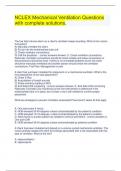
NCLEX Mechanical Ventilation Questions with complete solutions. The low tidal volume alarm on a client's ventilator keeps sounding. What is the nurse's first action? A) Manually ventilate the client. B) Put air into the endotracheal tube cuff. C) Check ventilator connections. D) Call the physician. - correct answers.Answer: C- Check ventilator connections Rationale: Ventilator connections should be check initially and loose connections or disconnections should be fixed. If there is no immediate problem found, the client should be manually ventilated and another person should check the ventilator connections. Test Plan: Management of care A client has just been intubated for placement on a mechanical ventilator. What is the first assessment of the tube placement? A) Chest X-Ray B) Auscultation of breath sounds C) Pulse oximetry reading of 95% D) End tidal CO2 monitoring - correct answers.Answer: D- End tidal CO2 monitoring Rationale: End tidal CO2 monitoring is the first intervention to determine if the endotracheal tube is in place, but a chest x-ray is still needed to confirm proper placement. What are strategies to prevent Ventilator-associated Pneumonia? select all that apply A. Oral care every 4 hours, B. HOB elevated 30-45 degrees unless contraindicated by the patient's condition C. HOB elevated 10-15 degrees, unless contraindicated by the patient's condition D. Allow family to suction patient as needed to remove secretions - correct answers.A. Oral care Q4h B. HOB elevated 30-45 degrees unless contraindicated by patients condition. A Client has been intubated and placed on a volume-cycled mechanical ventilator. The nurse carefully assess the client for findings associated with a risk associated with this type of ventilator. What is the risk? A. Hypoventilation B. Hypercapnia C. Respiratory acidosis D. Barotrauma - correct answers.D. Barotrauma rationale: the volume-cycled ventilator has the potential to increase pressure in order to deliver the set volume. barotrauma is a risk associated with this form of mechanical ventilation. A patient is placed on volume-cycled ventilation. The nurse plans care for this client based on which characteristic of this method of ventilation? A. Delivers a set volume, which will help overcome the client's airway resistance changes. B. The mechanism by which the phase of the breath switches from inspiration to expiration. C. Provides a consistent tidal volume. D. Delivers a preset volume of gas to the lungs to generate high pressures. - correct answers.A. Delivers a set volume, which will help overcome the client's airway resistance changes. Rationale: Volume- cycled ventilation delivers a preset volume of gas to the lungs, making volume constant therefore, overcoming the changes in lung compliance and airway resistance. The client is on CPAP for weaning from a mechanical ventilator. Assessment reveals a respiratory rate of 32/min, oxygen saturation of 88 percent, and use of accessory muscles. What should the nurse anticipate will occur? A. The FiO2 will be increased. B. Weaning will continue. C. The client will be placed back on full ventilatory support. D. The client will be extubated. - correct answers.Correct Answer: C. The client will be placed back on full ventilatory support. Rationale: Weaning should be discontinued, as the client is showing signs of intolerance.
Escuela, estudio y materia
- Institución
- NCLEX Mechanical Ventilation
- Grado
- NCLEX Mechanical Ventilation
Información del documento
- Subido en
- 12 de agosto de 2023
- Número de páginas
- 2
- Escrito en
- 2022/2023
- Tipo
- Examen
- Contiene
- Preguntas y respuestas
Temas
-
nclex mechanical ventilation

Documento también disponible en un lote