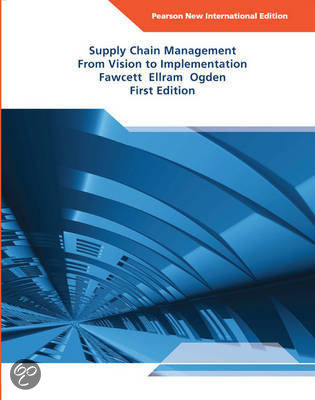
Supply Chain Management: From Vision to Implementation
by Stanley Fawcett, Lisa Ellram, and Jeffrey Ogden
Test Item File - Chapter 1: Supply Chain Management and Competitive Strategy
Multiple Choice
1. One definition of supply chain management is managing the flow of _________and _________
from the suppliers’ supplier to the customers’ customer.
A) raw materials, labor
B) orders, inventory
C) information, materials
D) suppliers, customers
Moderate
2. A goal of supply chain managers is to use technology and teamwork to build efficient and
effective processes that create _____for the end customer.
A) value
B) profit
C) inventory
D) processes
Easy
3. One definition of supply chain management is the design and management of seamless
value-added _________ across organizational boundaries to meet the real needs of the
__________.
A) products, producer
B) processes, end customer
, C) information systems, supply chain
D) services, supplier
Difficult
4. A “value chain” defined by Michael Porter in the text refers to ________.
A) external products of suppliers that add value to a process
B) the business’s financial return on investment
C) only the manufacturing transformation of raw materials to customer products
D) the interconnectivity of internal business functions whose decisions create value to
a product or process
Difficult
5. Supply chain members experience the “bullwhip effect” ________.
A) as a direct result of inadequate communications up and down the supply chain
B) when members of the supply chain initiate a collaborative forecast
C) when demand forecasts are stable, quantified and communicated throughout the
chain
D) typically during a new product introduction when the rate of increase in demand
occurs
Moderate
6. _________ is a phenomenon that occurs when demand variations are exaggerated as
decisions are made up the chain.
A) CPFR
B) SCM
C) The Bullwhip effect
D) Contingency theory
Easy
7. All of the following are major problems cited in the text regarding supply chain
management in actual practice except ________.
, A) they do not effectively work together to reduce inventory levels and costs up and
down the chain
B) excessive management focus on the external supply chain while minimal attention
on the internal chain
C) companies are actually members of the supply chain, they manage as separate
distinct entities
D) most company efforts at collaboration target only the first tier customers and
suppliers
Difficult
8. _________ theory regarding strategic thinking conceptualizes the relationship between a
changing environment, managerial decision-making, and performance.
A) Contingency
B) Industrial organization
C) Resource-based
D) Business model
Moderate
9. __________theory regarding strategic thinking claims that market forces should drive
decision-making.
A) Contingency
B) Industrial organization
C) Resource-based
D) Business model
Moderate
10. _________theory regarding strategic thinking focuses on building organizational skills and
processes that enable a company to deliver distinctive products and services.
A) Contingency
B) Business model
C) Industrial organization
D) Resource-based
Moderate
, 11. Managers must consider each of the following areas in developing effective supply chain
strategies to satisfy its customers except ________.
A) core competencies
B) environment
C) feedback
D) resources
Easy
12. A major weakness of historical supply chain strategies is________.
A) the operating costs are seldom budgeted
B) the lack of consideration of supplier geographic location
C) that interdependencies of the supply chain members are not realized
D) that they frequently do not require use contract manufacturers
Moderate
13. Questions that a supply chain strategist must ask in the development of supply chain
strategy are?
A) How does the company uniquely help the chain deliver on its value proposition?
B) What valued capabilities do other members of the chain possess?
C) What is the overall supply chain’s value proposition?
D) How can we do the job better than anyone else?
Moderate
14. SCM is the design and management of seamless, ________ processes across organizational
boundaries to meet the real needs of the end customer.
A) purchasing
B) business
C) value-added
D) quantifiable
Easy
by Stanley Fawcett, Lisa Ellram, and Jeffrey Ogden
Test Item File - Chapter 1: Supply Chain Management and Competitive Strategy
Multiple Choice
1. One definition of supply chain management is managing the flow of _________and _________
from the suppliers’ supplier to the customers’ customer.
A) raw materials, labor
B) orders, inventory
C) information, materials
D) suppliers, customers
Moderate
2. A goal of supply chain managers is to use technology and teamwork to build efficient and
effective processes that create _____for the end customer.
A) value
B) profit
C) inventory
D) processes
Easy
3. One definition of supply chain management is the design and management of seamless
value-added _________ across organizational boundaries to meet the real needs of the
__________.
A) products, producer
B) processes, end customer
, C) information systems, supply chain
D) services, supplier
Difficult
4. A “value chain” defined by Michael Porter in the text refers to ________.
A) external products of suppliers that add value to a process
B) the business’s financial return on investment
C) only the manufacturing transformation of raw materials to customer products
D) the interconnectivity of internal business functions whose decisions create value to
a product or process
Difficult
5. Supply chain members experience the “bullwhip effect” ________.
A) as a direct result of inadequate communications up and down the supply chain
B) when members of the supply chain initiate a collaborative forecast
C) when demand forecasts are stable, quantified and communicated throughout the
chain
D) typically during a new product introduction when the rate of increase in demand
occurs
Moderate
6. _________ is a phenomenon that occurs when demand variations are exaggerated as
decisions are made up the chain.
A) CPFR
B) SCM
C) The Bullwhip effect
D) Contingency theory
Easy
7. All of the following are major problems cited in the text regarding supply chain
management in actual practice except ________.
, A) they do not effectively work together to reduce inventory levels and costs up and
down the chain
B) excessive management focus on the external supply chain while minimal attention
on the internal chain
C) companies are actually members of the supply chain, they manage as separate
distinct entities
D) most company efforts at collaboration target only the first tier customers and
suppliers
Difficult
8. _________ theory regarding strategic thinking conceptualizes the relationship between a
changing environment, managerial decision-making, and performance.
A) Contingency
B) Industrial organization
C) Resource-based
D) Business model
Moderate
9. __________theory regarding strategic thinking claims that market forces should drive
decision-making.
A) Contingency
B) Industrial organization
C) Resource-based
D) Business model
Moderate
10. _________theory regarding strategic thinking focuses on building organizational skills and
processes that enable a company to deliver distinctive products and services.
A) Contingency
B) Business model
C) Industrial organization
D) Resource-based
Moderate
, 11. Managers must consider each of the following areas in developing effective supply chain
strategies to satisfy its customers except ________.
A) core competencies
B) environment
C) feedback
D) resources
Easy
12. A major weakness of historical supply chain strategies is________.
A) the operating costs are seldom budgeted
B) the lack of consideration of supplier geographic location
C) that interdependencies of the supply chain members are not realized
D) that they frequently do not require use contract manufacturers
Moderate
13. Questions that a supply chain strategist must ask in the development of supply chain
strategy are?
A) How does the company uniquely help the chain deliver on its value proposition?
B) What valued capabilities do other members of the chain possess?
C) What is the overall supply chain’s value proposition?
D) How can we do the job better than anyone else?
Moderate
14. SCM is the design and management of seamless, ________ processes across organizational
boundaries to meet the real needs of the end customer.
A) purchasing
B) business
C) value-added
D) quantifiable
Easy