

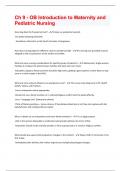
Ch 9 - OB Introduction to Maternity and Pediatric Nursing How long does the Puerperium last? - ✔✔-Known as postpartum period. -Six weeks following child birth - Sometimes referred to as the fourth trimester of pregnancy. How does nursing adapt for different cultures and OB nursing? - ✔✔The nursing care provided must be adapted to the circumstances of the m other and infant. What are some nursing considerations fro specific groups of patients? - ✔✔-Adolescents, Single women, Families at or below the poverty level, Families who have twins (or more) -Education, Support, Resources,Twins would be high stress, ge tting a good system/ routine down to stay sane or or both maybe in the NICU. What are some cultural influences on postpartum care? - ✔✔-The nurse must adapt care to fit: Health beliefs, Values, and Practices. -Use an interpreter where appropriate. -Should not use a family member or in cultural/religious conflict with the patient/family. -Use a "Language Line" (Interpreter phone) -Think of Dietary practices — Some cultures, if they believe blood loss is hot they only replace with hot liquids/foods. And nothi ng cold (ice water). Why is it better to use interpreters and never family members? - ✔✔-It is a legal purpose -Aids in the woman being able to understand and provide optimal care to her infant. -Interpreter should not be a family member or from a group t hat is in social or religious conflict. What should you expect with postpartum changes in the mother? - ✔✔-Major shifts in hormones in the first 3 days. -Immediately after delivery, the mother experiences multiple physiological changes. -It is important f or the nurse to assess all body systems and not just focus on the reproductive system changes. Parts of the Reproductive System? - ✔✔-Uterus (Involution, Uterine lining, Descent of uterine fund us, Afterpains.) -Lochia (Rubra, Serosa, Alba) -Cervix -Vagina (Stress importance of discussing with health care provider when to resume vaginal intercourse postpartum) -Breasts (Engorgement, Nursing Care) -Perineum -Episiotomy (REEDA Assessment) (Nursing care and patient teaching - cold packs , Ice diaper, Topical and systemic medications, Non pharmacological pain relief methods) -Return of ovulation and menst ruation (Menstrual cycle typically resumes in 6 -8 weeks if not breastfeeding, Return of ovulation is delayed if breastfeeding; however, it can occur at any time after birth (pregnancy is possible) Mom maybe ovulation even with no period. What happens with the breasts postpartum? - ✔✔-First 2 -3 days postpartum, breasts are full but soft. -Day 3, breasts become firm, lumpy due to increased blood flow and milk production -Engorged breasts occur in both nursing and non nursing mothers -Nipples should be assess ed for redness and cracking and washed with plain water -Support bra should be worn (Don't want cracks, Nursing needs to do make sure to do good breast care, Supply and demand - maybe oral gratification if they are staying latched on longer than 10 -15 mins) Changes with Cardiovascular System? - ✔✔-Cardiac output and blood volume -Coagulation -Blood values -Chills -Orthostatic hypotension -Nursing Care
Examen
Ch 9 - OB Introduction to Maternity and Pediatric Nursing | Questions and Answers with complete
Puntuación
Vendido
-
Páginas
9
Grado
A+
Subido en
09-08-2023
Escrito en
2023/2024
How long does the Puerperium last? - -Known as postpartum period. -Six weeks following child birth - Sometimes referred to as the fourth trimester of pregnancy. How does nursing adapt for different cultures and OB nursing? - The nursing care provided must be adapted to the circumstances of the mother and infant. What are some nursing considerations fro specific groups of patients? - -Adolescents, Single women, Families at or below the poverty level, Families who have twins (or more) -Education, Support, Resources,Twins would be high stress, getting a good system/ routine down to stay sane or or both maybe in the NICU. What are some cultural influences on postpartum care? - -The nurse must adapt care to fit: Health beliefs, Values, and Practices. -Use an interpreter where appropriate. -Should not use a family member or in cultural/religious conflict with the patient/family. -Use a "Language Line" (Interpreter phone) -Think of Dietary practices— Some cultures, if they believe blood loss is hot they only replace with hot liquids/foods. And nothing cold (ice water). Why is it better to use interpreters and never family members? - -It is a legal purpose -Aids in the woman being able to understand and provide optimal care to her infant. -Interpreter should not be a family member or from a group that is in social or religious conflict. What should you expect with postpartum changes in the mother? - -Major shifts in hormones in the first 3 days. -Immediately after delivery, the mother experiences multiple physiological changes.-It is important for the nurse to assess all body systems and not just focus on the reproductive system changes. Parts of the Reproductive System? - -Uterus (Involution, Uterine lining, Descent of uterine fund us, Afterpains.) -Lochia (Rubra, Serosa, Alba) -Cervix -Vagina (Stress importance of discussing with health care provider when to resume vaginal intercourse postpartum) -Breasts (Engorgement, Nursing Care) -Perineum -Episiotomy (REEDA Assessment) (Nursing care and patient teaching- cold packs , Ice diaper, Topical and systemic medications, Non pharmacological pain relief methods) -Return of ovulation and menstruation (Menstrual cycle typically resumes in 6-8 weeks if not breastfeeding, Return of ovulation is delayed if breastfeeding; however, it can occur at any time after birth (pregnancy is possible) Mom maybe ovulation even with no period.
Mostrar más
Leer menos
Institución
Introduction To Maternity And Pediatric
Grado
Introduction to Maternity and Pediatric
Ups! No podemos cargar tu documento ahora. Inténtalo de nuevo o contacta con soporte.
Escuela, estudio y materia
- Institución
- Introduction to Maternity and Pediatric
- Grado
- Introduction to Maternity and Pediatric
Información del documento
- Subido en
- 9 de agosto de 2023
- Número de páginas
- 9
- Escrito en
- 2023/2024
- Tipo
- Examen
- Contiene
- Preguntas y respuestas
Temas
-
introduction to maternity and pediatric
Vista previa del contenido
$4.99
Accede al documento completo:
100% de satisfacción garantizada
Inmediatamente disponible después del pago
Tanto en línea como en PDF
No estas atado a nada

Documento también disponible en un lote
Package deal
Introduction to Maternity and Pediatric Nursing Bundled exams everything you need to pass is here
8
2023
$ 39.92
Más información
