TRADE
The distinction between absolute and comparative advantage
There are two theories of why countries trade:
o Absolute and comparative advantage
A country has absolute advantage in the production of a good or service if they can
produce it using fewer resources and at a lower cost than another country
Comparative advantage occurs when a country can produce a good or service at a
lower opportunity cost than another country. This means they have to give up
producing less of another good, than another country, using the same resources
Countries can specialise where they have a comparative advantage- this increases
economic welfare
1. Calculating opportunity cost
Comparative advantage is derived by calculating the opportunity cost of each good
for each country.
Whichever country has the lower opportunity cost for a good has a comparative
advantage in that good
The other country will ALWAYS have a comparative advantage in the other good
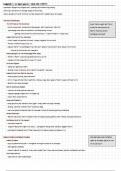
To work out which country has the comparative
advantage go to the axis where there is the
greatest gap between the countries
i.e. the y axis
and the country which is higher up has the
comparative advantage in that good i.e.
computers
then go to the other axis where the other
country will have the comparative advantage in that good i.e. cotton
Sources of comparative advantage
1. Factor endowments
a. How much of a given factor of production a country possesses
2. Factor intensities
a. Countries with more/cheaper labour will specialise in labour intensive
industries
b. Countries with more abundant capital will specialise in capital intensive
industries
, 3. Factor efficiencies
a. Countries will also tend to specialise in those goods and services by using
factors of production more efficiently.
4. Examples:
a. Germany has a comparative advantage in cars because of the capital and
skilled labour it has and because car manufacturing is capital-intensive
b. Guatemala has a comparative advantage in coffee because it has a lot of
coffee (!) and because harvesting it is labour intensive and labour is cheap.
Criticism of Comparative Advantage
1. It assumes that consumers have perfect knowledge and will always know where the
lowest prices are
2. It doesn’t consider transport costs of trade- distorts the CA
3. It doesn’t consider economies of scale- which could lead to a country enjoying its
advantage for much longer
a. On the other hand, a country that doesn’t have comparative advantage may
be able to exploit economies of scale better than that country
b. Assuming constant returns is unrealistic
4. Ignores rates of inflation- advantage may be eroded if inflation rates are very high
5. Doesn’t include import controls- tariffs and quotas may erode the price and cost
advantage
6. Non-price competitiveness is being ignored
7. Exchange rate movements ignored- if a country has a comparative advantage but a
very strong currency, its competitiveness may be ignored
8. R&D investment ignored- countries that do not have a comparative advantage may
plough lots of money into R&D and put a patent on their product which creates a
monopoly market even though they do not have CA
Benefits of trade
If we lived in a closed economy with no international trade, goods and services
would be limited to those that the country can produce based on the country’s
resources
In a small country, average costs of production are likely to be high because of the
small population size and the absence of export markets means that economies of
scale and long production runs cannot be achieved
An open economy can import raw materials and energy from the rest of the world
This widens the economy’s production possibilities
Open economies benefit from economies of scale and long production runs gained
from the access to the much larger world market
Imports lead to a much wider choice, higher level of economic welfare and living
standards
Benefits for developing countries
1. Trade can help boost development and reduce poverty by generating growth
through increased commercial opportunities and investment, as well as broadening
the productive base through private sector development
The distinction between absolute and comparative advantage
There are two theories of why countries trade:
o Absolute and comparative advantage
A country has absolute advantage in the production of a good or service if they can
produce it using fewer resources and at a lower cost than another country
Comparative advantage occurs when a country can produce a good or service at a
lower opportunity cost than another country. This means they have to give up
producing less of another good, than another country, using the same resources
Countries can specialise where they have a comparative advantage- this increases
economic welfare
1. Calculating opportunity cost
Comparative advantage is derived by calculating the opportunity cost of each good
for each country.
Whichever country has the lower opportunity cost for a good has a comparative
advantage in that good
The other country will ALWAYS have a comparative advantage in the other good
To work out which country has the comparative
advantage go to the axis where there is the
greatest gap between the countries
i.e. the y axis
and the country which is higher up has the
comparative advantage in that good i.e.
computers
then go to the other axis where the other
country will have the comparative advantage in that good i.e. cotton
Sources of comparative advantage
1. Factor endowments
a. How much of a given factor of production a country possesses
2. Factor intensities
a. Countries with more/cheaper labour will specialise in labour intensive
industries
b. Countries with more abundant capital will specialise in capital intensive
industries
, 3. Factor efficiencies
a. Countries will also tend to specialise in those goods and services by using
factors of production more efficiently.
4. Examples:
a. Germany has a comparative advantage in cars because of the capital and
skilled labour it has and because car manufacturing is capital-intensive
b. Guatemala has a comparative advantage in coffee because it has a lot of
coffee (!) and because harvesting it is labour intensive and labour is cheap.
Criticism of Comparative Advantage
1. It assumes that consumers have perfect knowledge and will always know where the
lowest prices are
2. It doesn’t consider transport costs of trade- distorts the CA
3. It doesn’t consider economies of scale- which could lead to a country enjoying its
advantage for much longer
a. On the other hand, a country that doesn’t have comparative advantage may
be able to exploit economies of scale better than that country
b. Assuming constant returns is unrealistic
4. Ignores rates of inflation- advantage may be eroded if inflation rates are very high
5. Doesn’t include import controls- tariffs and quotas may erode the price and cost
advantage
6. Non-price competitiveness is being ignored
7. Exchange rate movements ignored- if a country has a comparative advantage but a
very strong currency, its competitiveness may be ignored
8. R&D investment ignored- countries that do not have a comparative advantage may
plough lots of money into R&D and put a patent on their product which creates a
monopoly market even though they do not have CA
Benefits of trade
If we lived in a closed economy with no international trade, goods and services
would be limited to those that the country can produce based on the country’s
resources
In a small country, average costs of production are likely to be high because of the
small population size and the absence of export markets means that economies of
scale and long production runs cannot be achieved
An open economy can import raw materials and energy from the rest of the world
This widens the economy’s production possibilities
Open economies benefit from economies of scale and long production runs gained
from the access to the much larger world market
Imports lead to a much wider choice, higher level of economic welfare and living
standards
Benefits for developing countries
1. Trade can help boost development and reduce poverty by generating growth
through increased commercial opportunities and investment, as well as broadening
the productive base through private sector development