

BILIARY DISEASE
Gallstones:
- Mostly formed from concentrated bile from the bile ducts, and are made
of cholesterol
- Patients can be completely asymptomatic, or can have serious symptoms
such as in acute cholecystitis, acute cholangitis & gall-stone pancreatitis
(gallstones blocking the drainage of the pancreas via the pancreatic duct
resulting in pancreatitis)
Biliary Anatomy:
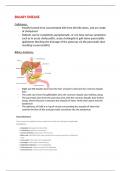
- Right and left hepatic duct leave the liver and join to become the common hepatic
duct
- The cystic duct from the gallbladder joins the common hepatic duct halfway along
- The pancreatic duct from the pancreas joins with the common hepatic duct further
along, where they join to become the ampulla of Vater, which then opens into the
duodenum
- The sphincter of Oddi is a ring of muscle surrounding the ampulla of Vater that
controls the flow of bile and pancreatic secretions into the duodenum
,Risk Factors:
- Fair
- Fat
- Female
- Fertile
- Forty
Presentation:
- Can be asymptomatic
- Can experience biliary colic which is caused by gallstones temporarily obstructing
drainage of the gallbladder, and may involve gallstones being lodged at the neck of
the gallbladder or in the cystic duct, and then when it falls back into the gallbladder
the symptoms will resolve. These symptoms include:
Severe, colicky epigastric or right upper quadrant pain
Often triggered by meals (particularly meals high in fat) – this is because fat
enterin the GIT causes cholecystokinin (CCK) secretion from the duodenum,
which triggers the contraction of the gallbladder and leads to an episode of
biliary colic. Therefore patients with biliary colic are advised to avoid fatty foods
to prevent CCK relese and hence prevent gallbladder contraction (which causes
the pain)
Lasts 30 minutes-8 hours
May be associated with N&V
- Patients can also present with a complication of gallstones, such as:
Acute cholecystitis
Acute cholangitis
Obstructive jaundice (if the stone blocks the ducts)
Pancreatitis
Liver Function Tests:
- Bilirubin: bilirubin usually drains from the liver through the bile ducts
and into the intestines.
Raised bilirubin (or jaundice) with pale stools and dark urine
represents an obstructive picture (obstruction to the flow of the
biliary system) which can be caused by a gallstone in the bile duct, or
an external mass pressing on the bile ducts (e.g., cholangiocarcinoma
or head of pancreas cancer)
- ALP = an enzyme which originates in the liver, biliary system and bone,
and therefore abnormal ALP can indicate either liver or bone problems
(and is therefore a non-specific marker). ALP can also be raised in
pregnancy due to production by the placenta.
Raised ALP in the presence of RUQ pain/jaundice is consistent with
biliary obstruction
Raised ALP can also be caused by liver or bone malignancy, primary
biliary cirrhosis and Paget’s disease of the bone
, - ALT & AST = enzymes produced in the liver that are markers of
hepatocellular injury.
A minimal rise in ALT or AST in the presence of cholestasis is a sign of
an obstructive picture, and will have an accompanying higher rise in
ALP
If ALT and AST are high compared to the ALP level, this is more
indicative of a problem within the liver (hepatocellular injury/hepatic
picture)
Ultrasound Investigation:
USS is a useful first-line investigation for symptoms of gallstone disease. USS
can be limited by:
- Patient’s weight
- Gaseous bowel obstructing the view
- Discomfort from the probe
Ultrasound Findings:
- Gallstones in the gallbladder
- Gallstones in the ducts
- Bile duct dilatation (normally less than 6mm diameter)
- Acute cholecystitis (thickened gallbladder wall, stones or sludge in
gallbladder, and fluid around the gallbladder)
- The pancreas and pancreatic duct
MRCP Investigation:
- MRCP = MRI scan with a specific protocol that produces a detailed image
of the biliary system
- Very sensitive and specific for biliary tree disease, such as stones in the
bile duct and malignancy
- MRCP is used to investigate further if the USS does not show stones in
the duct, but there is bile duct dilatation or raised bilirubin suggestive of
obstruction
ERCP Investigation:
- ERCP = involves inserting an endoscope down the oesophagus, past the
stomach, to the duodenum and the opening of the CBD (the sphincter of
Oddi), which gives the operator access to the biliary system
- The main indication for ERCP is to clear stones in the bile ducts
- ERCP allows the operator to:
Inject contrast and take X-rays to visualise the biliary system and
diagnose pathology (e.g., stone or strictures)
, Perform sphincterotomy on the sphincter to Oddi if it is dysfunctional
(blocking flow)
Clear stones from the ducts
Insert stents to improve bile duct drainage (with strictures or
tumours)
Take biopsies of tumours
- Key complications of ERCP:
Excessive bleeding
Cholangitis (infection of bile ducts)
Pancreatitis
Gallstones:
- Mostly formed from concentrated bile from the bile ducts, and are made
of cholesterol
- Patients can be completely asymptomatic, or can have serious symptoms
such as in acute cholecystitis, acute cholangitis & gall-stone pancreatitis
(gallstones blocking the drainage of the pancreas via the pancreatic duct
resulting in pancreatitis)
Biliary Anatomy:
- Right and left hepatic duct leave the liver and join to become the common hepatic
duct
- The cystic duct from the gallbladder joins the common hepatic duct halfway along
- The pancreatic duct from the pancreas joins with the common hepatic duct further
along, where they join to become the ampulla of Vater, which then opens into the
duodenum
- The sphincter of Oddi is a ring of muscle surrounding the ampulla of Vater that
controls the flow of bile and pancreatic secretions into the duodenum
,Risk Factors:
- Fair
- Fat
- Female
- Fertile
- Forty
Presentation:
- Can be asymptomatic
- Can experience biliary colic which is caused by gallstones temporarily obstructing
drainage of the gallbladder, and may involve gallstones being lodged at the neck of
the gallbladder or in the cystic duct, and then when it falls back into the gallbladder
the symptoms will resolve. These symptoms include:
Severe, colicky epigastric or right upper quadrant pain
Often triggered by meals (particularly meals high in fat) – this is because fat
enterin the GIT causes cholecystokinin (CCK) secretion from the duodenum,
which triggers the contraction of the gallbladder and leads to an episode of
biliary colic. Therefore patients with biliary colic are advised to avoid fatty foods
to prevent CCK relese and hence prevent gallbladder contraction (which causes
the pain)
Lasts 30 minutes-8 hours
May be associated with N&V
- Patients can also present with a complication of gallstones, such as:
Acute cholecystitis
Acute cholangitis
Obstructive jaundice (if the stone blocks the ducts)
Pancreatitis
Liver Function Tests:
- Bilirubin: bilirubin usually drains from the liver through the bile ducts
and into the intestines.
Raised bilirubin (or jaundice) with pale stools and dark urine
represents an obstructive picture (obstruction to the flow of the
biliary system) which can be caused by a gallstone in the bile duct, or
an external mass pressing on the bile ducts (e.g., cholangiocarcinoma
or head of pancreas cancer)
- ALP = an enzyme which originates in the liver, biliary system and bone,
and therefore abnormal ALP can indicate either liver or bone problems
(and is therefore a non-specific marker). ALP can also be raised in
pregnancy due to production by the placenta.
Raised ALP in the presence of RUQ pain/jaundice is consistent with
biliary obstruction
Raised ALP can also be caused by liver or bone malignancy, primary
biliary cirrhosis and Paget’s disease of the bone
, - ALT & AST = enzymes produced in the liver that are markers of
hepatocellular injury.
A minimal rise in ALT or AST in the presence of cholestasis is a sign of
an obstructive picture, and will have an accompanying higher rise in
ALP
If ALT and AST are high compared to the ALP level, this is more
indicative of a problem within the liver (hepatocellular injury/hepatic
picture)
Ultrasound Investigation:
USS is a useful first-line investigation for symptoms of gallstone disease. USS
can be limited by:
- Patient’s weight
- Gaseous bowel obstructing the view
- Discomfort from the probe
Ultrasound Findings:
- Gallstones in the gallbladder
- Gallstones in the ducts
- Bile duct dilatation (normally less than 6mm diameter)
- Acute cholecystitis (thickened gallbladder wall, stones or sludge in
gallbladder, and fluid around the gallbladder)
- The pancreas and pancreatic duct
MRCP Investigation:
- MRCP = MRI scan with a specific protocol that produces a detailed image
of the biliary system
- Very sensitive and specific for biliary tree disease, such as stones in the
bile duct and malignancy
- MRCP is used to investigate further if the USS does not show stones in
the duct, but there is bile duct dilatation or raised bilirubin suggestive of
obstruction
ERCP Investigation:
- ERCP = involves inserting an endoscope down the oesophagus, past the
stomach, to the duodenum and the opening of the CBD (the sphincter of
Oddi), which gives the operator access to the biliary system
- The main indication for ERCP is to clear stones in the bile ducts
- ERCP allows the operator to:
Inject contrast and take X-rays to visualise the biliary system and
diagnose pathology (e.g., stone or strictures)
, Perform sphincterotomy on the sphincter to Oddi if it is dysfunctional
(blocking flow)
Clear stones from the ducts
Insert stents to improve bile duct drainage (with strictures or
tumours)
Take biopsies of tumours
- Key complications of ERCP:
Excessive bleeding
Cholangitis (infection of bile ducts)
Pancreatitis

