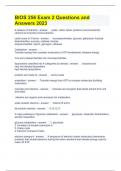
BIOS 256 Exam 2 Questions and Answers 2023
BIOS 256 Exam 2 Questions and Answers 2023 6 classes of nutrients water, carbs, lipids, proteins (macronutrients) vitamins & minerals (micronutrients) carbs come in 3 forms monosaccharides: glucose, galactose, fructose disaccharides: sucrose, maltose, lactose polysaccharides: starch, glycogen, cellulose Catabolism . Transfer energy from complex molecules to ATP (breakdown) releases energy You turn polysaccharides into monosaccharides lipoproteins classified into 4 categories by density chylomicrons very low density lipoproteins high density lipoproteins proteins are made of amino acids anabolism Transfer energy from ATP to complex molecules (building molecules) minerals and vitamins minerals are inorganic that plants extract from soil and water vitamins are organic and necessary for metabolism water soluble vitamins Vitamin B and C fat soluble vitamins A, D, E, K 3 major pathways of glucose catabolism glycolysis, anaerobic fermentation, aerobic respiration glucose metabolism 1. glycolysis 2. formation of acetyle coenzyme A 3. Krebs cycle 4. Electron Transport Chain electron transport A sequence of electron carrier molecules (membrane proteins) that shuttle electrons during the redox reactions that release energy used to make 32 ATP. anaerobic respiration most atp generated in mitochondria which requires oxygen as final electron acceptor end result is cellular respiration glycogenesis formation of glycogen from glucose stimulated by insulin glycogenolysis breakdown of glycogen to glucose stimulated by glucagon and epinephrine when you skip a meal Gluconeogenesis formation of glucose from noncarbohydrate sources like amino acids or glycerol Lipogenesis the process of converting protein into fatty acids lypolysis Breakdown of triglycerides (fat) for energy protein catabolism breakdown of protein to amino acids (krebs cycle) protein anabolism synthesis of protein from amino acids Metabolism states absorptive: fed state regulated by insulin can end up with diabetes postabsorptive state: fasting state regulated by glucagon, cortisol, and sympathetic ns prevails in the late morning, late afternoon, and overnight hypothermia low body temperature can slow metabolism and cause death hyperthermia high body temp can disrupt coordination and metabolic pathways causing death urinary system kidneys, ureters, urinary bladder, urethra homeostatic kidney functions regulation of blood ionic composition: Na+, K+, Cl- regulation of blood pH: H+, HCO3- regulation of blood volume: H20 regulation of blood pressure homeostatic kidney functions cont. regulates blood osmolarity produces hormones (calcitrol & erythropoietin) excretion of metabolic wastes (drugs and toxins) regulates blood glucose level Renal Anatomy cortex and medulla know where renal column is anatomy of the nephron 1) Renal Corpuscle aka Glomerular Capsule aka (Bowman's Capsule) function: filtration 2) Proximal tubule 3) Distal tubule 4) Collecting Duct renal corpuscle and gfr Glomerulus and Glomerular capsule (bowman's capsule) GFR: glomerular filtration rate - the amount of filtrate formed by both kidneys each min too low=renal failure regulation of GFR myogenic mechanisms, tubuloglomerular feeback, and neural regulation leads to constriction of the afferent arterioles and causes GFR to decrease hormone regulation: constriction of afferent and efferent arterioles causes GFR to decrease ANP: relaxation of mesangial cells causes GFR to increase renal physiology process 1. glomerular filtration 2. tubular reabsorption 3. tubular secretion 4. water conservation reabsorption and secretion in PCT 65% of na+ and water reabsorbed aquaporin-1
Escuela, estudio y materia
- Institución
- Bio 256 comprehensive
- Grado
- Bio 256 comprehensive
Información del documento
- Subido en
- 6 de agosto de 2023
- Número de páginas
- 4
- Escrito en
- 2023/2024
- Tipo
- Examen
- Contiene
- Preguntas y respuestas
Temas
-
carbs
-
lipids
-
prote
-
gluc
-
bios 256 exam 2 questions and answers 2023
-
6 classes of nutrients water
-
catabolism transfer energy from complex molecule
-
lipoproteins classified into 4 categories by densi

Documento también disponible en un lote