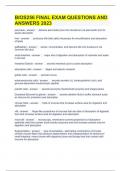
BIOS256 FINAL EXAM QUESTIONS AND ANSWERS 2023
BIOS256 FINAL EXAM QUESTIONS AND ANSWERS 2023 pancreas delivers pancreatic juice into duodenum via pancreatic duct to assist absorption liver produces bile (bile salts) necessary for emulsification and absorption of lipids gallbladder stores, concentrates, and delivers bile into duodenum via common bile duct small intestine major site of digestion and absorption of nutrients and water in GI tract Intestinal Glands secrete intestinal juice to assist absorption absorptive cells digest and absorb nutrients goblet cells secrete mucus enteroendocrine cells secrete secretin (s), cholecystokinin (cck), and glucose-dependent insulinotropic peptide paneth cells secrete lysozyme (bactericidal enzyme) and phagocytosis Duodenal (Brunner's) glands secrete alkaline fluid to buffer stomach acids an dmucus for protection and lubrication circular folds folds of mucosa that increase surface area for digestion and absorption villi finger-like projections of mucosa that are sites of absorption of digested food and increase surface area for digestion and absorption microvilli microscopic, membrane-covered projections of absorptive epithelial cells that contain brush-border enzymes and that increase surface area for digestion and absorption Segmentation type of peristalsis - alternating contractions of circular smooth muscle fibers that produce segmentation and resegmentation of sections of small intestine, mixes chyme with digestive juices and brings food into contact with mucosa for absorption Migrating Motility Complex Type of peristalsis: waves of contraction and relaxation of circular and longitudinal smooth muscle fibers passing the length of the small intestine; moves chyme toward ileocecal sphincter. Buffer Systems Bicarbonate, proteins, phosphate (chemical) respiratory (exhalation of carbon dioxide) renal - secretion of hydrogen into urine via PCT, reabsorbs or secretes bicarbonate Glycolysis one glucose molecule is oxidized and two molecules of pyruvic acid are produced. Also produces 2 ATP and 2 NADH + H Krebs Cycle oxidize acetyl coenzyme A, produce CO2, ATP, NADH + H, and FADH2 Electron Transport Chain oxidize NADH + H and FADH2, transfer electrons through series of carriers Catabolic reactions exergonic break down macronutrients occur in glycolysis, Krebs, and ETC Anabolic reactions endergonic formation of peptide bonds between amino acids building of fatty acids into phospholipids linkage of glucose monomers to form glycogen Functions of the Pancreas Produce pancreatic juice buffer acidic gastric juice in chyme stops action of pepsin creates proper pH for action of digestive enzymes secretes inactive enzymes Gastrin promotes secretion of gastric juice, increases gastric motility, promotes growth of gastric mucosa stimulated by stomach distention, high pH produced by G cells Secretin stimulates secretion of pancreatic juice and bile that are rich in bicarbonate ions stimulated by acidic chyme entering small intestine produced by S cells CCK stimulates secretion of gastric juice, ejection of bile, induces satiety stimulated by partially digested proteins, triglycerides, and fatty acids that enter small intestine produced by CCK cells Ghrelin increases appetite secreted by stomach GIP & GLP stimulates release of insulin, increasing blood glucose concentration stimulated by presence of food Somatostatin Inhibits gastrin release Salivary glands produce saliva, moistens, softens, and dissolves food cleanses mouth and teeth contains salivary amylase three pairs Sodium ions causes reabsorption of water huge in maintaining electrolyte balance as highest concentrated ion Chloride ion maintains balance of anions between ECF and ICF, part of hydrochloric acid secreted into gastric juice Hydrogen ions dictate pH level Potassium intracellular fluid establish resting membrane potential and repolarization phase of action potentials maintains normal intracellular fluid volume regulates pH by exchange with hydrogen ions Bicarbonate ions second most prevalent extracellular ions carries carbon dioxide kidneys are main regulators as they can reabsorb or secrete into urine calcium ions most abundant mineral contributes to hardness of bones and teeth, blood clotting, neurotransmitter release, maintenance of muscle tone, excitability of nervous and muscle tissue regulated by PTH Phosphate important buffer of hydrogen ions mostly bound to lipids, proteins, carbs, nucleic acids, and ATPs Magnesium part of bone matrix and ICF essential for normal neuromuscular activity, synaptic transmission, and myocardial functioning Secretion of PTH depends on it Nephron actually produces urine in process of removing waste and excess substances from blood Renal corpuscle where blood plasma is filtered Glomerulus capillary network inside renal corpuscle Glomerular capsule double walled epithelial cup that surrounds glomerular capillaries renal tubule filtered fluid passes proximal convoluted tubule filtrate comes from glomerular capsule - most reabsorption of ions occurs here descending limb of nephron loop where pct tubule takes final turn down ascending limb of nephron loop after hairpin turn, terminates at DCT Collecting duct and DCT where ADH focuses to reabsorb sodium and water cortical nephrons 80-85% of nephrons, short nephron loops juxtamedullary nephrons 15-20%, long nephron loops kidney functions excretion of wastes regulation of blood ions regulation of blood pH regulation of blood volume regulation of blood pressure maintenance of blood osmolarity production of hormones regulation of blood glucose level production of renin in response to low blood pressure Functions of the Male Reproductive System testes produce sperm and testosterone ducts transport, store, and assist in maturation of sperm accessory glands secrete most of liquid portion of semen penis contains urethra GnRH gonadotropin-releasing hormone secreted by hypothalamus stimulates release of LH and FSH from anterior pituitary females: controls ovarian and uterine cycles FSH Follicle stimulating hormone initiates follicular growth females: stimulates ovarian follicles to secrete estrogen androgens are taken up by granulosa cells and converted into estrogens males: stimulates spermatogenesis LH Luteinizing hormone males: stimulates testosterone secretion females: stimulates ovarian follicles to secrete estrogens stimulates theca cells to produce androgens triggers ovulation and promotes formation of corpus luteum stimulates CL to produce and secrete estrogens, progesterone, relaxin, and inhibin Estrogens secreted by ovarian follicles promote development and maintenance of female structures increase protein anabolism, strong bones lower cholesterol level stimulates proliferation of stratum basalis to form new stratum functionalis modern levels inhibit release of GnRH, LH, and FSH Testosterone secreted by interstitial cells decreases release of GnRH and LH male pattern of development enlargmenet of male sex organs expression of male characteristics anabolism ABP Androgen binding protein secreted by sustenacular cells binds to testosterone, keeping concentration high
Escuela, estudio y materia
- Institución
- Bio 256 comprehensive
- Grado
- Bio 256 comprehensive
Información del documento
- Subido en
- 6 de agosto de 2023
- Número de páginas
- 9
- Escrito en
- 2023/2024
- Tipo
- Examen
- Contiene
- Preguntas y respuestas
Temas
-
gallbladder stores
-
concentrates
-
and delivers bil
-
cholec
-
bios256 final exam questions and answers 2023
-
pancreas delivers pancreatic juice into duodenum v
-
enteroendocrine cells secrete secretin s
-
v

Documento también disponible en un lote