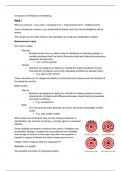
Marketing Principles (MAN 1075) – Notes
Why Become a Marketing Expert?
• Marketing leads economies.
• Marketing influences what people buy.
• Marketing dominates Marketing and Supply Chains.
• Marketing leads innovation and change.
• Marketers are now more than product sellers.
• Marketing offers excitement and interest.
Module Overview
• Students will learn how customer value is created and captured- drives every
effective marketing strategy.
• Using an organisation and learning design that includes real-world example and
information that help bring marketing to life.
• Latest trends in marketing, including new coverage on online, social media, mobile
and other digital technologies, leaving students with a richer understanding of basic
marketing concepts, strategies and practices.
Module Organisation
• 11 Online Lectures (2 Weekly ~Short Recordings)
• Weekly Assigned Activity Exercises
• 10 Seminars (1 Hour Online)
• Module Plan (SurreyLearn)
• Primary Text for the Module:
o Armstrong, G. Kottler with Opresnik, M.O., (2020), Marketing an Introduction
(Global Edition) 14th edition, Pearson Education.
Week 1:
Marketing Strategy and the Environment
Learning Outcomes:
• Explore the principles of marketing.
• Define marketing and key concepts.
• Introduce the concept of Marketing Strategy.
• Understand how Strategy impacts on an organisation.
• Understand some of the tools used in developing a Strategy.
Key Components of the Marketing Concept:
Marketing Concept- The achievement of corporate goals through meeting and exceeding
customer needs and expectations better than the competition.
,Customer Orientation- Corporative activities are focused upon providing customer
satisfaction.
Integrated Effort- All staff accept the responsibility for creating customer satisfaction.
Goal Achievement- The belief that corporate goals can be achieved through customer
satisfaction.
Jobber and Chadwick-Ellis, ‘Principles and Practice of Marketing, Ninth Edition’.
Basic Elements of Market Orientation
• Customer Needs.
• Potential Market Opportunities.
• Marketing Products and Services.
• Customers.
,Product Orientation
• Production Capabilities.
• Manufacture Product.
• Aggressive Sales Effort.
• Customers.
Basic Elements of Market Conditions
Contrasting Business: Market Versus Internal Focus
Market Focus Internal Focus
Customer Concern throughout Business. Convenience Comes First.
Knowledge of Customer Choice Criteria Assumes Price and Product Performance is
enables matching with Marketing Mix. Key to Generating Sales.
Segment by customer differences. Segment by Product.
, Invest in Market Research (MR) and track Rely on Anecdotes and Received Wisdom.
market changes.
Welcome Change. Cherish Status Quo.
Try to Understand Competition. Ignore Competition.
Marketing Spend Regarded as an Marketing Spend regarded as Luxury.
Investment.
Innovation Rewarded. Innovation punished.
Search for Latent Markets. Stick with the Same.
Fast. Why Rush?
Strive for Competitive Advantage. Happy to be ‘me too’.
Efficient and Effective. Efficient.
Jobber and Chadwick-Ellis
Efficiency and Effectiveness:
Efficiency- is defined as the ability to accomplish something with the least amount of
wasted time, money, and effort or competency in performance.
Effectiveness- is defined as the degree to which something is successful in producing a
desired result: success.
Benefits of the Marketing Concept
1. Customer Value.
2. Customer Satisfaction.
3. Customer Loyalty.
4. Long-Term Customer Relationships.
Why Become a Marketing Expert?
• Marketing leads economies.
• Marketing influences what people buy.
• Marketing dominates Marketing and Supply Chains.
• Marketing leads innovation and change.
• Marketers are now more than product sellers.
• Marketing offers excitement and interest.
Module Overview
• Students will learn how customer value is created and captured- drives every
effective marketing strategy.
• Using an organisation and learning design that includes real-world example and
information that help bring marketing to life.
• Latest trends in marketing, including new coverage on online, social media, mobile
and other digital technologies, leaving students with a richer understanding of basic
marketing concepts, strategies and practices.
Module Organisation
• 11 Online Lectures (2 Weekly ~Short Recordings)
• Weekly Assigned Activity Exercises
• 10 Seminars (1 Hour Online)
• Module Plan (SurreyLearn)
• Primary Text for the Module:
o Armstrong, G. Kottler with Opresnik, M.O., (2020), Marketing an Introduction
(Global Edition) 14th edition, Pearson Education.
Week 1:
Marketing Strategy and the Environment
Learning Outcomes:
• Explore the principles of marketing.
• Define marketing and key concepts.
• Introduce the concept of Marketing Strategy.
• Understand how Strategy impacts on an organisation.
• Understand some of the tools used in developing a Strategy.
Key Components of the Marketing Concept:
Marketing Concept- The achievement of corporate goals through meeting and exceeding
customer needs and expectations better than the competition.
,Customer Orientation- Corporative activities are focused upon providing customer
satisfaction.
Integrated Effort- All staff accept the responsibility for creating customer satisfaction.
Goal Achievement- The belief that corporate goals can be achieved through customer
satisfaction.
Jobber and Chadwick-Ellis, ‘Principles and Practice of Marketing, Ninth Edition’.
Basic Elements of Market Orientation
• Customer Needs.
• Potential Market Opportunities.
• Marketing Products and Services.
• Customers.
,Product Orientation
• Production Capabilities.
• Manufacture Product.
• Aggressive Sales Effort.
• Customers.
Basic Elements of Market Conditions
Contrasting Business: Market Versus Internal Focus
Market Focus Internal Focus
Customer Concern throughout Business. Convenience Comes First.
Knowledge of Customer Choice Criteria Assumes Price and Product Performance is
enables matching with Marketing Mix. Key to Generating Sales.
Segment by customer differences. Segment by Product.
, Invest in Market Research (MR) and track Rely on Anecdotes and Received Wisdom.
market changes.
Welcome Change. Cherish Status Quo.
Try to Understand Competition. Ignore Competition.
Marketing Spend Regarded as an Marketing Spend regarded as Luxury.
Investment.
Innovation Rewarded. Innovation punished.
Search for Latent Markets. Stick with the Same.
Fast. Why Rush?
Strive for Competitive Advantage. Happy to be ‘me too’.
Efficient and Effective. Efficient.
Jobber and Chadwick-Ellis
Efficiency and Effectiveness:
Efficiency- is defined as the ability to accomplish something with the least amount of
wasted time, money, and effort or competency in performance.
Effectiveness- is defined as the degree to which something is successful in producing a
desired result: success.
Benefits of the Marketing Concept
1. Customer Value.
2. Customer Satisfaction.
3. Customer Loyalty.
4. Long-Term Customer Relationships.