Financial Accounting 2 Notes- MAN2090
Lecturer
Tracy Robinson
Assessments:
• Assessment 1- 50 Minute Mid-Term Test. 30 MCQs. Contents from Week 1-6.
Weighting = 30%. Date TBC. Online. Assessment Slot.
• Assessment 2- Timed 2 Hour Exam. Assessment Slot. Date TBC. Content from Week
1-11. Weighting = 70%.
Week 1:
Brief Recap of Financial Accounting 1:
Financial Statements
• Mainly external stakeholders.
• Standard format.
• Usually Annually.
• Historic.
• Summarised.
• Rules.
• Financial Information.
Users of Financial Statements
• Investors.
• Lenders.
• Employees.
• Analysts.
• Customers/ Suppliers.
• Government.
• Public.
• Management.
Qualities of Accounting Information
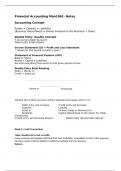
,Accounting Equation
Ownership Interest = Resources of Business
Net Assets (Assets – Liabilities) = Capital
Or:
Assets = Capital + Liabilities
Capital (Equity) represents the amounts that owners would receive once all assets were sold
and all liabilities were settled at their SFP amounts (Equity = Net Assets).
Business Organisations
Types of Organisations:
• Sole Traders.
• Partnerships.
• Clubs and Societies.
• Charities.
• Limited Companies (Ltd).
• Public Limited Companies (Plc).
Statement of Financial Position (SFP)
Assets:
• Fixed (Non-Current) Assets.
• Current Assets.
Liabilities:
• Long-Term (Non-Current Liabilities).
• Current Liabilities.
Capital (Equity):
• Capital/ Share Capital.
• Profit/ Retained Earnings.
Capital (Sole Traders and Partnerships)
Capital:
,Capital
+ Capital Introduced.
+ Profit For the Year.
- Drawings.
Equity (Limited Companies)
Equity:
Ordinary Share Capital.
Share Premium.
Retained Earnings.
General Reserve. – Like a savings pot where some funds can be transferred from retained
earnings to be set aside for investment in the future/ in some way for contingency.
Revaluation Reserve- Assets have increased in value and a business decides o revalue the
asset – e.g., revaluing a building that has increased in value- the increase can then be added
into the books of account added onto the asset and the revaluation reserve (Books must
balance).
Capital Redemption Reserve- A reserve set up where a company buys back its own shares.
Limitations of SFP
• Historic Costs vs. Current Value.
• A Snapshot at one point in time.
• Doesn’t reflect all assets and liabilities and current market value of the entity.
o E.g., Human Capital, Goodwill, etc.
Limited Companies
Characteristics:
• Legal requirements for content and format in accordance with Companies Act 2006
and IAS1.
• Separate Legal Entity.
• Perpetual existence.
o Owners can come and go/ change and the company will continue.
• Limited Liability.
o Owners of the company are not liable for any debts of the company.
o Limited to you as a shareholder to the amount you have invested into the
company.
• Shared Ownership and Profits.
o Two or more owners.
o Different size stakes in the company.
o All owners are entitled to a share in the profits as a result of their invest.
• Voting Rights.
o Equity shareholders usually have voting rights. One vote attached to each
vote owned (usually).
• Ownership and Management are Separated.
o Owners are not necessarily the management.
, o Owners don’t necessarily have the right to have any say in the company
unless they have a large stake in the company.
o Not all management are owners in the company (hold shares of that
company).
• Annual Accounts.
o Prepared yearly.
o Rigid Structure and Preparation.
• Independent Auditors.
o Acting on behalf of the shareholders to make sure owners are given a true
and fair impression of the company.
Private vs. Public Limited Companies
• Private Companies (Ltd):
o Can’t sell shares to the General Public.
o Usually Few Shareholders.
▪ Can only be sold privately.
▪ Various Website where you can find investors in this way.
• Public Companies (Plc):
o Can issue shares to General Public.
o Can be Traded on Stock Exchange.
▪ Vulnerable to a hostile takeover.
o Can have Many Shareholders.
o More Onerous Rules and Regulations.
o Public Accountability.
Financing
• Sole Traders and Partnerships:
o Capital Introduced (Sole Traders and Partnerships).
• All Businesses:
o Bank Finance (Overdrafts and Loans),
• Limited Companies:
o Debenture (Loans/ Bonds).
▪ A type of loan but the loan is divided up into smaller units.
▪ E.g., A. bit like Getting a loan of £1,000 from 100 investors of £10
each.
▪ These units can also be traded on the stock exchange like shares.
o Ordinary Share Capital.
▪ Selling shares.
o Preference Share Capital.
Share Capital
• Issued by all Limited Companies.
• Permanent Source of Finance.
o Never have to pay back the money invested into the company through sales
of shares.
o Never obliged to buy back shares.
o Redeemable Preference Shares.
Lecturer
Tracy Robinson
Assessments:
• Assessment 1- 50 Minute Mid-Term Test. 30 MCQs. Contents from Week 1-6.
Weighting = 30%. Date TBC. Online. Assessment Slot.
• Assessment 2- Timed 2 Hour Exam. Assessment Slot. Date TBC. Content from Week
1-11. Weighting = 70%.
Week 1:
Brief Recap of Financial Accounting 1:
Financial Statements
• Mainly external stakeholders.
• Standard format.
• Usually Annually.
• Historic.
• Summarised.
• Rules.
• Financial Information.
Users of Financial Statements
• Investors.
• Lenders.
• Employees.
• Analysts.
• Customers/ Suppliers.
• Government.
• Public.
• Management.
Qualities of Accounting Information
,Accounting Equation
Ownership Interest = Resources of Business
Net Assets (Assets – Liabilities) = Capital
Or:
Assets = Capital + Liabilities
Capital (Equity) represents the amounts that owners would receive once all assets were sold
and all liabilities were settled at their SFP amounts (Equity = Net Assets).
Business Organisations
Types of Organisations:
• Sole Traders.
• Partnerships.
• Clubs and Societies.
• Charities.
• Limited Companies (Ltd).
• Public Limited Companies (Plc).
Statement of Financial Position (SFP)
Assets:
• Fixed (Non-Current) Assets.
• Current Assets.
Liabilities:
• Long-Term (Non-Current Liabilities).
• Current Liabilities.
Capital (Equity):
• Capital/ Share Capital.
• Profit/ Retained Earnings.
Capital (Sole Traders and Partnerships)
Capital:
,Capital
+ Capital Introduced.
+ Profit For the Year.
- Drawings.
Equity (Limited Companies)
Equity:
Ordinary Share Capital.
Share Premium.
Retained Earnings.
General Reserve. – Like a savings pot where some funds can be transferred from retained
earnings to be set aside for investment in the future/ in some way for contingency.
Revaluation Reserve- Assets have increased in value and a business decides o revalue the
asset – e.g., revaluing a building that has increased in value- the increase can then be added
into the books of account added onto the asset and the revaluation reserve (Books must
balance).
Capital Redemption Reserve- A reserve set up where a company buys back its own shares.
Limitations of SFP
• Historic Costs vs. Current Value.
• A Snapshot at one point in time.
• Doesn’t reflect all assets and liabilities and current market value of the entity.
o E.g., Human Capital, Goodwill, etc.
Limited Companies
Characteristics:
• Legal requirements for content and format in accordance with Companies Act 2006
and IAS1.
• Separate Legal Entity.
• Perpetual existence.
o Owners can come and go/ change and the company will continue.
• Limited Liability.
o Owners of the company are not liable for any debts of the company.
o Limited to you as a shareholder to the amount you have invested into the
company.
• Shared Ownership and Profits.
o Two or more owners.
o Different size stakes in the company.
o All owners are entitled to a share in the profits as a result of their invest.
• Voting Rights.
o Equity shareholders usually have voting rights. One vote attached to each
vote owned (usually).
• Ownership and Management are Separated.
o Owners are not necessarily the management.
, o Owners don’t necessarily have the right to have any say in the company
unless they have a large stake in the company.
o Not all management are owners in the company (hold shares of that
company).
• Annual Accounts.
o Prepared yearly.
o Rigid Structure and Preparation.
• Independent Auditors.
o Acting on behalf of the shareholders to make sure owners are given a true
and fair impression of the company.
Private vs. Public Limited Companies
• Private Companies (Ltd):
o Can’t sell shares to the General Public.
o Usually Few Shareholders.
▪ Can only be sold privately.
▪ Various Website where you can find investors in this way.
• Public Companies (Plc):
o Can issue shares to General Public.
o Can be Traded on Stock Exchange.
▪ Vulnerable to a hostile takeover.
o Can have Many Shareholders.
o More Onerous Rules and Regulations.
o Public Accountability.
Financing
• Sole Traders and Partnerships:
o Capital Introduced (Sole Traders and Partnerships).
• All Businesses:
o Bank Finance (Overdrafts and Loans),
• Limited Companies:
o Debenture (Loans/ Bonds).
▪ A type of loan but the loan is divided up into smaller units.
▪ E.g., A. bit like Getting a loan of £1,000 from 100 investors of £10
each.
▪ These units can also be traded on the stock exchange like shares.
o Ordinary Share Capital.
▪ Selling shares.
o Preference Share Capital.
Share Capital
• Issued by all Limited Companies.
• Permanent Source of Finance.
o Never have to pay back the money invested into the company through sales
of shares.
o Never obliged to buy back shares.
o Redeemable Preference Shares.