Auditing Notes
MAN3098
Module Textbook
Auditing by Alan Millichamp and John Taylor
Module Lecturer
Lecturer: Victoria Milligan
Office: 64MS02
Email:
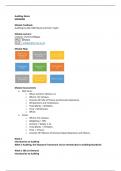
Module Map
Module Assessments
• Mid-Term:
o What: Content: Weeks 1-6.
o Where: On Campus.
o Consists Of: Mix of Theory and Scenario Questions.
o All Questions are Compulsory.
o Total Marks = 30 Marks.
o Time = 60 Minutes.
o When:
• Finals:
o Where: On Campus.
o Weighting = 70%.
o Content = Weeks 1-11.
o Total Marks = 70 Marks.
o Time = 2 Hours.
o Consists Of: Mixture of Scenario Based Questions and Theory.
Week 1
Introduction to Auditing
What is Auditing, the Statutory Framework and an Introduction to Auditing Standards
Week 1 SBS on Demand
Introduction to Auditing
,What is an Audit?
• Shareholders own the business.
• Managers (or directors) manage the business.
• Shareholders need an independent expert to give an opinion on whether the
accounts of their company - which the managers prepare - show a ‘true and fair
view’.
• These experts are the auditors.
What is an Audit for?
• The purpose of an audit is to enhance the degree of confident of intended users in
the FS. This is achieved by the expression of an opinion by the auditor on whether
the FS are prepared, in all material respects, in accordance with an applicable
financial reporting framework.
• In the case of most general purpose frameworks, that opinion is on whether the FS
are presented fairly, in all material respects, or give a true and fair view in
accordance with the framework.
• ISA(UK)200 Overall objectives of the independent auditor and the conduct of an
audit in accordance with the international standards on auditing.
Stewardship and Accountability
• Directors act as agents for the shareholders.
• They have a duty to:
o Safeguard the assets of the business (stewardship), and
▪ Fiduciary relationship.
o Accounts to the shareholders for their actions (accountability).
Why are Audits Needed?
• Directors are motivated to show good results.
o This can benefit them personally- bonuses, share options, etc.
• Shareholders need realism- what’s really going on?
• Impractical for individual shareholders to check accounts.
• Auditors also report on whether proper books and records have been kept and on
any weaknesses in the accounting systems.
Duties of Directors
• Directors of a company must act in the way they consider; in good faith, would be
most likely to promote the success of the company for the benefit of its members as
a whole, and in doing so have regard (amongst other matters) to-
o (a) the likely consequences of any decision in the LT.
o (b) the interests of the company’s employees.
o (c) the need to foster the company’s business relationships with suppliers,
customers and others.
o (d) the impact of the company’s operations on the community and the
environment.
o (e) the desirability of the company maintaining a reputation for high
standards of business conduct, and
o (f) the need to act fairly as between members of the company.
, • Companies Act 2006 Section 172.
Reporting
• Companies (Miscellaneous Reporting) Regulations 2018 sets out the requirement for
the Strategic Report required to be included in the FS of listed companies.
• Now there is a specific requirement for boards to make a statement, as part of the
Strategic Report, on how they have had regard to the matters in section 172. The
revised UK Corporate Governance Code (‘the 2018 Code’) also contains a similar
reporting requirement.
• This requirement relates directly to corporate culture and, possibly for the first time,
directs directors’ attention away from the previous imperatives of maximising profits
and growing the business. They now have to consider a host of other factors
contained in section 172 and report on the usual comply or explain basis.
Some More Law About Directors
• A director of a company must exercise independent judgment. (Section 173)
• A director of a company must exercise reasonable care, skill and diligence. (Section
174)
• A director of a company must avoid a situation in which he has, or can have, a direct
or indirect interest that conflicts, or possibly may conflict, with the interests of the
company. (Section 175)
• A director of a company must not accept a benefit from a third party conferred by
reason of-
o (a) his being a director, or
o (b) his doing (or not doing) anything as director. (Section 176)
• If a director of a company is in any way, directly or indirectly, interested in a
proposed transaction or arrangement with the company, he must declare the nature
and extent of that interest to the other directors. (Section 177).
Value of Financial Information
• Consider the value of reliable financial information to stakeholders in companies, for
example:
o To potential investors.
o To regulators of companies.
o To employees.
o To suppliers and customers.
o To the taxation authorities.
Fiduciary Relationship
• The directors act in a fiduciary capacity towards the shareholders.
• They are in a special position of trust charged with preserving the assets of the
business and, running it for the benefit of the shareholders so that it increases
shareholder value and pays them some dividend.
• The fiduciary relationship between the parties places the onus firmly on the
directors to be accountable for their actions and to be transparent in their reporting.
, What does the Auditor do?
• The auditor’s job is to gather evidence to prove that:
o Profits and losses are properly stated.
o Assets and liabilities belong to the company and are shown at their correct
values.
o Accounting entries are properly recorded in the correct accounting period.
• To do this they:
o Review the accounting records and controls.
o Ask for explanations.
o Obtain details from third parties.
Other Benefits of the Financial Audit
• During the course of the work auditors may be involved in:
o Discovering weaknesses in financial systems.
o Checking compliance with laws and accounting standards.
o Discovering frauds or errors.
Advantages of an Audit
• The provider of finance, e.g., a bank usually requires audited accounts. If they were
to ask for their own independent audits this might increase costs to the entity.
• Audit can help protect creditors.
• An audit can reinforce financial discipline.
• An audit helps establish the credibility of the company.
• There may be shareholders who are not involved in the business and their interests
need to be protected by an independent audit.
• It provides reassurance for directors that the figures they are using are reliable.
• It improves credibility of the profits or losses with HMRC and assists in settling tax
and VAT liabilities.
Disadvantages of an Audit
• An audit is only for compliance and doesn’t assist management in running the
business- it is simply ‘red tape’.
• The costs of the audit represent a non-productive expense and the money could be
better used elsewhere.
• Banks and other lenders, including suppliers can make their own conditions for
lending and don’t really need historical audited accounts. For example:
o Banks will lend on security and personal guarantees; they will monitor
performance of the bank accounts; they may require regular monthly
management information.
o Suppliers will deal on a pro-forma basis (i.e., cash before supply) until a depth
of trust has been established.
o Historical accounts, taking advantage of limited disclosure requirements, are
of little value as they can be up to nine months old when they become
publicly available.
Other Benefits of the Financial Audit
• An audit is useful to company management.
MAN3098
Module Textbook
Auditing by Alan Millichamp and John Taylor
Module Lecturer
Lecturer: Victoria Milligan
Office: 64MS02
Email:
Module Map
Module Assessments
• Mid-Term:
o What: Content: Weeks 1-6.
o Where: On Campus.
o Consists Of: Mix of Theory and Scenario Questions.
o All Questions are Compulsory.
o Total Marks = 30 Marks.
o Time = 60 Minutes.
o When:
• Finals:
o Where: On Campus.
o Weighting = 70%.
o Content = Weeks 1-11.
o Total Marks = 70 Marks.
o Time = 2 Hours.
o Consists Of: Mixture of Scenario Based Questions and Theory.
Week 1
Introduction to Auditing
What is Auditing, the Statutory Framework and an Introduction to Auditing Standards
Week 1 SBS on Demand
Introduction to Auditing
,What is an Audit?
• Shareholders own the business.
• Managers (or directors) manage the business.
• Shareholders need an independent expert to give an opinion on whether the
accounts of their company - which the managers prepare - show a ‘true and fair
view’.
• These experts are the auditors.
What is an Audit for?
• The purpose of an audit is to enhance the degree of confident of intended users in
the FS. This is achieved by the expression of an opinion by the auditor on whether
the FS are prepared, in all material respects, in accordance with an applicable
financial reporting framework.
• In the case of most general purpose frameworks, that opinion is on whether the FS
are presented fairly, in all material respects, or give a true and fair view in
accordance with the framework.
• ISA(UK)200 Overall objectives of the independent auditor and the conduct of an
audit in accordance with the international standards on auditing.
Stewardship and Accountability
• Directors act as agents for the shareholders.
• They have a duty to:
o Safeguard the assets of the business (stewardship), and
▪ Fiduciary relationship.
o Accounts to the shareholders for their actions (accountability).
Why are Audits Needed?
• Directors are motivated to show good results.
o This can benefit them personally- bonuses, share options, etc.
• Shareholders need realism- what’s really going on?
• Impractical for individual shareholders to check accounts.
• Auditors also report on whether proper books and records have been kept and on
any weaknesses in the accounting systems.
Duties of Directors
• Directors of a company must act in the way they consider; in good faith, would be
most likely to promote the success of the company for the benefit of its members as
a whole, and in doing so have regard (amongst other matters) to-
o (a) the likely consequences of any decision in the LT.
o (b) the interests of the company’s employees.
o (c) the need to foster the company’s business relationships with suppliers,
customers and others.
o (d) the impact of the company’s operations on the community and the
environment.
o (e) the desirability of the company maintaining a reputation for high
standards of business conduct, and
o (f) the need to act fairly as between members of the company.
, • Companies Act 2006 Section 172.
Reporting
• Companies (Miscellaneous Reporting) Regulations 2018 sets out the requirement for
the Strategic Report required to be included in the FS of listed companies.
• Now there is a specific requirement for boards to make a statement, as part of the
Strategic Report, on how they have had regard to the matters in section 172. The
revised UK Corporate Governance Code (‘the 2018 Code’) also contains a similar
reporting requirement.
• This requirement relates directly to corporate culture and, possibly for the first time,
directs directors’ attention away from the previous imperatives of maximising profits
and growing the business. They now have to consider a host of other factors
contained in section 172 and report on the usual comply or explain basis.
Some More Law About Directors
• A director of a company must exercise independent judgment. (Section 173)
• A director of a company must exercise reasonable care, skill and diligence. (Section
174)
• A director of a company must avoid a situation in which he has, or can have, a direct
or indirect interest that conflicts, or possibly may conflict, with the interests of the
company. (Section 175)
• A director of a company must not accept a benefit from a third party conferred by
reason of-
o (a) his being a director, or
o (b) his doing (or not doing) anything as director. (Section 176)
• If a director of a company is in any way, directly or indirectly, interested in a
proposed transaction or arrangement with the company, he must declare the nature
and extent of that interest to the other directors. (Section 177).
Value of Financial Information
• Consider the value of reliable financial information to stakeholders in companies, for
example:
o To potential investors.
o To regulators of companies.
o To employees.
o To suppliers and customers.
o To the taxation authorities.
Fiduciary Relationship
• The directors act in a fiduciary capacity towards the shareholders.
• They are in a special position of trust charged with preserving the assets of the
business and, running it for the benefit of the shareholders so that it increases
shareholder value and pays them some dividend.
• The fiduciary relationship between the parties places the onus firmly on the
directors to be accountable for their actions and to be transparent in their reporting.
, What does the Auditor do?
• The auditor’s job is to gather evidence to prove that:
o Profits and losses are properly stated.
o Assets and liabilities belong to the company and are shown at their correct
values.
o Accounting entries are properly recorded in the correct accounting period.
• To do this they:
o Review the accounting records and controls.
o Ask for explanations.
o Obtain details from third parties.
Other Benefits of the Financial Audit
• During the course of the work auditors may be involved in:
o Discovering weaknesses in financial systems.
o Checking compliance with laws and accounting standards.
o Discovering frauds or errors.
Advantages of an Audit
• The provider of finance, e.g., a bank usually requires audited accounts. If they were
to ask for their own independent audits this might increase costs to the entity.
• Audit can help protect creditors.
• An audit can reinforce financial discipline.
• An audit helps establish the credibility of the company.
• There may be shareholders who are not involved in the business and their interests
need to be protected by an independent audit.
• It provides reassurance for directors that the figures they are using are reliable.
• It improves credibility of the profits or losses with HMRC and assists in settling tax
and VAT liabilities.
Disadvantages of an Audit
• An audit is only for compliance and doesn’t assist management in running the
business- it is simply ‘red tape’.
• The costs of the audit represent a non-productive expense and the money could be
better used elsewhere.
• Banks and other lenders, including suppliers can make their own conditions for
lending and don’t really need historical audited accounts. For example:
o Banks will lend on security and personal guarantees; they will monitor
performance of the bank accounts; they may require regular monthly
management information.
o Suppliers will deal on a pro-forma basis (i.e., cash before supply) until a depth
of trust has been established.
o Historical accounts, taking advantage of limited disclosure requirements, are
of little value as they can be up to nine months old when they become
publicly available.
Other Benefits of the Financial Audit
• An audit is useful to company management.