Test Bank Theory and Practice of Counseling and Psychotherapy 10th Edition by Gerald Corey
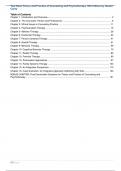
Table of Contents Chapter 1- Introduction and Overview ..................................................................................................... 2 Chapter 2- The Counselor: Person and Professional .............................................................................. 6 Chapter 3- Ethical Issues in Counseling Practice .................................................................................. 11 Chapter 4- Psychoanalytic Therapy ...................................................................................................... 15 Chapter 5- Adlerian Therapy ................................................................................................................. 26 Chapter 6- Existential Therapy .............................................................................................................. 34 Chapter 7- Person-Centered Therapy ................................................................................................... 41 Chapter 8- Gestalt Therapy ................................................................................................................... 51 Chapter 9- Behavior Therapy ................................................................................................................ 59 Chapter 10- Cognitive Behavior Therapy .............................................................................................. 70 Chapter 11- Reality Therapy ................................................................................................................. 82 Chapter 12- Feminist Therapy............................................................................................................... 90 Chapter 13- Postmodern Approaches ................................................................................................... 97 Chapter 14- Family Systems Therapy ................................................................................................. 103 Chapter 15- An Integrative Perspective ............................................................................................... 113 Chapter 16- Case Illustration: An Integrative Approach to Working with Stan ....................................... 124
BONUS CHAPTER: Final Examination Questions for Theory and Practice of Counseling and Psychotherapy .................................................................................................................................... 131
1 | P a g eChapter 1- Introduction and Overview
MULTIPLE-CHOICE TEST ITEMS
Note: Below are test items for chapter 1 of Theory and Practice of Counseling and
Psychotherapy.
1. Synthesizing the approaches covered in the text:
a. can easily be accomplished after taking an introductory course.
b. is usually mastered by the end of the first year of one’s graduate program.
c. often requires many years of study, training, and practical counseling experience.
d. rarely, if ever, happens and is a completely unrealistic goal.
ANS: C
PG: 5
2. Which one of the following is not considered an experiential and relationship-oriented therapy?
a. Gestalt therapy
b. family systems therapy
c. existential approach
d. person-centered
approach
ANS: B PG: 10
3. Which one of the following is not associated with the cognitive-behavioral action-oriented
therapies?
a. existential therapy
b. cognitive therapy
c. reality therapy
d. behavior therapy
e. rational emotive behavior
therapy
ANS: A
PG: 10
4. Which humanistic approach emphasizes the basic attitudes of the
therapist as the core of the therapeutic process?
a. psychoanalytic therapy
b. Adlerian therapy
c. person-centered therapy
d. cognitive-behavioral therapy
e. family
therapy
ANS: C
12
5. Presenting one model to which all trainees subscribe
a. is what the counseling profession endorses at present.
b. is likely to be a reality by the year 2020 when the CACREP standards are revisited.
PG:
2 | P a g ec. is dangerous in that it can limit their effectiveness in working with a diverse range of future
clients.
d. is illegal in the Northeastern region of the U.S., but not in other parts of the country.
ANS: C
PG: 5
6. The author makes a case for:
a. initially getting an overview of the major theoretical orientations, and then delving more
deeply into each approach.
b. delving deeply into one approach initially and then taking a superficial look at other
theoretical models.
c. learning the theories of counseling only after starting to work with clients in order to
make the theories more relevant.
d. the reader to choose the approach to which s/he subscribes.
ANS: A
PG: 5
7. Which of the following statements about theories or models of counseling/ psychotherapy is
true?
a. Extensive research has shown that certain popular models of psychotherapy are ―wrong.‖
b. There is a clear place for theoretical pluralism in our society.
c. Accepting the validity of one model implies rejecting the validity of other models.
d. Theoretical pluralism has been frowned on by several major professional organizations.
ANS: B
PG: 5
8. What type of factors oftentimes limit our freedom of choice?
a. social
b. environmental
c. cultural
d. biological
e. all of these
ANS: E
PG: 6
9. Which of these statements about interventions is true?
a. It is helpful to use one type of intervention with most clients.
b. During the course of an individual’s therapy, different interventions may be needed at different
times.
c. It is best to require clients to adapt to your approach to counseling and the interventions that
you are skilled at using.
d. You should only use counseling interventions when you are certified or licensed.
ANS: B
PG: 8
10. Which approach was developed during the 1940s as a nondirective reaction against
psychoanalysis?
a. person-centered therapy
b. family systems therapy
c. Adlerian therapy
d. reality therapy
e. cognitive therapy
ANS: A
PG: 10
3 | P a g e11. Francesca, a cognitive behavioral therapist, likes to give homework assignments to her
clients. What might her rationale be for doing this?
a. Homework can be a vehicle for assisting her clients in putting into action what they are
learning in therapy.
b. By assigning homework to her clients, she establishes her clear authority over them (as if
she is their teacher).
c. She is probably a novice therapist who is insecure about her skills; thus, by assigning
homework, she may feel like she is being more productive.
d. In order to be reimbursed by insurance companies, Francesca is required to give her clients
homework assignments.
ANS: A
PG: 6
12. Which of the following statements best describes the author’s view of the medical model?
a. Corey appreciates the focus on psychopathology and believes it gives clinicians the tools to
assess what’s
wrong with clients.
b. A focus on the medical model restricts therapeutic practice because it stresses deficits
rather than strengths.
c. The medical model emphasizes strengths and competencies rather than psychopathology.
d. The medical model is especially relevant for culturally diverse client populations.
ANS: B
PG: 7
13. A comprehensive approach to counseling:
a. goes beyond focusing on our internal dynamics and addresses those environmental and
systemic realities that influence us.
b. focuses almost exclusively on the client’s internal dynamics.
c. focuses primarily on the therapist’s internal reactions to the client’s behavior.
d. focuses only on systemic factors.
ANS: A
PG: 7
14. Effective psychotherapy is a practice in which:
a. the therapist solves problems for clients.
b. the therapist is merely a skilled technician.
c. the client and therapist collaborate in co-constructing solutions to problems.
d. the client is in complete control of the direction of the therapy.
ANS: C
PG: 7
15. Which of the following is not an issue that Stan struggles with?
a. fear of being alone
b. fear of intimate relationships with women
c. substance use
d. lacking a sense of direction and meaning in his life
e. aggressive
outbursts
ANS: E PG: 14
TRUE-FALSE TEST ITEMS
1. An undisciplined mixture of approaches can be an excuse for failing to develop a sound
rationale for systematically adhering to certain concepts and to the techniques that are
4 | P a g eextensions of them.
ANS: T PG: 5
2. An integrative perspective is not developed in a random fashion.
ANS: T PG: 5
3. Since Corey challenges the deterministic notion that humans are the product of their
early conditioning and, thus, are victims of their past, he believes that an exploration of
the past is rarely useful.
ANS: F PG: 6
4. Both family therapy and feminist therapy are based on the premise that to understand the
individual it is essential to take into consideration the interpersonal dimensions and the
sociocultural context rather than focusing primarily on the intrapsychic domain.
ANS: T PG: 7
5. Psychotherapy is a process of engagement between two people, both of whom are bound
to change through the therapeutic venture.
ANS: T PG: 7
6. Those practicing brief therapy are in business to change clients, to give them quick
advice, and to solve their problems for them.
ANS: F PG: 11
7. With respect to mastering the techniques of counseling and applying them appropriately and
effectively, it is Corey’s belief that you are your own very best technique.
ANS: T PG: 7
8. Techniques can counteract a client–therapist relationship that is lacking in certain respects.
ANS: F PG: 8
9. Much of effective therapy is the product of artistry.
ANS: T PG: 8
10. Rudolf Dreikurs is credited with popularizing the Adlerian approach in the United States.
ANS: T PG: 10
11. Reality therapy applies the principles of learning to the resolution of specific behavioral
problems.
ANS: F PG: 11
12. Donald Meichenbaum is a prominent contributor to the development of cognitive behavior
therapy.
ANS: T PG: 10
13. Reality therapy is based on choice theory and focuses on the client assuming
5 | P a g eresponsibility in the present.
ANS: T PG: 11
14. Michael White and David Epston are the major figures associated with narrative therapy.
ANS: T PG: 11
15. An experiential approach is Gestalt therapy, which offers a range of experiments to
help clients gain awareness of what they are experiencing in the here and now.
ANS: T PG: 12
Chapter 2- The Counselor: Person and Professional
MULTIPLE-CHOICE TEST ITEMS
Note: Below are test items for chapter 2 of Theory and Practice of Counseling and
Psychotherapy.
1. It is especially important for counselors who work with culturally diverse client populations to:
a. be aware of their own cultural heritage.
b. have a broad base of counseling techniques that can be employed with flexibility.
c. consider the cultural context of their clients in determining what interventions are appropriate.
d. examine their own assumptions about cultural values.
e. all of these
ANS: E
PG: 25
2. According to the text, research shows that counselor values influence:
a. therapy goals.
b. assessment strategies.
c. treatment outcome.
d. all of these
e. none of these
ANS: D
PG: 23
3. Clients place more value on
than on
a. the personality of the therapist; the specific techniques used.
b. the specific techniques used; the personality of the therapist.
c. the therapist’s theoretical orientation; the quality of the services being provided.
d. the aesthetics of the therapeutic setting; the personality of the therapist.
ANS: A
PG: 19
4. Regarding psychotherapy treatment outcome, research suggests all of the following except:
a. the therapist as a person is an integral part of successful treatment.
b. the therapeutic relationship is an essential component of effective treatment.
c. both the therapy methods and the therapy relationship make contributions to
treatment outcome.
d. therapy techniques are the key component of successful
6 | P a g etreatment
ANS: D PG: 19
5.
An authentic counselor is best
described as:
a. having the highest regard for all clients.
b. being willing to be totally open and self-disclosing.
c. being a technical expert who is committed to objectivity.
d. being willing to shed stereotyped roles and being a real person.
ANS: D
PG: 18
6. In the text, all of the following are listed as characteristics of the counselor as a
therapeutic person except:
a. counselors have a sense of humor.
b. counselors no longer have to cope with personal problems.
c. counselors feel alive and their choices are life-oriented.
d. counselors make mistakes and they are willing to admit them.
e. counselors appreciate the influence of culture.
ANS: B
PG: 19
7. Which of the following statements about theories or models of counseling/ psychotherapy is
true?
a. Extensive research has shown that certain popular models of psychotherapy are ―wrong.‖
b. There is a clear place for theoretical pluralism in our society.
c. Accepting the validity of one model implies rejecting the validity of other models.
d. Theoretical pluralism has been frowned on by several major professional organizations.
ANS: B
PG: 28
8. In the text, the main reason given for having counseling students receive some form of
psychotherapy is to help them:
a. work through early childhood trauma.
b. learn to deal with countertransference.
c. recognize and resolve their co-dependent tendencies.
d. become self-actualized individuals.
ANS: B
PG: 21
9. Personal therapy for therapists can be instrumental in assisting them:
a. to heal their own psychological wounds.
b. to gain an experiential sense of what it is like to be a client.
c. to understand their own needs and motives for choosing to become professional helpers.
d. to work through their own personal conflicts.
e. all of these
ANS: E
PG: 22
10. With regard to the role of counselors’ personal values in therapy, it is appropriate for counselors
to:
a. teach and persuade clients to act the right way.
b. maintain an indifferent, neutral, and passive role by simply listening to everything
the client reports.
c. avoid challenging the values of clients.
7 | P a g ed. avoid the imposition of their values, yet expose their values to clients.
ANS: D
PG: 23
11. The author describes the characteristics of an effective counselor. By including this
information in the chapter, he is hoping to convey the message that:
a. if you do not possess all of these characteristics, you are doomed to fail in the helping
professions.
b. deficits in these qualities almost always require years of psychoanalysis.
c. you should develop your own concept of what personality traits you think are essential to
strive for to promote your own personal growth.
d. those who possess all of these qualities can bypass the requirement to participate in clinical
supervision.
ANS: C
PG: 19
12. During an initial session, an adolescent girl tells you that she is pregnant and is
considering an abortion. Which of the following would be the most ethical and professional
course for you to follow?
a. Encourage her to get the abortion as soon as possible, without exploring any other option.
b. Steer her toward having her baby and then consider adoption for her baby.
c. Suggest that she go to church and pray about her situation.
d. Help her to clarify the range of her choices in light of her own values.
ANS: D
PG: 23
13. Culturally encapsulated counselors would be most likely to:
a. depend entirely on their own internalized value assumptions about what is good for people.
b. have an appreciation for a multicultural perspective in their counseling practice.
c. recognize the cultural dimensions their clients bring to therapy.
d. accept clients who have a different set of assumptions about life.
ANS: A
PG: 23
14. You are working with an ethnic minority client who is silent during the initial phase of
counseling. This silence is probably best interpreted as:
a. resistance.
b. a manifestation of uncooperative behavior.
c. a response consistent with his or her cultural context.
d. a clear sign that counseling will not work.
ANS: C
PG: 25
15. Which of the following is not considered an essential skill of an effective culturally
competent counselor?
a. being able to modify techniques to accommodate cultural differences
b. being able to send and receive both verbal and nonverbal messages accurately
c. being able to get clients to intensify their feelings by helping them to
vividly reexperience early childhood events
d. assuming the role of consultant and change
agent ANS: C PG: 26
16. Which of the following is not considered essential knowledge for a culturally competent
counselor?
a. knowing how to analyze transference reactions
8 | P a g eb. understanding the impact of oppression and racist concepts
c. being aware of culture-specific methods of helping
d. being aware of institutional barriers that prevent minorities from making full use of
counseling services in the community
ANS: A
PG: 26
17. Essential components of effective multicultural counseling include all of the following except:
a. Counselors avoid becoming involved in out-of-office interventions.
b. Counselors feel comfortable with their clients’ values and beliefs.
c. Counselors are aware of how their own biases could affect ethnic minority clients.
d. Counselors employ institutional intervention skills on behalf of their clients when
necessary or appropriate.
ANS: A
PG: 26
18. In working with culturally diverse clients, it helps to understand and assess:
a. what these clients expect from counseling.
b. the degree of acculturation that has taken place.
b. the attitudes these clients have about seeking counseling for their personal problems.
c. the messages they received from their culture about asking for professional help.
e. all of these
ANS: E
PG: 25
19. Which of the following is not a method of increasing effectiveness in working with
diverse client populations?
a. Learn about how your own cultural background has influenced your thinking and behaving.
b. Realize that practicing from a multicultural perspective will probably make your job very
difficult.
c. Be flexible in applying techniques with clients.
d. Identify your basic assumptions pertaining to diversity.
e. Pay attention to the common ground that exists among people of diverse backgrounds.
ANS: B
20.
The
PG: 27
factors —the alliance, the relationship, the personal and
interpersonal skills of the therapist, client agency, and extra-therapeutic factors—are the primary
determinants of therapeutic outcome.
a. logistical
b. contextual
c. psychodynamic
d. technical
ANS: B
PG: 19
TRUE-FALSE TEST ITEMS
1. If we are inauthentic, it is unlikely that our clients will detect it.
ANS: F PG: 18
2. A meta-analysis of research on therapeutic effectiveness found that the personal and
interpersonal components are, at best, only moderately related to effective
psychotherapy.
9 | P a g eANS: F PG: 19
3. Effective therapists are not the victims of their early decisions.
ANS: T PG: 19
4. Therapists should not admit their mistakes since that could diminish their clients’ confidence
in
them.
ANS: F PG: 20
5. Truly dedicated therapists carry the problems of their clients around with them during
leisure hours.
ANS: F PG: 20
6. The vast majority of mental health professionals have experienced personal therapy,
typically on several occasions.
ANS: T PG: 21
7. Therapists need to be free of conflicts before they can counsel others.
ANS: F PG: 21
8. It is not our function to persuade clients to accept or adopt our value system.
ANS: T PG: 23
9. Your role as a counselor is to provide a safe and inviting context in which clients can
explore the congruence between their values and their behavior.
ANS: T PG: 23
10. The general goals of counselors must be congruent with the personal goals of the client.
ANS: T PG: 23
11. If you try to figure out in advance how to proceed with a client, you may be depriving the
client of the opportunity to become an active partner in her or his own therapy.
ANS: T PG: 24
12. Counselors from all cultural groups must examine their expectations, attitudes,
biases, and assumptions about the counseling process and about persons from
diverse groups.
ANS: T PG: 25
13. Practitioners must have had the same experiences as their clients in order to have
empathy for them.
ANS: F PG: 27
14. The skill of immediacy involves revealing what we are thinking or feeling in the here and
10 | P a g enow with the client.
ANS: T PG: 29
15. Ideally, our self-care should mirror the care we provide for others.
ANS: T PG: 34
Chapter 3- Ethical Issues in Counseling Practice
MULTIPLE-CHOICE TEST ITEMS
1. In becoming an ethical practitioner, a crucial task is to:
a. learn how to arrive at clear-cut answers for difficult situations.
b. identify a specific ethical code as the source of answers to ethical dilemmas.
c.
learn how to interpret and apply ethical codes to an ethical dilemma.
d. avoid making any mistakes in counseling practice.
e. discover the correct solution for every ethical dilemma that might arise.
ANS: C
PG: 38
2. According to the text, the challenge of providing informed consent consists of:
a. telling clients about the nature of confidentiality.
b. striking a balance between giving clients too much and too little information about the
therapeutic process.
c. convincing clients that counselors know what they are doing.
d. teaching clients about state laws that pertain to counseling.
e. getting clients to read the ethical codes of the profession.
ANS: B
PG: 40
3. Many ethical codes state that dual or multiple relationships:
a. should be avoided whenever possible.
b. are clearly grounds for revocation of one’s professional license.
c. are helpful in case of counseling one’s friends or relatives.
d. are impossible to avoid.
e. always result in serious harm to the client.
ANS: A
PG: 49
4. Privileged communication does not apply to
a. group counseling
b. couples counseling
c. family therapy
d. child and adolescent therapy
e. all of these.
ANS: E
PG: 41
5. Confidentiality must be breached and information must be reported by practitioners when:
a. clients pose a danger to others.
b. a child under the age of 16 is the victim of incest, rape, or child abuse.
c. an older adult is being abused.
d. the therapist determines that the client needs immediate, involuntary hospitalization.
e. all of these
ANS: E
PG: 41
11 | P a g e6. Which of the following statements is not true about guidelines for ethical practice in
counseling and psychotherapy?
a. Most professional organizations provide broad guidelines.
b. Therapists ultimately have to discover their own guidelines for reasonable practice.
c. Practitioners are free to formulate any ethics they choose.
d. Ethical issues should be periodically reexamined throughout your professional life.
e. There are differences of opinion among practitioners about how ethical guidelines apply
to certain situations.
ANS: C
PG: 40
7. Under what circumstances should a therapist consult with colleagues or specialists?
a. when a client complains of physical symptoms
b. when facing an ethical problem
c. when working with a client for an extended period of time and losing objectivity
d. all of these
ANS: D
PG: 40
8. Clients have a right to be informed about:
a. their therapist’s qualifications.
b. the general goals of counseling.
c.
the approximate length of the therapeutic process.
d. all of these
ANS: D
PG: 40
9. Both feminist therapists and postmodern therapists tend to view diagnosis as it is traditionally
done:
a. as an appropriate part of counseling sessions.
b. as generally helpful to women clients.
c. as an essential part of the medical model they follow.
d. as often oppressive and ignoring of societal contexts.
ANS: D
PG: 45
10. Marcus, a therapist in a community agency, recently divorced his wife and seems to be
harboring anger towards women in general. His colleagues, who have noticed a change in his
attitude and behavior lately, have encouraged him to seek personal counseling to work through
his issues. They are:
a. overreacting to his anger and are overstepping the boundaries by suggesting he go to counseling.
b. unwise to suggest counseling since he will not benefit from it because he is a therapist
and already knows how to deal with his problems.
c. acting ethically by recommending counseling for Marcus; as counselors, they recognize that
personal issues that have not been worked through are likely to be projected onto clients.
d. being unsupportive colleagues; since they are aware of his situation, they should offer to
provide counseling to him and not refer him to a professional outside of the agency.
ANS: C
PG: 38
11. According to the text, positive ethics is a practice in which counselors:
a. do what is mandated by professional standards.
b. base their ethical decisions on what is best for their clients rather than minimum
standards of care.
c. strive for the highest level of ethical practice.
d. strictly adhere to lengthy ethics codes, even if this is not in the client’s best interest.
12 | P a g eANS: B
PG: 37
12. During her sessions, Justine questions whether she is trying to meet her clients’ needs or her
own
needs. Justine is:
a. being overly analytical.
b. engaging in meaningful self-reflection and self-assessment as a professional.
c. self-absorbed and insecure.
d. behaving unethically since she is preoccupied during her clients’ sessions.
ANS: B
PG: 37
13. Assessment is a useful method of:
a. evaluating a client’s current level of functioning.
b. forming a case conceptualization.
c. involving the client as an active participant in treatment.
d. gaining insight into the client’s subjective world.
e. all of these.
ANS: E
PG: 44
14. Evidenced-based practices are not:
a. based on psychodynamic principles.
b. tailored to address specific problems and symptoms.
c. founded on empirical research.
d. generally time limited.
ANS: A
15.
professional practice.
a. Mandatory ethics
b. Minimal ethics
c. Positive ethics
d. Aspirational ethics
ANS: A
37
TRUE-FALSE TEST ITEMS
1. It is optional for therapists to inform their clients that they may discuss certain details of the
relationship with a supervisor or a colleague.
ANS: F
PG: 41
2. Confidentiality can be considered an absolute.
ANS: F
PG: 41
3. Contemporary therapy approaches are grounded on a core set of values, which are neither
value-neutral nor applicable to all cultures.
ANS: T
PG: 43
PG:
PG: 47
is the view of ethical practice that deals with the minimum level of
13 | P a g e4. Overemphasizing cultural differences is always appropriate in a counseling context.
ANS: F
PG: 43
5. A diagnosis provides a working hypothesis that guides the practitioner in understanding the client.
ANS: T
PG: 44
6. Clinicians who work in community mental health agencies, private practice, and other human
service settings are generally expected to assess client problems within the framework of the
National Association of Social Workers’ Diagnostic and Assessment Protocol Manual (3rd ed.)
ANS: F
PG: 45
7. Evidence-based practice is a potent force in psychotherapeutic practice today, and it may
mandate the types of treatments therapists can offer in the future.
ANS: T
PG: 47
8. Practice-based evidence involves using data generated during treatment to inform the
process and outcome of treatment.
ANS: T
PG: 48
9. The only setting in which one might be forced to manage multiple roles is in community
mental health centers.
ANS: F
PG: 49
10. The ethics codes mandate avoidance of all dual or multiple relationships.
ANS: F
PG: 49
11. Multiple relationship issues can be resolved with ethics codes alone.
ANS: F
PG: 49
12. If you are successful in establishing boundaries in various aspects of your personal life,
you have a good foundation for creating sound boundaries with clients.
ANS: T
PG: 51
13. A boundary crossing could potentially benefit a client.
ANS: T
PG: 51
14. Becoming an ethical practitioner is not a final destination but a journey that will continue
throughout your career.
ANS: T
PG: 51
15. The American Counseling Association uses the term ―nonprofessional relationships‖ when
referring to
dual or multiple
relationships. ANS: T
PG: 48
14 | P a g eChapter 4- Psychoanalytic Therapy
MULTIPLE-CHOICE TEST ITEMS
1. Evidence suggesting the concept of the unconscious includes:
a. dreams.
b. post-hypnotic suggestions.
c. free-association.
d. all of these.
e. direct observation based on experimental research.
ANS: D
PG: 65
2. A person who unconsciously exhibits overly nice behavior to conceal hostile feelings is
probably using which ego defense?
a. displacement
b. reaction formation
c. introjection
d. projection
e. regression
ANS: B
PG: 67
3. One of the most important Freudian concepts, which consists of pushing unacceptable life
events and painful feelings into the unconscious, is:
a. repression.
b. regression.
c. displacement.
d. rationalization.
e. projection.
ANS: A
PG: 67
4. The ego defense mechanism in which a person exhibits behavior that clearly shows signs
of reverting to less mature stages is ?
a. fixation
b. rationalization
c. regression
d. introjection
e. reaction
formation ANS: C
PG: 68
5. Attributing to others the qualities or traits that are unacceptable to our own ego is best described
as:
a. displacement.
b. introjection.
c. reaction formation.
d. projection.
e. none of these.
ANS: D
PG: 67
6. Resolution of sexual conflicts and sex-role identity is a critical function of the:
a. oral stage.
15 | P a g eb. anal stage.
c. phallic stage.
d. genital stage.
ANS: C
PG: 70
7. Feelings of hostility, destructiveness, anger, rage, and hatred are associated with the:
a. oral stage.
b. anal stage.
c. phallic stage.
d. genital stage.
ANS: B
PG: 70
8. The basic aim of psychoanalytic therapy is:
a. to treat specific learning disorders.
b. to change overt behavior.
c. to correct irrational thinking.
d. to make the unconscious material conscious.
ANS: D
PG: 66
9. A major characteristic of the classical psychoanalytic therapist is:
a. openness and self-disclosure.
b. a deeply personal and sharing relationship.
c. a sense of being anonymous.
d. a focus on specific behavior and an objective appraisal of learned patterns of behavior.
ANS: C
PG: 72
10. The ―fundamental rule‖ for the client in psychoanalysis is:
a. forming a contract with the therapist.
b. willingness to do ―homework assignments.‖
c. participating in free association.
d. writing down dreams.
ANS: C
PG: 73
11. A more flexible variant of psychoanalysis is:
a. psychoanalytically oriented psychotherapy
b. psychoanalytically oriented reality therapy
c. superego-oriented psychotherapy
d. psychoanalytic behavior
analysis ANS: A PG: 64
12. The technique whereby the analyst explains the meaning of certain behavior is known as:
a. transference.
b. rationalization.
c. countertransference.
d. interpretation.
e. free association.
ANS: D
PG: 80
16 | P a g e13. The concept of resistance can best be described as:
a. everything that prevents a client from producing unconscious material.
b. that which needs to be analyzed and interpreted.
c. an inevitable part of psychoanalytic therapy.
d. an unwillingness to freely share with the analyst certain thoughts and feelings.
e. all of these
ANS: E
PG: 81
14. A person who manages their anxiety by distorting reality and failing to acknowledge painful
events is most likely using:
a. introjection.
b. sublimation.
c. denial.
d. compensation.
e. undoing.
ANS: C
PG: 67
15. Directing energy toward another object or a person (when anxiety is reduced by focusing on
a ―safer target‖) is known as:
a. sublimation.
b. repression.
c. introjection.
d. displacement.
e. compensation.
ANS: D
PG: 67
16. Manufacturing ―good‖ reasons to explain away a bruised ego, or to explain away failures or
losses, is known as:
a. rationalization.
b. projection.
c. displacement.
d. introjection.
e. reaction formation.
ANS: A
PG: 67
17. The young adult who adopts his parent’s outdated political beliefs to avoid unpleasant
feelings of anxiety is an example of:
a. displacement.
b. reaction formation.
c. sublimation.
d. introjection.
e. projection.
ANS: D
PG: 68
18. The ego defense mechanism that consists of masking perceived weaknesses or
developing certain positive traits to make up for limitations is known as:
a. sublimation.
b. compensation.
c. introjection.
d. reaction formation.
17 | P a g ee. regression.
ANS: B
PG: 68
19. The process of redirecting sexual energy into some form of socially acceptable behavior is
known as:
a. displacement.
b. denial.
c. compensation.
d. sublimation.
e. repression.
ANS: D
PG: 68
20. The Electra complex and the Oedipus complex are associated with what
psychosexual stage of development?
a. anal stage
b. genital stage
c. oral stage
d. phallic stage
e. latency stage
ANS: D
PG: 70
21. In Freud’s view, an individual experiencing neurotic anxiety feels:
a. he has behaved in a manner that is inconsistent with his moral code.
b. a realistic threat is present in the environment.
c. he will not be able to control his instincts and will behave inappropriately.
d. guilt associated with past actions.
ANS: C
PG: 66
22. Freud used the term libido in which of the following ways?
a. To refer to the death instincts
b. to refer to the energy of all the life instincts
c. To refer to sexual abuse
d. To account for the aggressive
drive ANS: B PG: 64
23. What is the correct sequence of the psychosexual stages?
a. anal/phallic/latency/genital/oral
b. oral/anal/phallic/latency/genital
c. oral/anal/latency/genital/phallic
d. latency/oral/anal/phallic/genital
e. latency/anal/oral/phallic/genit
al ANS: B
PG: 70
24. In Erikson’s view, the major developmental task in adolescence is:
a. intimacy vs. isolation.
b. integrity vs. despair.
c. identity vs. role confusion.
d. initiative vs. guilt.
e. identity vs. shame and doubt.
18 | P a g eANS: C
PG: 71
25. A person experiencing persistent feelings of inadequacy has probably had difficulty attaining a
sense of
during the
a. intimacy; young adulthood
b. identity; adolescent
c. integrity; later life
d. initiative; preschool age
e. industry; school
age ANS: E
PG: 71
26. Jacqueline feels guilty whenever she considers taking a day off from work for
personal reasons. Which of the psychic structures postulated by Freud is fueling her guilt
feelings?
a. The id
b. The ego
c. The superego
ANS: C
PG: 65
27. Self psychology and object relations theory emphasize:
a. the influence of critical factors in early development on later development.
b. the origins, transformations and organizational functions of the self.
c. the differentiation between self and others.
d. all of these.
ANS: D
PG: 86
28. Which of the following statements is not true with regard to the relational approach to
psychoanalysis?
a. The approach is based on an egalitarian model.
b. There is an exploration of the subjectivities of both client and therapist.
c. Countertransference provides rich information about the client’s dynamics.
d. Therapist anonymity is used to foster the transference relationship.
ANS: D
PG: 86
29. The primary aim of time limited dynamic psychotherapy is to:
a. explore sources of childhood trauma.
b. deal exclusively with a single presenting problem.
c. change the client’s repetitive patterns of relating to others.
d. bring about catharsis.
ANS: C
PG: 90
30. The main function of the ego is:
a. to inhibit id impulses.
b. to seek pleasure in life.
c. to mediate between the instincts and the surrounding environment.
d. to strive for perfection.
ANS: C
PG: 65
31. All of the following are true about the superego except:
a. It is the judicial branch of personality.
stage.
19 | P a g eb. It is the internalization of the standards of parents and society. c. It represents the ideal. d. It inhibits id impulses. e. It governs, controls and regulates the personality.
ANS: E PG: 65
32. Henry has the impulse to gamble excessively whenever he goes to Las Vegas. Aware of this, he has decided to turn down a job offer in Las Vegas to avoid the temptation to gamble. What part of Henry’s personality helped him to reach this decision? a. The id b. The ego
Vista previa del contenido
Test Bank Theory and Practice of Counseling and Psychotherapy 10th Edition by Gerald
Corey
Table of Contents
Chapter 1- Introduction and Overview ..................................................................................................... 2
Chapter 2- The Counselor: Person and Professional .............................................................................. 6
Chapter 3- Ethical Issues in Counseling Practice .................................................................................. 11
Chapter 4- Psychoanalytic Therapy ...................................................................................................... 15
Chapter 5- Adlerian Therapy ................................................................................................................. 26
Chapter 6- Existential Therapy .............................................................................................................. 34
Chapter 7- Person-Centered Therapy ................................................................................................... 41
Chapter 8- Gestalt Therapy ................................................................................................................... 51
Chapter 9- Behavior Therapy ................................................................................................................ 59
Chapter 10- Cognitive Behavior Therapy .............................................................................................. 70
Chapter 11- Reality Therapy ................................................................................................................. 82
Chapter 12- Feminist Therapy............................................................................................................... 90
Chapter 13- Postmodern Approaches ................................................................................................... 97
Chapter 14- Family Systems Therapy ................................................................................................. 103
Chapter 15- An Integrative Perspective ............................................................................................... 113
Chapter 16- Case Illustration: An Integrative Approach toWorking with Stan ....................................... 124
BONUS CHAPTER: Final Examination Questions for Theory and Practice of Counseling and
Psychotherapy .................................................................................................................................... 131
1|Page
, Chapter 1- Introduction and Overview
MULTIPLE-CHOICE TEST ITEMS
Note: Below are test items for chapter 1 of Theory and Practice of Counseling and
Psychotherapy.
1. Synthesizing the approaches covered in the text:
a. can easily be accomplished after taking an introductory course.
b. is usually mastered by the end of the first year of one’s graduate program.
c. often requires many years of study, training, and practical counseling experience.
d. rarely, if ever, happens and is a completely unrealistic goal.
ANS: C PG: 5
2. Which one of the following is not considered an experiential and relationship-oriented therapy?
a. Gestalt therapy
b. family systems therapy
c. existential approach
d. person-centered
approach
ANS: B PG: 10
3. Which one of the following is not associated with the cognitive-behavioral action-oriented
therapies?
a. existential therapy
b. cognitive therapy
c. reality therapy
d. behavior therapy
e. rational emotive behavior
therapy
ANS: A PG: 10
4. Which humanistic approach emphasizes the basic attitudes of the
therapist as the core of the therapeutic process?
a. psychoanalytic therapy
b. Adlerian therapy
c. person-centered therapy
d. cognitive-behavioral therapy
e. family
therapy
ANS: C PG:
12
5. Presenting one model to which all trainees subscribe
a. is what the counseling profession endorses at present.
b. is likely to be a reality by the year 2020 when the CACREP standards are revisited.
2|Page
, c. is dangerous in that it can limit their effectiveness in working with a diverse range of future
clients.
d. is illegal in the Northeastern region of the U.S., but not in other parts of the country.
ANS: C PG: 5
6. The author makes a case for:
a. initially getting an overview of the major theoretical orientations, and then delving more
deeply into each approach.
b. delving deeply into one approach initially and then taking a superficial look at other
theoretical models.
c. learning the theories of counseling only after starting to work with clients in order to
make thetheories more relevant.
d. the reader to choose the approach to which s/he subscribes.
ANS: A PG: 5
7. Which of the following statements about theories or models of counseling/ psychotherapy is
true?
a. Extensive research has shown that certain popular models of psychotherapy are ―wrong.‖
b. There is a clear place for theoretical pluralism in our society.
c. Accepting the validity of one model implies rejecting the validity of other models.
d. Theoretical pluralism has been frowned on by several major professional organizations.
ANS: B PG: 5
8. What type of factors oftentimes limit our freedom of choice?
a. social
b. environmental
c. cultural
d. biological
e. all of these
ANS: E PG: 6
9. Which of these statements about interventions is true?
a. It is helpful to use one type of intervention with most clients.
b. During the course of an individual’s therapy, different interventions may be needed at different
times.
c. It is best to require clients to adapt to your approach to counseling and the interventions that
you are skilled at using.
d. You should only use counseling interventions when you are certified or licensed.
ANS: B PG: 8
10. Which approach was developed during the 1940s as a nondirective reaction against
psychoanalysis?
a. person-centered therapy
b. family systems therapy
c. Adlerian therapy
d. reality therapy
e. cognitive therapy
ANS: A PG: 10
3|Page
, 11. Francesca, a cognitive behavioral therapist, likes to give homework assignments to her
clients. What might her rationale be for doing this?
a. Homework can be a vehicle for assisting her clients in putting into action what they are
learning in therapy.
b. By assigning homework to her clients, she establishes her clear authority over them (as if
she is their teacher).
c. She is probably a novice therapist who is insecure about her skills; thus, by assigning
homework, shemay feel like she is being more productive.
d. In order to be reimbursed by insurance companies, Francesca is required to give her clients
homework assignments.
ANS: A PG: 6
12. Which of the following statements best describes the author’s view of the medical model?
a. Corey appreciates the focus on psychopathology and believes it gives clinicians the tools to
assess what’s
wrong with clients.
b. A focus on the medical model restricts therapeutic practice because it stresses deficits
rather than strengths.
c. The medical model emphasizes strengths and competencies rather than psychopathology.
d. The medical model is especially relevant for culturally diverse client populations.
ANS: B PG: 7
13. A comprehensive approach to counseling:
a. goes beyond focusing on our internal dynamics and addresses those environmental and
systemic realities that influence us.
b. focuses almost exclusively on the client’s internal dynamics.
c. focuses primarily on the therapist’s internal reactions to the client’s behavior.
d. focuses only on systemic factors.
ANS: A PG: 7
14. Effective psychotherapy is a practice in which:
a. the therapist solves problems for clients.
b. the therapist is merely a skilled technician.
c. the client and therapist collaborate in co-constructing solutions to problems.
d. the client is in complete control of the direction of the therapy.
ANS: C PG: 7
15. Which of the following is not an issue that Stan struggles with?
a. fear of being alone
b. fear of intimate relationships with women
c. substance use
d. lacking a sense of direction and meaning in his life
e. aggressive
outbursts
ANS: E PG: 14
TRUE-FALSE TEST ITEMS
1. An undisciplined mixture of approaches can be an excuse for failing to develop a sound
rationale for systematically adhering to certain concepts and to the techniques that are
4|Page