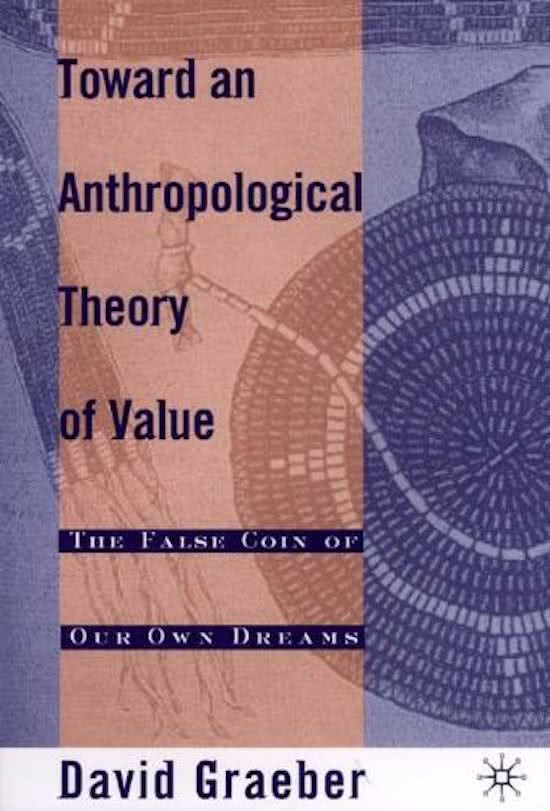
Graeber (2001) – Toward an Anthropological Theory of Value
Introduction
A Few Words by Way of Introduction
First of all, in making a contribution to anthropological theories of value. Many anthropologists have
long felt we really should have a theory of value: that is, one that seeks to move from understanding
how different cultures define the world in radically different ways one that seeks to move from
understanding how different cultures define the world in radically different to how, at the same
time, they define what is beautiful, or worthwhile, or important about it. my own assumptions and
priorities were in many ways diametrically opposed to much of what now stands as common wisdom
in the social sciences The last several years have seen the rapid growth of new social movements—
particularly, movements against neoliberalism It is becoming increasingly obvious that what those
who celebrated postmodernism were describing was in large part simply the effects of this universal
market system, which, like any totalizing system of value, tends to throw all others into doubt and
disarray it strikes me that if one is looking for alternatives to what might be called the philosophy of
neoliberalism, its most basic assumptions about the human condition, then a theory of value would
not be a bad place to start. If we are not, in fact, calculating individuals trying to accumulate the
maximum possible quantities of power, pleasure, and material wealth, then what, precisely, are we?
Chapter 1 - Three Ways of Talking about Value
It is extremely difficult to find a systematic “theory of value” anywhere in the recent literature It will
become easier to see why a theory of value should have seemed to hold such promise if one looks at
the way the word “value” has been used in social theory in the past. There are, one might say, three
large streams of thought that converge in the present term. These are:
1. “values” in the sociological sense: conceptions of what is ultimately good, proper, or
desirable in human life
2. “value” in the economic sense: the degree to which objects are desired, particularly, as
measured by how much others are willing to give up to get them
3. “value” in the linguistic sense, which goes back to the structural linguistics of Ferdinand de
Saussure (1966), and might be most simply glossed as “meaningful difference”
When anthropologists nowadays speak of “value”—particularly, when they refer to “value” in the
singular when one writing twenty years ago would have spoken of “values” in the plural—they are at
the very least implying that the fact that all these things should be called by the same word is no
coincidence.
I: Clyde Kluckhohn’s value project
The theoretical analysis of “values” or “systems of values” is largely confined to philosophy (where it
is called “axiology”) and sociology (where it is what one is free from when one is “value-free.”) It is
not as if anthropologists haven’t always used the term. One can pick up a work of anthropology from
almost any period and, if one flips through long enough, be almost certain to find at least one or two
Introduction
A Few Words by Way of Introduction
First of all, in making a contribution to anthropological theories of value. Many anthropologists have
long felt we really should have a theory of value: that is, one that seeks to move from understanding
how different cultures define the world in radically different ways one that seeks to move from
understanding how different cultures define the world in radically different to how, at the same
time, they define what is beautiful, or worthwhile, or important about it. my own assumptions and
priorities were in many ways diametrically opposed to much of what now stands as common wisdom
in the social sciences The last several years have seen the rapid growth of new social movements—
particularly, movements against neoliberalism It is becoming increasingly obvious that what those
who celebrated postmodernism were describing was in large part simply the effects of this universal
market system, which, like any totalizing system of value, tends to throw all others into doubt and
disarray it strikes me that if one is looking for alternatives to what might be called the philosophy of
neoliberalism, its most basic assumptions about the human condition, then a theory of value would
not be a bad place to start. If we are not, in fact, calculating individuals trying to accumulate the
maximum possible quantities of power, pleasure, and material wealth, then what, precisely, are we?
Chapter 1 - Three Ways of Talking about Value
It is extremely difficult to find a systematic “theory of value” anywhere in the recent literature It will
become easier to see why a theory of value should have seemed to hold such promise if one looks at
the way the word “value” has been used in social theory in the past. There are, one might say, three
large streams of thought that converge in the present term. These are:
1. “values” in the sociological sense: conceptions of what is ultimately good, proper, or
desirable in human life
2. “value” in the economic sense: the degree to which objects are desired, particularly, as
measured by how much others are willing to give up to get them
3. “value” in the linguistic sense, which goes back to the structural linguistics of Ferdinand de
Saussure (1966), and might be most simply glossed as “meaningful difference”
When anthropologists nowadays speak of “value”—particularly, when they refer to “value” in the
singular when one writing twenty years ago would have spoken of “values” in the plural—they are at
the very least implying that the fact that all these things should be called by the same word is no
coincidence.
I: Clyde Kluckhohn’s value project
The theoretical analysis of “values” or “systems of values” is largely confined to philosophy (where it
is called “axiology”) and sociology (where it is what one is free from when one is “value-free.”) It is
not as if anthropologists haven’t always used the term. One can pick up a work of anthropology from
almost any period and, if one flips through long enough, be almost certain to find at least one or two