

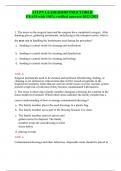
ATI PN LEADERSHIP PROCTORED EXAM-with 100% verified answers-
1. The nurse on the surgical team and the surgeon have completed a surgery. After donning gloves, gathering instruments, and placing in the transport carrier, what is the next step in handling the instruments used during the procedure? a. Sending to central sterile for cleaning and sterilization b. Sending to central sterile for cleaning and disinfection c. Sending to central sterile for cleaning and boiling d. Sending to central sterile for cleaning ANS: A Surgical instruments need to be cleaned and sterilized. Disinfecting, boiling, or cleaning is not utilized on critical items that will be reused on patients in the hospital environment. Items that are used on sterile tissue or in the vascular system present a high risk of infection if they become contaminated with bacteria. 2. The nurse is observing a family member changing a dressing for a patient in the home health environment. Which observation indicates the family member has a correct understanding of how to manage contaminated dressings? a. The family member places the used dressings in a plastic bag. b. The family member saves part of the dressing because it is clean. c. The family member removes gloves and gathers items for disposal. The family member wraps the used dressing in toilet tissue before d. placing in trash. ANS: A Contaminated dressings and other infectious, disposable items should be placed in impervious plastic or brown paper bags and then disposed of properly in garbage containers. Gloves should be worn during this process. Parts of the dressing should not be saved, even though they may seem clean, because microbes may be present. 3. The nurse is caring for a group of patients. Which patient will the nurse see first? a. A patient with Clostridium difficile in droplet precautions b. A patient with tuberculosis in airborne precautions c. A patient with MRSA infection in contact precautions d. A patient with a lung transplant in protective environment precautions ANS: A A patient with Clostridium difficile should be on contact precautions, not droplet; therefore, the nurse will see this patient first to correct the precautions. All the rest are on correct precautions. Patients with tuberculosis belong in airborne precautions; patients with MRSA infection belong in contact precautions; and patients with lung transplants belong in protective environment precautions. 4. The home health nurse is teaching a patient and family about hand hygiene in the home. Which situation will cause the nurse to emphasize washing hands before and after? a. Shaking hands b. Performing treatments c. Opening the refrigerator d. Working on a computer ANS: B Patients and family members should perform hand hygiene before and after treatments and when coming in contact with body fluids. Shaking hands does not require washing of hands before and after. Washing hands before and after opening the refrigerator and using the computer is not required. 5. The surgical mask the perioperative nurse is wearing becomes moist. Which action will the perioperative nurse take next? a. Apply a new mask. b. Reapply the mask after it air-dries. c. Change the mask when relieved by next shift. d. Do not change the mask if the nurse is comfortable. ANS: A After the mask is worn for several hours, it can become moist. The mask should be changed as soon as possible because moisture does not provide a barrier to microorganisms and is ineffective. Waiting to change the mask, air-drying it, or wearing it because it is comfortable does not support the principles of infection control. 6. The nurse is caring for a patient on contact precautions. Which action will be most appropriate to prevent the spread of disease? a. Place the patient in a room with negative airflow. Wear a gown, gloves, face mask, and goggles for interactions with the b. patient. Transport the patient safely and quickly when going to the radiology c. department. Use a dedicated blood pressure cuff that stays in the room and is used d. for that patient only. ANS: D Contact precautions are a type of isolation precaution used for patients with illness that can be transmitted through direct or indirect contact. Patients who are on contact precautions should have dedicated equipment wherever possible. This would mean, for example, that one blood pressure cuff and one stethoscope would stay in the room with the patient and would be used for that patient only. A gown and gloves may be required for interactions with a patient who is on contact precautions. A face mask and goggles are not part of contact precautions. A room with negative airflow is needed for patients placed on airborne precautions; it is not necessary for a patient on contact precautions. When a patient on contact precautions needs to be transported, the patient should wear clean gown, and hands cleaned, and the infectious material is contained or covered. 7. The nurse is caring for a patient who has cultured positive for Clostridium difficile. Which action will the nurse take next?
Información del documento
- Subido en
- 28 de julio de 2023
- Número de páginas
- 34
- Escrito en
- 2022/2023
- Tipo
- Examen
- Contiene
- Preguntas y respuestas

