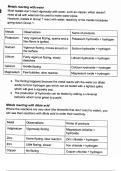
Metals reacting with water
I Most metals don't react vigorously with water, such as copper,
which doesn't
react at all with watercan be· used to make water pipes.
However, metals in Group 1 react with water, reactivity of the meta
ls increases
going down Group 1.
Metals Observations Name of products _
Potassium Very vigorous fizzing, sparks and a Potassium hydroxide + hydrogen
lilac flame is ignited.
Sodium Vigorous fizzing, moves around on Sodium hydroxide + hydrogen
the surface
Lithium Fairly vigorous fizzing, slowly Lithium hydroxide + hydrogen
dissolves '
Calcium Gentle fizzing Calcium hydroxide + hydrogen
Magnesium Few bubbles, slow reaction Magnesium oxide + hydrogen
• The fizzing happens because the metal reacts with the wate
r (or dilute
acids) to form hydrogen gas which can be tested with a lighted
splint
which will give a squeaky pop.
• The·production of hydroxide can be tested by adding a unive
rsal
indicator which turns green ~o purple.
Metals reacting with dilute acid
Where the reactions are very slow (the elements that don't react
to water), you
can see their reactions with dilute acid to order their reactivity.
Metal Observations Name of products
magnesium Vigorously fizzing Magnesium chloride +
" hydroxide
Zinc Some fizzing, slow reaction Zinc chloride + hydrogen
Iron Little fizzing, slower Iron chloride + hydrogen
Copp er No fizzing Copp er chloride + hydrogen
I Most metals don't react vigorously with water, such as copper,
which doesn't
react at all with watercan be· used to make water pipes.
However, metals in Group 1 react with water, reactivity of the meta
ls increases
going down Group 1.
Metals Observations Name of products _
Potassium Very vigorous fizzing, sparks and a Potassium hydroxide + hydrogen
lilac flame is ignited.
Sodium Vigorous fizzing, moves around on Sodium hydroxide + hydrogen
the surface
Lithium Fairly vigorous fizzing, slowly Lithium hydroxide + hydrogen
dissolves '
Calcium Gentle fizzing Calcium hydroxide + hydrogen
Magnesium Few bubbles, slow reaction Magnesium oxide + hydrogen
• The fizzing happens because the metal reacts with the wate
r (or dilute
acids) to form hydrogen gas which can be tested with a lighted
splint
which will give a squeaky pop.
• The·production of hydroxide can be tested by adding a unive
rsal
indicator which turns green ~o purple.
Metals reacting with dilute acid
Where the reactions are very slow (the elements that don't react
to water), you
can see their reactions with dilute acid to order their reactivity.
Metal Observations Name of products
magnesium Vigorously fizzing Magnesium chloride +
" hydroxide
Zinc Some fizzing, slow reaction Zinc chloride + hydrogen
Iron Little fizzing, slower Iron chloride + hydrogen
Copp er No fizzing Copp er chloride + hydrogen