Upper GI tract pharmacology and therapeutics
https://www.youtube.com/watch?v=lkrTOSUTvAg&ab_channel=SpeedPharmacology
Gastric Acid Production
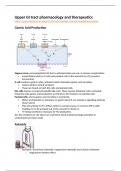
Vagous nerve: parasympathetic NS that is activated when you eat. It releases acetylcholine.
acetylcholine binds to G cells and parietal cells in the stomach by M3 receptors
(muscarinic).
G cell: produces gastrin when activated which stimulates gastric acid secretion.
Gastrin binds to CCK-B receptors
These are found on both ECL cells and parietal cells.
ECL cells: known as enterochromaffin-like cells. These secrete histamine when activated.
Histamine aids gastric acid production as it binds to H2 receptors on parietal cells.
Parietal cells: where gastric acid secretion is monitored.
When acetylcholine or histamine or gastrin binds it can activate a signalling pathway
shown above
This will activate H+/K+ ATPase which is a proton pump. It converts ATP to ADP,
enabling H+ to be pumped out of the cell and K+ drawn in.
H+ being secreted is necessary for HCl production.
ALL the receptors we see above are G proteins (look at pharmacology principles to
understand how these work).
Antacids
examples: aluminium hydroxide, magnesium hydroxide and calcium carbonate
o magnesium=laxative effect
, o aluminium=constipation effect
o when used together you can preserve GI function.
MOA: acts by neutralising HCl and does NOT decrease acid secretion
o metal ion and HCL form salt and water.
o e.g. Al(OH)3 + 3HCl → AlCl3 +3H2O
o this raises the pH of the stomach and aids dyspepsia symptoms.
OTC
liquids are more effective, but tablets are more convenient.
high salt content so contra indicates pregnancy, liver/renal/cardiac conditions, and
hypertension.
as new stomach acid is constantly being churned out, take FOUR daily and only short-
term.
Alginates
e.g. sodium alginate from brown seaweed
used in combination with antacids for GORD.
increases the viscosity of stomach content.
forms a raft on the top of the stomach to prevent a burning sensation during
dyspepsia.
only lasts for 4 hours due to producing new stomach acid continuously.
Mucosal Protection
H2 receptors=Gs proteins meaning they stimulate adenylyl cyclase to make cAMP from ATP
(look at pharmacology principles lecture)
Prostaglandin E1 analogue=Gi proteins meaning they inhibit the same adenylyl cyclase. It
decreases cellular cAMP levels. This decreases the activity of H+/K+ ATPase.
Histamine H2 receptor antagonist
used to treat: GORD, peptic ulcer disease and dyspepsia.
MOA: reversibly blocks H2 receptors on the parietal cells of the stomach. Stops cAMP
levels increasing. So, ATPase cannot be activated to pump out H+ for gastric acid.
Reduces gastric acid secretion.
side effects=dizziness, headache, diarrhoea, and rash.
https://www.youtube.com/watch?v=lkrTOSUTvAg&ab_channel=SpeedPharmacology
Gastric Acid Production
Vagous nerve: parasympathetic NS that is activated when you eat. It releases acetylcholine.
acetylcholine binds to G cells and parietal cells in the stomach by M3 receptors
(muscarinic).
G cell: produces gastrin when activated which stimulates gastric acid secretion.
Gastrin binds to CCK-B receptors
These are found on both ECL cells and parietal cells.
ECL cells: known as enterochromaffin-like cells. These secrete histamine when activated.
Histamine aids gastric acid production as it binds to H2 receptors on parietal cells.
Parietal cells: where gastric acid secretion is monitored.
When acetylcholine or histamine or gastrin binds it can activate a signalling pathway
shown above
This will activate H+/K+ ATPase which is a proton pump. It converts ATP to ADP,
enabling H+ to be pumped out of the cell and K+ drawn in.
H+ being secreted is necessary for HCl production.
ALL the receptors we see above are G proteins (look at pharmacology principles to
understand how these work).
Antacids
examples: aluminium hydroxide, magnesium hydroxide and calcium carbonate
o magnesium=laxative effect
, o aluminium=constipation effect
o when used together you can preserve GI function.
MOA: acts by neutralising HCl and does NOT decrease acid secretion
o metal ion and HCL form salt and water.
o e.g. Al(OH)3 + 3HCl → AlCl3 +3H2O
o this raises the pH of the stomach and aids dyspepsia symptoms.
OTC
liquids are more effective, but tablets are more convenient.
high salt content so contra indicates pregnancy, liver/renal/cardiac conditions, and
hypertension.
as new stomach acid is constantly being churned out, take FOUR daily and only short-
term.
Alginates
e.g. sodium alginate from brown seaweed
used in combination with antacids for GORD.
increases the viscosity of stomach content.
forms a raft on the top of the stomach to prevent a burning sensation during
dyspepsia.
only lasts for 4 hours due to producing new stomach acid continuously.
Mucosal Protection
H2 receptors=Gs proteins meaning they stimulate adenylyl cyclase to make cAMP from ATP
(look at pharmacology principles lecture)
Prostaglandin E1 analogue=Gi proteins meaning they inhibit the same adenylyl cyclase. It
decreases cellular cAMP levels. This decreases the activity of H+/K+ ATPase.
Histamine H2 receptor antagonist
used to treat: GORD, peptic ulcer disease and dyspepsia.
MOA: reversibly blocks H2 receptors on the parietal cells of the stomach. Stops cAMP
levels increasing. So, ATPase cannot be activated to pump out H+ for gastric acid.
Reduces gastric acid secretion.
side effects=dizziness, headache, diarrhoea, and rash.