

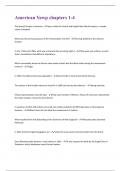
American Yawp chap ters 1 -4 The Spanish Empire in America - ✔✔was, unlike the French and English New World empires, a mostly urban civilization. What was the primary purpose of the Proclamation of 1763? - ✔✔To bring stability to the colonial frontier. In the 1770s and 1780s, what was a characteristic of voting rights? - ✔✔They were not uniform, as each state's constitution had different stipulations. Which commodity drove the African slave trade in Brazil and the West Indies during the seventeenth century? - ✔✔Sugar. In 1492, the Native American population: - ✔✔lived mostly in Central and South America. The actions of the Pueblo Indians at Santa Fe in 1680 can best be described as: - ✔✔being assertive Virtual representation was the idea: - ✔✔that each member of Brita in's House of Commons represented the entire empire, not just his own district. In Carolina, conflict with Indians occurred, but similar problems did NOT take place in Pennsylvania because: - ✔✔William Penn did not allow the enslavement of Indians. What resulted from the disbanding of the Dominion of New England? - ✔✔Massachusetts absorbed Plymouth. In 1651 the first English Navigation Act - ✔✔aimed to wrest control of world trade from the Dutch. Once Massachusetts became a royal colony in 1691: - ✔✔it was required to abide by the English Act of Toleration, which displeased many Puritan leaders. As the slave society consolidated in the Chesapeake region, what happened to free blacks? - ✔✔They lost many of their rights. A West African captured and sold into slavery in 1650 most likely ended up in: - ✔✔the West Indies Republican motherhood encouraged - ✔✔greater educational opportunities for women. What was a potential criticism from slave owners about the task system? - ✔✔Slaves would have too much aut onomy. Unlike the Stamp Act, the Townshend Acts focused on: - ✔✔taxing goods imported into the colonies. At the heart of the English Civil War was: - ✔✔a question of sovereignty in who would make decisions for the government. The Glorious Revolution of 1688 - ✔✔resulted mainly from the fears of English aristocrats that the birth of James II's son would lead to a Catholic succession. In 1608, Samuel de Champlain founded: - ✔✔Quebec The Pueblo Indians encountered by the Spanish in the sixteenth century: - ✔✔perfected techniques of desert farming Why did colonists object to the Tea Act? - ✔✔By paying it, they would be acknowledging Great Britain's right to tax the colonists. Native A merican religious ceremonies - ✔✔were related to the Native American belief that sacred spirits could be found in living and inanimate things
Examen
American Yawp chapters 1-4 | Questions and Answers with complete solution
Puntuación
Vendido
-
Páginas
6
Grado
A+
Subido en
22-07-2023
Escrito en
2022/2023
The Spanish Empire in America - was, unlike the French and English New World empires, a mostly urban civilization. What was the primary purpose of the Proclamation of 1763? - To bring stability to the colonial frontier. In the 1770s and 1780s, what was a characteristic of voting rights? - They were not uniform, as each state's constitution had different stipulations. Which commodity drove the African slave trade in Brazil and the West Indies during the seventeenth century? - Sugar. In 1492, the Native American population: - lived mostly in Central and South America. The actions of the Pueblo Indians at Santa Fe in 1680 can best be described as: - being assertive Virtual representation was the idea: - that each member of Britain's House of Commons represented the entire empire, not just his own district. In Carolina, conflict with Indians occurred, but similar problems did NOT take place in Pennsylvania because: - William Penn did not allow the enslavement of Indians. What resulted from the disbanding of the Dominion of New England? - Massachusetts absorbed Plymouth. In 1651 the first English Navigation Act - aimed to wrest control of world trade from the Dutch. Once Massachusetts became a royal colony in 1691: - it was required to abide by the English Act of Toleration, which displeased many
Mostrar más
Leer menos
Institución
American Yawp Chapters 1-4
Grado
American Yawp chapters 1-4
Ups! No podemos cargar tu documento ahora. Inténtalo de nuevo o contacta con soporte.
Escuela, estudio y materia
- Institución
- American Yawp chapters 1-4
- Grado
- American Yawp chapters 1-4
Información del documento
- Subido en
- 22 de julio de 2023
- Número de páginas
- 6
- Escrito en
- 2022/2023
- Tipo
- Examen
- Contiene
- Preguntas y respuestas
Temas
-
american yawp chapters 1 4
Vista previa del contenido
$4.09
Accede al documento completo:
100% de satisfacción garantizada
Inmediatamente disponible después del pago
Tanto en línea como en PDF
No estas atado a nada

Documento también disponible en un lote
Package deal
American Yawp Bundled exams everything you need to pass
1
12
2023
$ 47.28
Más información
