(TOP SCORE) Gordis Epidemiology 6th Edition Celentano Test Bank Gordis Epidemiology 6th Edition Celentano Test Bank Chapter 01: Introduction Celentano: Gordis Epidemiology, 6th Edition Test Bank MULTIPLE CHOICE 1. Which of the following is an example of tertiary prevention? a. Vaccination for rotavirus for children younger than the age of 1 year b. Surgical amputation of an extremity with osteosarcoma (bone cancer) c. Screening for gestational diabetes after 24 weeks of pregnancy d. Sexual education program in elementary schools e. Increasing taxes for buying cigarettes ANS: B Surgical amputation of an extremity with osteosarcoma (bone cancer) is an example in which when a disease is present the treatment (amputation) is done to reduce the impact of disease by preventing the tumor from dissemination. Vaccination for rotavirus for children younger than the age of 1 year, sexual education program in elementary schools, and increasing taxes for buying cigarettes represent examples of primary prevention. Screening for gestational diabetes after 24 weeks of pregnancy is an example of secondary prevention. 2. This historic character ob servedNtUhaRt SchIilNdbGeTd Bfe.veCr OmMortality was more common among women treated by physicians and medical students compared with women treated by midwives. Based on his observations, he implemented a hand wash policy that resulted in a decrease in mortality. Name the character that we are talking about. a. John Snow b. Edward Jenner c. D.A. Henderson d. Leon Gordis e. Ignaz Semmelweis ANS: E Ignaz Semmelweis identified that medical students and physicians transmitted the disease by not washing their hands after examining bodies at autopsies and conducting multiple examinations in the clinic. 3. Thanks to the contributions of Edward Jenner, the following disease was eradicated later by efforts organized by D.A. Henderson: a. Cholera b. Smallpox c. Chickenpox d. Polio e. Zika ANS: B Smallpox was eradicated in 1980. Edward Jenner vaccinated James Phipps in 1796 against smallpox. Almost 200 years later, the World Health Organization (WHO) commissioned D.A. Henderson to lead the efforts to eradicate the disease. 4. Over the past century, a marked decline in the mortality rates of many infectious diseases has been observed. Which of the following is the most likely reason for the observed decline in mortality rates from common infectious diseases? a. Development of penicillin b. Development of insulin c. Development of vaccines d. Improvement in social conditions e. Worse sanitation and unsafe water ANS: D Although medical treatments potentially helped in the decrease of infectious diseases, the advancement in social conditions played a major role. These improvements include better sanitation, safe disposal of waste, better nutrition, and improvement in housing conditions. N R I G B.C Chapter 02: The Dynamics of Disease Transmission Celentano: Gordis Epidemiology, 6th Edition MULTIPLE CHOICE 1. Which term most accurately describes the following definition? “The occurrence in a community or region of cases of an illness, specific health-related behavior, or other health- related events clearly in excess of normal expectancy.” [Porta M, ed. A Dictionary of Epidemiology. New York: Oxford University Press; 2014.] a. Endemic b. Epidemic c. Pandemic d. Attack rate e. Incubation period ANS: B An epidemic is the occurrence of health-related events in a community or region , in clear excess of normal expectation . Endemic is not true because it is defined as the constant occurrence of a disease, disorder, or noxious infectious agent in a geographic area or population group. Pandemic is not true because it is defined as an epidemic occurring over a very wide area, crossing internationUal bSounNdarTies, andOusually affecting a large number of people. Attack rate is not true because it is defined as number of people at risk in whom a certain illness develops over total number of people at risk. Incubation period is not true because it is the interval from receipt of infection to the time of onset of clinical illness (the onset of recognizable symptoms). 2. What is the most accurate definition of the incubation period (of an infectious disease)? a. The time of onset of clinical illness or the onset of recognizable symptoms b. The interval from receipt of infection to the time of onset of clinical illness (the onset of recognizable symptoms) c. The time of invasion by an infectious agent d. The time between initiation of infection and first shedding or excretion of the agent e. The period between exposure and the onset of infectiousness ANS: B The incubation period is defined as the interval from receipt of infection to the time of onset of clinical illness (the onset of recognizable symptoms); in other words, the time between the moment of developing symptoms and the moment of invasion by an infectious agent. “The time of onset of clinical illness or the onset of recognizable symptoms” is not true as it corresponds to “time of onset.” “The time of invasion by an infectious agent” is not true as it corresponds to “time of infection.” “The time between initiation of infection and first shedding or excretion of the agent” and “The period between exposure and the onset of infectiousness” are not true as they correspond to the latent period. (The latent period is
Examen
(TOP SCORE) Gordis Epidemiology 6th Edition Celentano Test Bank.
Puntuación
Vendido
-
Páginas
83
Grado
A+
Subido en
18-07-2023
Escrito en
2022/2023
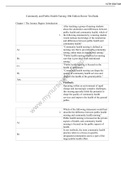
(TOP SCORE) Gordis Epidemiology 6th Edition Celentano Test Bank. Chapter 01: Introduction Celentano: Gordis Epidemiology, 6th Edition Test Bank MULTIPLE CHOICE 1. Which of the following is an example of tertiary prevention? a. Vaccination for rotavirus for children younger than the age of 1 year b. Surgical amputation of an extremity with osteosarcoma (bone cancer) c. Screening for gestational diabetes after 24 weeks of pregnancy d. Sexual education program in elementary schools e. Increasing taxes for buying cigarettes ANS: B Surgical amputation of an extremity with osteosarcoma (bone cancer) is an example in which when a disease is present the treatment (amputation) is done to reduce the impact of disease by preventing the tumor from dissemination. Vaccination for rotavirus for children younger than the age of 1 year, sexual education program in elementary schools, and increasing taxes for buying cigarettes represent examples of primary prevention. Screening for gestational diabetes after 24 weeks of pregnancy is an example of secondary prevention. 2. This historic character observedNtUhaRt SchIilNdbGeTd BCr Om Mortality was more common among women treated by physicians and medical students compared with women treated by midwives. Based on his observations, he implemented a hand wash policy that resulted in a decrease in mortality. Name the character that we are talking about. a. John Snow b. Edward Jenner c. D.A. Henderson d. Leon Gordis e. Ignaz Semmelweis ANS: E Ignaz Semmelweis identified that medical students and physicians transmitted the disease by not washing their hands after examining bodies at autopsies and conducting multiple examinations in the clinic. 3. Thanks to the contributions of Edward Jenner, the following disease was eradicated later by efforts organized by D.A. Henderson: a. Cholera b. Smallpox c. Chickenpox d. Polio e. Zika ANS: B Smallpox was eradicated in 1980. Edward Jenner vaccinated James Phipps in 1796 against smallpox. Almost 200 years later, the World Health Organization (WHO) commissioned D.A. Henderson to lead the efforts to eradicate the disease. 4. Over the past century, a marked decline in the mortality rates of many infectious diseases has been observed. Which of the following is the most likely reason for the observed decline in mortality rates from common infectious diseases? a. Development of penicillin b. Development of insulin c. Development of vaccines d. Improvement in social conditions e. Worse sanitation and unsafe water ANS: D Although medical treatments potentially helped in the decrease of infectious diseases, the advancement in social conditions played a major role. These improvements include better sanitation, safe disposal of waste, better nutrition, and improvement in housing conditions. N R I G B.C Chapter 02: The Dynamics of Disease Transmission Celentano: Gordis Epidemiology, 6th Edition MULTIPLE CHOICE 1. Which term most accurately describes the following definition? “The occurrence in a community or region of cases of an illness, specific health-related behavior, or other healthrelated events clearly in excess of normal expectancy.” [Porta M, ed. A Dictionary of Epidemiology. New York: Oxford University Press; 2014.] a. Endemic b. Epidemic c. Pandemic d. Attack rate e. Incubation period ANS: B An epidemic is the occurrence of health-related events in a community or region, in clear excess of normal expectation. Endemic is not true because it is defined as the constant occurrence of a disease, disorder, or noxious infectious agent in a geographic area or population group. Pandemic is not true because it is defined as an epidemic occurring over a very wide area, crossing internationUal bSounNdarTies, andOusually affecting a large number of people. Attack rate is not true because it is defined as number of people at risk in whom a certain illness develops over total number of people at risk. Incubation period is not true because it is the interval from receipt of infection to the time of onset of clinical illness (the onset of recognizable symptoms). 2. What is the most accurate definition of the incubation period (of an infectious disease)? a. The time of onset of clinical illness or the onset of recognizable symptoms b. The interval from receipt of infection to the time of onset of clinical illness (the onset of recognizable symptoms) c. The time of invasion by an infectious agent d. The time between initiation of infection and first shedding or excretion of the agent e. The period between exposure and the onset of infectiousness ANS: B The incubation period is defined as the interval from receipt of infection to the time of onset of clinical illness (the onset of recognizable symptoms); in other words, the time between the moment of developing symptoms and the moment of invasion by an infectious agent. “The time of onset of clinical illness or the onset of recognizable symptoms” is not true as it corresponds to “time of onset.” “The time of invasion by an infectious agent” is not true as it corresponds to “time of infection.” “The time between initiation of infection and first shedding or excretion of the agent” and “The period between exposure and the onset of infectiousness” are not true as they correspond to the latent period. (The latent period is focusing on the onset of infectiousness, but the incubation period is focusing on the onset of the symptom.) 3. There was a food poisoning outbreak on April 1, 2018, at the City Z Food Safety Conference. There were 1,000 people registered for the conference with luncheon, 100 volunteers to host attendees, and 50 people who served the luncheon during the conference. Except for 50 people who served the food, all of the participants and volunteers ate the food from the luncheon at the conference on April 1, 2018. Based only on the information given in this question, how many people are at risk in this food poisoning outbreak? a. 1,000 b. 1,100 c. 1,150 d. 150 e. 50 ANS: B People at risk in this outbreak are people who were exposed to the food at the conference. Even though 1,150 people were at the conference, 50 people who served the food did not eat the food. Therefore we have to exclude those 50 people. 4. There was a food poisoning outbreak on April 1, 2018, at the City Z Food Safety Conference. There were 1,000 people registered for the conference with luncheon, 100 volunteers to host attendees, and 50 people who served the luncheon during the conference. Except for 50 people who served NthUe RfoSodI,NalGl oTfBth.eCpaOrtMicipants and volunteers ate the food from the luncheon at the conference on April 1, 2018. After an initial outbreak of food poisoning is reported, an epidemiologist sends surveys to all people at risk to investigate the cause. However, only 900 people among those at risk answer the survey. After analysis of 900 survey results, the epidemiologist concludes that the most suspected foods in the outbreak are pepperoni pizza and meatball spaghetti. What is the overall attack rate for those who ate meatball spaghetti? Use the following table to answer the question. Summary of Survey Responses Number of people who developed the case definition symptoms Number of people who ate the food Pepperoni pizza only 113 275 Meatball spaghetti only 62 375 Both pepperoni pizza and meatball spaghetti 57 150 Neither of pepperoni pizza or meatball spaghetti 10 100 a. 41% b. 38% c. 27% d. 40% e. 23% ANS: E To calculate the food-specific attack rate, we need to define how many people are exposed to the specific food and how many people develop the symptoms in the case definition. In this question, we are asking about “overall” attack rate in those people who ate meatball spaghetti, so we have to add “meatball spaghetti only” and “both pepperoni pizza and meatball spaghetti” to get the overall rate. Which is 525 (375 plus 150), who are at risk of exposure, and 119 (62 plus 57), who developed the symptoms, corresponding to 23% of attack rate. 5. There was a food poisoning outbreak on April 1, 2018, at the City Z Food Safety Conference. There were 1,000 people registered for the conference with luncheon, 100 volunteers to host attendees, and 50 people who served the luncheon during the conference. Except for 50 people who served the food, all of the participants and volunteers ate the food from the luncheon at the conference on April 1, 2018. After an initial outbreak of food poisoning is reported, an epidemiologist sends surveys to all people at risk to investigate the cause. However, only 900 people among those at risk answer the survey. After analysis of 900 survey results, the epidemiologist concludes that the most suspected foods in the outbreak are pepperoni pizza and meatball spaghetti. What is the most suspected food for food poisoning after cross-tabulation? Use the following table to answer the question. Summary of Survey Responses NNumRberIof GpeoBpl.e CwhoM deUveloSpedNtheTcase dOefinition symptoms Number of people who ate the food Pepperoni pizza only 113 275 Meatball spaghetti only 62 375 Both pepperoni pizza and meatball spaghetti 57 150 Neither of pepperoni pizza or meatball spaghetti 10 100 a. Pepperoni pizza only b. Meatball spaghetti only c. Both pepperoni pizza and meatball spaghetti d. Neither pepperoni pizza nor meatball spaghetti e. We cannot determine the cause of food based on this information ANS: A Pepperoni pizza only attack rate is 41.09% (113 divided by 275), and meatball spaghetti only is 16.53% (62 divided by 375). The attack rate of both pepperoni pizza and meatball spaghetti is 38.00% (57 divided by 150). Some may choose both of them which are the most suspected food. If both the foods were the most suspected food, we should have a higher attack rate in meatball spaghetti only group as well.
Mostrar más
Leer menos
Institución
Gordis Epidemiology 6th Edition Celentano
Grado
Gordis Epidemiology 6th Edition Celentano
Ups! No podemos cargar tu documento ahora. Inténtalo de nuevo o contacta con soporte.
Escuela, estudio y materia
- Institución
- Gordis Epidemiology 6th Edition Celentano
- Grado
- Gordis Epidemiology 6th Edition Celentano
Información del documento
- Subido en
- 18 de julio de 2023
- Número de páginas
- 83
- Escrito en
- 2022/2023
- Tipo
- Examen
- Contiene
- Preguntas y respuestas
Temas
-
top score gordis epidemiology 6th edition
-
gordis epidemiology 6th edition celentano
-
gordis epidemiology 6th edition
-
gordis epidemiology 6th edition test bank
-
top score gordis epidemiology test ba
Vista previa del contenido
$17.99
Accede al documento completo:
100% de satisfacción garantizada
Inmediatamente disponible después del pago
Tanto en línea como en PDF
No estas atado a nada