ABRET Waveform Analysis and Identification, ECI recording 100% Pass
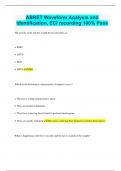
ABRET Waveform Analysis and Identification, ECI recording 100% Pass The activity in the red box would be best describes as: a. EMG b. RTTD c. EKG d. BETS EMG Which of the following is characteristic of triphasic waves? a. They have a sharp initial positive phase b. They are posterior dominant c. They have a time lag from frontal to posterior head regions d. They are usually unilateral They have a time lag from frontal to posterior head regions What is happening in the first 2 seconds and the last 2 seconds in the sample? a. the low filter was turned off b. 60 Hz artifact c. seizure activity d. the high filter was turned off 60 Hz artifact Which of the following EEG patterns is LEAST likely to be associated with clinical symptoms? a. Generalized slow spike and wave of 1.5 to 2.5 Hz b. 6 Hz spike and wave c. Generalized 3 Hz spike and wave d. FIRDA 6 Hz spike and wave The patient is a 25 year old male with a traumatic brain injury. What is seen in this sample? a. complex partial seizure b. generalized tonic clonic seizure c. burst suppression d. artifact Artifact Which of the following patterns is characteristically eliminated by movement of a limb? a. lambda waves b. POSTS c. Kappa d. Mu rhythm Mu rhythm Mu rhythm a. 12-14 Hz b. 2-6 Hz c. 15-16 Hz d. 8-10 Hz 8-10 Hz Which of the following is considered abnormal? a. 6 Hz spike b. Wicket spikes c. small sharp spikes (SSS) d. spikes spikes Benign Epileptiform Transients of Sleep a. stage IV sleep b. common in infancy c. midline occipital d. peak at 30-60 years peak at 30-60 years What EEG pattern is seen in this image? a burst suppression b. postictal state c. hypsarrhythmia with electrodecremental period d. GPEDS burst suppression Which is most important when evaluating background frequency? a. wakefulness and age b. quality of sleep and HV effort c. medications and allergies d. photic stimulation and stimulating frequencies wakefulness and age Which of the following best describes secondary bilateral synchrony? a. generates simultaneous generalized discharges b. produces 3 Hz spike and wave discharges c. originates from both temporal lobes at the same time d. reflects rapid generalization from one or multiple sources reflects rapid generalization from one or multiple sources Small sharp spikes a. Positive occipital sharp transients of sleep b. benign epileptiform transients of sleep c. temporal intermittent rhythmic delta activity d. occipital intermittent rhythmic delta activity benign epileptiform transients of sleep (BETS) What are the most significant findings in this sample? a. eye blinks with bifrontal poly spike and wave b. generalized spike and wave c. bifrontal polyspike and wave d. focal frontal spikes generalized spike and wave During neonatal seizures, the EEG is most likely to show: a. attenuation of EEG activity b. focal rhythmic activity c. generalized spike and wave discharges d. low voltage fast activity focal rhythmic activity Which scenario would be of more diagnostic value? a. asymmetric frequency b. asymmetric amplitude c. decreasing amplitude of alpha d. presence of small sharp spikes (BETS) asymmetric frequency What differentiates Lambda and POSTS? a. occurs with eyes open b. common in adults c. location d. polarity occurs with eyes open An EEG Tech observes what appears to be both Mu rhythm and Posterior dominant rhythm at the same time during the live EEG. What can they do to prove that the rhythm is Mu? a. Ask the patient to move their hand that is contralateral to the suspected Mu rhythm b. perform HV on the patient c. perform photic stimulation on the patient d. ask the patient to move their hand that is ipsilateral to the suspected mu rhythm ask the patient to move their hand that is contralateral to the suspected Mu rhythm (contralateral is the other side) It is common for FIRDA to a. react to stimulation b. be confused with nystagmus c. be considered normal in adults ages 30-50 d. have spikes intermixed react to stimulation The EEG activity starting in the 2nd second of this epoch is most likely: a. eye fluttering b. facial twitching c. abrupt onset of a generalized tonic clonic seizure d. photic driving response photic driving Lambda waves a. sleep b. thinking c. muscle activity d. visual input visual input Hypsarrhythmia a. High voltage diffuse 2 Hz spike wave discharges b. focal repetitive sharp wave activity c. disorganized, continuous high voltage slow waves with interspersed multifocal spike waves d. continuous triphasic complexes disorganized, continuous high voltage slow waves with interspersed multifocal spike waves Which of the following would be considered a focal abnormality? a. 3 Hz spike and wav b. burst suppression c. hypsarrhythmia d. unilateral spikes unilateral spikes Subclinical rhythmic electrographic discharges in adults (SREDA) most often appears: a. in those under age 50 b. unilaterally c. during photic stimulation d. suddenly in resting EEG suddenly in resting EEG Alpha coma a. 8-13 Hz activity occurring diffusely, maximum anteriorly b. nonreactive activity, 0.5 - 4 Hz c. diffuse rhythmic 5 Hz activity, maximum anteriorly d. no recordable cerebral activity 8-13 Hz activity occurring diffusely, maximum anteriorly What is the most prominent feature of this EEG sample? a. focal seizure b. lambda activity c. stage 2 sleep d. electrode pop a. focal electrode pop Morphology, location and frequency are ways to describe a. clinical semiology b. filter settings c. response to photo stimulation d. EEG patterns and seizures EEG patterns and seizures Saccadic eye movement a. midline theta b. beta c. lambda d. Mu Lambda BIPLEDS a. hypoxia b. migraine c. hypothyroidism d. attention deficit hypoxia Which of the following is one of the 10 ACNS Guidelines for ECI recordings? a. application of movement transducers b. application of double grounds c. utilization of eye lead monitors d. use of double distance montage use of double distance montage Of the following, which is not an ACNS guideline for ECI recording? a. high frequency filters should not be set below 30 Hz, and low frequency filters should not be set above 1 Hz b. record at the standard sensitivity setting of 7 uV/mm for at least 30 minutes of the recording c. the integrity of the entire system should be tested by tapping each electrode individually d. montages used should include electrode pairs that are at least 10 cm apart record at the standard sensitivity setting of 7 uV/mm for at least 30 minutes of the recording (the guideline is to record at 2 uV for 30 min)
Escuela, estudio y materia
- Institución
- ABRET Waveform Analysis and Identification, ECI
- Grado
- ABRET Waveform Analysis and Identification, ECI
Información del documento
- Subido en
- 15 de julio de 2023
- Número de páginas
- 13
- Escrito en
- 2022/2023
- Tipo
- Examen
- Contiene
- Preguntas y respuestas
Temas
-
eci re
-
abret waveform analysis and identification
-
the activity in the red box would be best describe

Documento también disponible en un lote