Week 10 Notes
March 22, 2023 11:08 AM
Chapter 17 monitoring and controlling
What is controlling and why is it important
Controlling
• The process of monitoring activities to ensure that they are being accomplished as planned,
correcting any significant deviation, where neccessary modifying the plan
Why is control important
• It is the final link in the four management functions
• It is the only way managers know whether organizational goals are being met and if not, the
reasons why
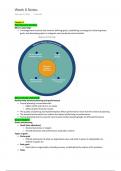
The Control Process
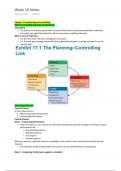
Control Process
A three step process
1. Measuring actual performance
2. Comparing performance
Control Process
Step 1 - measuring performance
• How we measure - four sources of information frequently used by managers to measure actual
performance are
○ Personal observations
○ Statistical reports
○ Oral reports
○ Written reportsz
What we measure: what we measure is probably more critical to the control process than how we
measure
• The selection of the wrong criteria can result in serious dysfunctional consequences
Step 2 - Comparing Performance against a standard
, • Comparing requires determining the degree of variation between actual performance and the
standard
• Significant Variation is determined by
○ The acceptable range of variation from the standard (forecast or budget)
○ The size (large or small) and direction (over or under) of the variation from the standard
• Range of variation
○ The acceptable degree of variation between actual performance and standard
Step 3 - taking managerial action
• Doing nothing
○ Only if deviation is insignificant
• Correcting actual (current) performance
○ Immediate or basic corrective
○ Immediate corrective action
Corrective action that correct problems at once to get performance back on track
○ Basic corrective action
Corrective action that looks at how and why performance deviated and then proceeds
to correct the source of deviation
• Revising the standard
○ Determine whether the standard is realistic, fair and achievable
○ In some cases, variance may be a result of an unrealistic standard-- a goal that's too low or
too high, in this case, the standard-- not the performance-- needs corrective action
Measuring organization and employee performance
Performance standard
• Performance
○ The end result of an activity
• Organizational performance
○ The accumulated results of all the organizations work activities
Measures of organizational performance
• Productivity
○ Is the over all output of goods and/or services divided by the inputs need to generate that
March 22, 2023 11:08 AM
Chapter 17 monitoring and controlling
What is controlling and why is it important
Controlling
• The process of monitoring activities to ensure that they are being accomplished as planned,
correcting any significant deviation, where neccessary modifying the plan
Why is control important
• It is the final link in the four management functions
• It is the only way managers know whether organizational goals are being met and if not, the
reasons why
The Control Process
Control Process
A three step process
1. Measuring actual performance
2. Comparing performance
Control Process
Step 1 - measuring performance
• How we measure - four sources of information frequently used by managers to measure actual
performance are
○ Personal observations
○ Statistical reports
○ Oral reports
○ Written reportsz
What we measure: what we measure is probably more critical to the control process than how we
measure
• The selection of the wrong criteria can result in serious dysfunctional consequences
Step 2 - Comparing Performance against a standard
, • Comparing requires determining the degree of variation between actual performance and the
standard
• Significant Variation is determined by
○ The acceptable range of variation from the standard (forecast or budget)
○ The size (large or small) and direction (over or under) of the variation from the standard
• Range of variation
○ The acceptable degree of variation between actual performance and standard
Step 3 - taking managerial action
• Doing nothing
○ Only if deviation is insignificant
• Correcting actual (current) performance
○ Immediate or basic corrective
○ Immediate corrective action
Corrective action that correct problems at once to get performance back on track
○ Basic corrective action
Corrective action that looks at how and why performance deviated and then proceeds
to correct the source of deviation
• Revising the standard
○ Determine whether the standard is realistic, fair and achievable
○ In some cases, variance may be a result of an unrealistic standard-- a goal that's too low or
too high, in this case, the standard-- not the performance-- needs corrective action
Measuring organization and employee performance
Performance standard
• Performance
○ The end result of an activity
• Organizational performance
○ The accumulated results of all the organizations work activities
Measures of organizational performance
• Productivity
○ Is the over all output of goods and/or services divided by the inputs need to generate that