psychological explanations
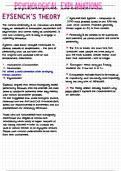
EYSENCK'S THEORY ~
Sybil and Hans Eysence -
companson of
2070 male prisoners scores on the EDQ test
The criminal personality
is an individual who scores with 2422 controls. Prisoners generally
highly extraversion,
on measures of neuroticism andscored higher on P.E. I than controls.
psycnoticism andcannot
easily be conditioned, is
cold and unfeeling, and is likely to engage in x
personality is too complex to be quantified
offending behaviour. and therefore we cannot
pinpoint the criminal
personality.
Eysenck
I
used factor analysis techniques to
x
The P.E.N scores are from
develop theories temperament
of -
the part of YES/NO
personality
that we are born with. questions were people are more likely to
His originalwork produced a set of two Pick the most
suitable answer rather than
distinctions:
temperament their true experiences-- lack of insight.
. Introversion/Extraversion x
farrington-meta-analysis finding
2. Necroticism exicence for P butnot
[or NV.
He added a third dimension after studying
X
Extroversion has been found to be made up
mental patients:
3.
Psychoticism and
impulsivity
of sociability. With impulsivity
being the only traitofoffenders.
Eysench argued that
certain biologically based
are invented, are more
features, that
personality x
The theory doesnt
actually explain why
prone to antisocial behaviour when
they interact people offend. Itexplains the characteristics of
with vanous socialisation processes. an offender.
He also suggested that
these biological factors,
combined with the ANS and CNS characteristics,
affect
our responsiveness to and
punishment our
predisposition for offending behaviour.
Those who are extroverted have biologically
determined low degrees circusal and
of
which leads to
arousability higher amounts of
risk-taking activities in order to increase the
level of conical arousal to an amount.
enjoyable
People with cortical underarousal do notlearn
from their punishment.
EYSENCK'S THEORY ~
Sybil and Hans Eysence -
companson of
2070 male prisoners scores on the EDQ test
The criminal personality
is an individual who scores with 2422 controls. Prisoners generally
highly extraversion,
on measures of neuroticism andscored higher on P.E. I than controls.
psycnoticism andcannot
easily be conditioned, is
cold and unfeeling, and is likely to engage in x
personality is too complex to be quantified
offending behaviour. and therefore we cannot
pinpoint the criminal
personality.
Eysenck
I
used factor analysis techniques to
x
The P.E.N scores are from
develop theories temperament
of -
the part of YES/NO
personality
that we are born with. questions were people are more likely to
His originalwork produced a set of two Pick the most
suitable answer rather than
distinctions:
temperament their true experiences-- lack of insight.
. Introversion/Extraversion x
farrington-meta-analysis finding
2. Necroticism exicence for P butnot
[or NV.
He added a third dimension after studying
X
Extroversion has been found to be made up
mental patients:
3.
Psychoticism and
impulsivity
of sociability. With impulsivity
being the only traitofoffenders.
Eysench argued that
certain biologically based
are invented, are more
features, that
personality x
The theory doesnt
actually explain why
prone to antisocial behaviour when
they interact people offend. Itexplains the characteristics of
with vanous socialisation processes. an offender.
He also suggested that
these biological factors,
combined with the ANS and CNS characteristics,
affect
our responsiveness to and
punishment our
predisposition for offending behaviour.
Those who are extroverted have biologically
determined low degrees circusal and
of
which leads to
arousability higher amounts of
risk-taking activities in order to increase the
level of conical arousal to an amount.
enjoyable
People with cortical underarousal do notlearn
from their punishment.