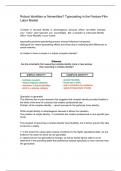
Robust Identities or Nonentities? Typecasting in the Feature‐Film
Labor Market
A simple or focused identity is advantageous because others can better estimate
your “value” (and typecast you accordingly). But a complex or unfocused identity
offers more flexibility in your career.
typecasting process typecasting process among Hollywood composers.
distinguish be- tween typecasting effects and those due to underlying skill differences or
social networks.
Is it better to have a simple or a robust (complex) identity?
Specialist vs generalist
This dilemma lies in past research that suggests that complex identity provides flexibity in
the kinds of the level of contracts that creative professional see.
Problem of the complex identity : cannot succeed in the particular focus identity.
While simple identity is advantageous because it allows the valuation.
The problem of simple identity ; it constraints the creative professional to one specific type
of job.
The prospect of assuming a complex identity have flexibility, but 2 factors prevent the idea
to become a reality.
1: to the extent the values tasks require investment in the highly specialized skills, we are
limited in the extent to which we are generalist.
2: opportunity for true generalist to emerge, we will be limited where skills is out to
determine in the prevailing belief that preference towards specificity is more common than
the generalism.
,By looking at the career path, at the advanced career point of actor, the specialized role
would hinder the value.
The question of specialist vs generalist turns on whether one as the established one sell
be on the point that the complex identity is construed as no identity at all.
Key terminologies
Role theory:
individual identity might not be fully encapsulated in an role. role distance describes the
extent to which an actor’s identity is confined to a role
Labeling theory :
individual receives a particular identity tag, might not be able to be inconsistent with he
attribution identity tag restricts an actor’s ability to move in a way that is inconsistent with
the attribution.
self-fulfilling prophecy
the application of an (negative) identity tag to an individual
Neo-institutional theory
Creative professionals will span multiple categories and have complex identity might
receive less attention but also they risk rejection.
defying prevailing socio-cognitive frames risks sowing confusion among relevant
audiences
Niche width theory
suggests that a generalist identity is advantageous in a volatile environment yet
disadvantageous in stable markets
Resource partitioning theory
support the coexistence of both generalists and specialists
typecasting
typically understood to involve a curtailment of the opportunities avail- able to job
candidates based either on social attributes such as gender and age or on past work.
two seemingly incompatible claims about identity: (a ) complex, multivalent identities are
advantageous be- cause they afford greater flexibility versus (b) simple, focused identities
are advantageous because they facilitate valuation.
Robust identity
, The influential notion of “robust action” suggests that assuming a narrowly defined identity
is problematic because it lowers an actor’s freedom of action
actors who could potentially be associated with multiple roles or groups retain flexibility in
responding to interactants whose more narrowly defined identities induce commitments to
restricted lines of action.
● role theory
○ identity is not fully encapsulated in the role
● labeling theory
○ self-fulfilling prophecy restricts his ability to act in a way that is inconsistent with
that attribution.
○ successful avoidance of a label means that one may potentially be accepted in
other (positively valued) roles
Whereas simple identities introduce constraints on future courses of action, complex
identities entail greater flexibility and therefore seem preferable.
But this conclusion runs counter to theories that analyze the sources of order in markets
and organizational fields.
Specific identity
Neo-institutionalism
actor who defies prevailing socio-cognitive frames risks sowing confusion among relevant
audiences, thereby producing social penalties in the form of lack of attention or outright
rejection
By trying to broaden their identity to include multiple and diverse roles, actors thus risk
being devalued and even rejected. As such, it might be preferable to assume a simple,
focused identity.
Reconciling the contradicting views…
There are several ways
1. Recognizing that the relative stability of a role or classificatory structure accounts for
differences in the relationship between complexity and success.
1. Niche width theory
1. identifying environments that support the coexistence of both generalists and specialists,
1. resource partitioning theory
Yet such models are less useful for elucidating the tensions in identity construction
outlined above because they treat the assignment of actors to generalist and specialist
roles as unproblematic.
Labor Market
A simple or focused identity is advantageous because others can better estimate
your “value” (and typecast you accordingly). But a complex or unfocused identity
offers more flexibility in your career.
typecasting process typecasting process among Hollywood composers.
distinguish be- tween typecasting effects and those due to underlying skill differences or
social networks.
Is it better to have a simple or a robust (complex) identity?
Specialist vs generalist
This dilemma lies in past research that suggests that complex identity provides flexibity in
the kinds of the level of contracts that creative professional see.
Problem of the complex identity : cannot succeed in the particular focus identity.
While simple identity is advantageous because it allows the valuation.
The problem of simple identity ; it constraints the creative professional to one specific type
of job.
The prospect of assuming a complex identity have flexibility, but 2 factors prevent the idea
to become a reality.
1: to the extent the values tasks require investment in the highly specialized skills, we are
limited in the extent to which we are generalist.
2: opportunity for true generalist to emerge, we will be limited where skills is out to
determine in the prevailing belief that preference towards specificity is more common than
the generalism.
,By looking at the career path, at the advanced career point of actor, the specialized role
would hinder the value.
The question of specialist vs generalist turns on whether one as the established one sell
be on the point that the complex identity is construed as no identity at all.
Key terminologies
Role theory:
individual identity might not be fully encapsulated in an role. role distance describes the
extent to which an actor’s identity is confined to a role
Labeling theory :
individual receives a particular identity tag, might not be able to be inconsistent with he
attribution identity tag restricts an actor’s ability to move in a way that is inconsistent with
the attribution.
self-fulfilling prophecy
the application of an (negative) identity tag to an individual
Neo-institutional theory
Creative professionals will span multiple categories and have complex identity might
receive less attention but also they risk rejection.
defying prevailing socio-cognitive frames risks sowing confusion among relevant
audiences
Niche width theory
suggests that a generalist identity is advantageous in a volatile environment yet
disadvantageous in stable markets
Resource partitioning theory
support the coexistence of both generalists and specialists
typecasting
typically understood to involve a curtailment of the opportunities avail- able to job
candidates based either on social attributes such as gender and age or on past work.
two seemingly incompatible claims about identity: (a ) complex, multivalent identities are
advantageous be- cause they afford greater flexibility versus (b) simple, focused identities
are advantageous because they facilitate valuation.
Robust identity
, The influential notion of “robust action” suggests that assuming a narrowly defined identity
is problematic because it lowers an actor’s freedom of action
actors who could potentially be associated with multiple roles or groups retain flexibility in
responding to interactants whose more narrowly defined identities induce commitments to
restricted lines of action.
● role theory
○ identity is not fully encapsulated in the role
● labeling theory
○ self-fulfilling prophecy restricts his ability to act in a way that is inconsistent with
that attribution.
○ successful avoidance of a label means that one may potentially be accepted in
other (positively valued) roles
Whereas simple identities introduce constraints on future courses of action, complex
identities entail greater flexibility and therefore seem preferable.
But this conclusion runs counter to theories that analyze the sources of order in markets
and organizational fields.
Specific identity
Neo-institutionalism
actor who defies prevailing socio-cognitive frames risks sowing confusion among relevant
audiences, thereby producing social penalties in the form of lack of attention or outright
rejection
By trying to broaden their identity to include multiple and diverse roles, actors thus risk
being devalued and even rejected. As such, it might be preferable to assume a simple,
focused identity.
Reconciling the contradicting views…
There are several ways
1. Recognizing that the relative stability of a role or classificatory structure accounts for
differences in the relationship between complexity and success.
1. Niche width theory
1. identifying environments that support the coexistence of both generalists and specialists,
1. resource partitioning theory
Yet such models are less useful for elucidating the tensions in identity construction
outlined above because they treat the assignment of actors to generalist and specialist
roles as unproblematic.