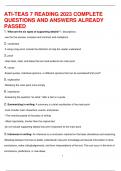
ATI-TEAS 7 READING 2023 COMPLETE QUESTIONS AND ANSWERS ALREADY PASSED
1. What are the six types of supporting details? 1. descriptions -use the five senses, compare and contrast, and metaphors 2. vocabulary -If using a big word, include the definition to help the reader understand 3. proof -Uses facts, stats, and dates that are hard evidence for main point 4. voices -Expert quotes, individual opinions, or different opinions that can be considered "soft proof" 5. explanation -Restating the main point more simply 6. importance -Answering the question "so what," after a fact or a quote 2. Summarizing in writing: A summary is a brief recollection of the main point -must include: main characters, events, and places --The overall purpose of the piece of writing --Most importantly, shorter than the original text -do not include supporting details that aren't important to the main point 3. Inferences in writing: An inference is a conclusion reached on the basis of evidence and reasoning. (Reading between the lines to better understand) Use prior knowledge and textual information to draw conclusions, make critical judgements, and form interpretations of the text. This can occur in the form of conclusions, predictions, or new ideas. Look for patterns or relationships in the text that might shed greater light on the subject. 4. Explicit and Implicit information: Explicit- something that is stated plainly -leaves no room for debate -useful in essays and reports, scientific and non-fiction writing because it is clear and unmistakable (when facts are given or used) Implicit- something that is implied and not stated directly -example: "all children grow up, except one." - Peter Pan -you aren't told exactly who that one child is but you can understand that Peter Pan is that one child that never did -used in fiction writing 5. Sequence: -sequence words: first, next, then, before -use context clues for words like until or finally, in advance -use sequence words to show the order of events taking place -sequence words are words that tell you when something did or will happen 6. Fact or Opinion: Fact - a statement that can be proven to be true by the use of evidence. Factual statements are true in all cases and for all people; facts are universal. Opinion - are neither true nor false. An opinion can express a belief, attitude, value, judgment, or feeling. Opinions can be masked as facts in the form of predictions. Predictions are still considered an opinion since they cannot be verified in the present. Value or Judgement words often signal an opinion. Some examples are: best, great, beautiful, worst, terrible, bad, should, must, good, strangest, disgusting, wonderful, pretty, most, lovely The words should or ought, suggests a course of action or give advice; advise is not factual. 7. Bias and Stereotype: Stereotype - a preconceived sweeping conclusion about an individual or an entire group of people that can be either good or bad. -a problem: humans are not consistent enough to be always or never anything. -a stereotype is a logical fallacy Bias - a personal preference 8. Connotation and Denotation: Denotation - the literal or objective meaning of a word -the meaning of the word most widely agreed upon by scholars that is not based on personal experience Connotation - the literal and subjective meaning of a word along with the emotions associated with it. -subjective meaning of a word, or relative to an individual's experience Example: "shady" In the denotative meaning, this means the amount of sunlight is blocked out. In the connotative meaning, the word possesses a negative connota- tion that implies slyness or sneakiness Example: "unique" In the denotative meaning, unique means for something or someone to be original, to stand out from the norm, or one of a kind. In this case, unique would have an arguably positive connotation; most people like to stand out, and that's not a bad thing. On the other hand, unique could be used in
Información del documento
- Subido en
- 2 de julio de 2023
- Número de páginas
- 17
- Escrito en
- 2022/2023
- Tipo
- Examen
- Contiene
- Preguntas y respuestas