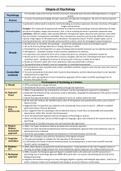
Origins of Psychology
The scientific study of the human mind & its functions, especially those functions affecting behaviour in a given
Psychology context
A means of acquiring knowledge through systematic and objective investigation. The aim is to discover general
Science laws.
A systematic method used to study the mind by breaking up conscious awareness into basic structures of thoughts,
images and sensations
Strengths: first systematic & experimental method to study the mind by breaking conscious awareness into basic
Introspection structure of thoughts, images and sensations. Also, it led to studying the mind in controlled, systematic ways
Limitations: different subjects often provide different introspective reports about the same stimulus, even when
they are trained in introspection (unreliable). Also, introspection cannot be used to study children/ animals as it
requires a high degree of self-awareness & articulation. Introspection doesn’t involve complex topics such as
learning development, mental disorders and personality so these cannot be investigated using introspection
• Wundt known as ‘the father of psychology’ – moved from philosophical roots to controlled research
• Set up the first psychology laboratory in Leipzig, Germany in 1870s
• Promoted the use of introspection as a way of studying internal mental processes e.g. by cognitive psychologists.
• Introspection – systematic analysis of own conscious experience of a stimulus
Wundt
• An experience was analysed in terms of its components parts e.g. sensations, emotional reaction etc.
• Wundt and his co-workers recorded their conscious thoughts, with the aim of breaking these down into their
constituent parts - Isolating the structure of consciousness in this way is called structuralism
• People are trained to report their inner experiences when presented with a stimulus
• This would be done in Wundt’s room at a university in a controlled environment
• All introspections were recorded under strictly controlled conditions using the same stimulus every time (such as
a ticking metronome)
Controlled • The same standardised instructions were issued to all participants, and this allowed procedures to be repeated
methods (replicated) every single time
• Wundt’s work was significant in that it marked the separation of the modern scientific psychology from its
broader philosophical roots
The Emergence of Psychology as a Science
1) Wundt • 1879 psychology lab, Leipzig, Germany
• Standardised instructions/ controlled conditions through lab experiment
• 1900s: Freud published ‘The interpretation of dreams’ and the psychodynamic approach is established
2) Sigmund • Emphasise the influence of the unconscious mind on behaviour, alongside the development of his person-centred
Freud therapy; psychoanalysis
• Argued that physical problems could be explained in terms of conflicts within the mind
• By the early 20th century, the scientific status/ value of introspection was questioned by many, such as John B.
Watson (1913)
• Suggested that introspection was subjective and varied greatly from person to person – difficult to establish
3) Watson &
Early general principles of human behaviour
Behaviourists • Also, suggested that for psychology to be considered a science, it must focus on observable and measurable
phenomenon rather than ‘private’ mental processes
• Led to the behaviourist approach and the emergence of Psychology as science
• Watson (19130 and later, Skinner (1953) brought the language, rigour and methods of the natural sciences into
psychology
• They focused on scientific processes and used controlled lab experiments
4) Rogers/ • 1950s: Carl Rogers & Abraham Maslow developed the humanistic approach
Maslow: • Rejects the views favoured by behaviourism and the psychodynamic approach that human behaviour was not
humanistic determined by the individual
approach • Humanistic psychologists emphasise the importance of self-determination and free will
• 1960s: this revolution came with the introduction of the digital computer
5) Cognitive • This gave psychologists a metaphor for the operation of the human mind
revolution • It reintroduces the study of internal mental processes to psychology but in a much more scientific way that
Wundt’s earlier investigations
6) Bandura: • 1960s: Albert Bandura proposed the social learning theory – draws attention to the role of cognitive factors in
SLT learning, providing a bridge between the newly established cognitive approach and traditional behaviourism
• 1980s onwards: the biological approach began to establish itself as the dominant scientific perspective in
7) Biological psychology due to technology advances (fMRI/ EEG) which led to increased understanding of the brain & the
approach biological processes
• Cognitive neuroscience emerges as a way of bringing together cognitive and biological approaches – built on he
earlier computer models and investigates how biological structures influence mental states.
The scientific study of the human mind & its functions, especially those functions affecting behaviour in a given
Psychology context
A means of acquiring knowledge through systematic and objective investigation. The aim is to discover general
Science laws.
A systematic method used to study the mind by breaking up conscious awareness into basic structures of thoughts,
images and sensations
Strengths: first systematic & experimental method to study the mind by breaking conscious awareness into basic
Introspection structure of thoughts, images and sensations. Also, it led to studying the mind in controlled, systematic ways
Limitations: different subjects often provide different introspective reports about the same stimulus, even when
they are trained in introspection (unreliable). Also, introspection cannot be used to study children/ animals as it
requires a high degree of self-awareness & articulation. Introspection doesn’t involve complex topics such as
learning development, mental disorders and personality so these cannot be investigated using introspection
• Wundt known as ‘the father of psychology’ – moved from philosophical roots to controlled research
• Set up the first psychology laboratory in Leipzig, Germany in 1870s
• Promoted the use of introspection as a way of studying internal mental processes e.g. by cognitive psychologists.
• Introspection – systematic analysis of own conscious experience of a stimulus
Wundt
• An experience was analysed in terms of its components parts e.g. sensations, emotional reaction etc.
• Wundt and his co-workers recorded their conscious thoughts, with the aim of breaking these down into their
constituent parts - Isolating the structure of consciousness in this way is called structuralism
• People are trained to report their inner experiences when presented with a stimulus
• This would be done in Wundt’s room at a university in a controlled environment
• All introspections were recorded under strictly controlled conditions using the same stimulus every time (such as
a ticking metronome)
Controlled • The same standardised instructions were issued to all participants, and this allowed procedures to be repeated
methods (replicated) every single time
• Wundt’s work was significant in that it marked the separation of the modern scientific psychology from its
broader philosophical roots
The Emergence of Psychology as a Science
1) Wundt • 1879 psychology lab, Leipzig, Germany
• Standardised instructions/ controlled conditions through lab experiment
• 1900s: Freud published ‘The interpretation of dreams’ and the psychodynamic approach is established
2) Sigmund • Emphasise the influence of the unconscious mind on behaviour, alongside the development of his person-centred
Freud therapy; psychoanalysis
• Argued that physical problems could be explained in terms of conflicts within the mind
• By the early 20th century, the scientific status/ value of introspection was questioned by many, such as John B.
Watson (1913)
• Suggested that introspection was subjective and varied greatly from person to person – difficult to establish
3) Watson &
Early general principles of human behaviour
Behaviourists • Also, suggested that for psychology to be considered a science, it must focus on observable and measurable
phenomenon rather than ‘private’ mental processes
• Led to the behaviourist approach and the emergence of Psychology as science
• Watson (19130 and later, Skinner (1953) brought the language, rigour and methods of the natural sciences into
psychology
• They focused on scientific processes and used controlled lab experiments
4) Rogers/ • 1950s: Carl Rogers & Abraham Maslow developed the humanistic approach
Maslow: • Rejects the views favoured by behaviourism and the psychodynamic approach that human behaviour was not
humanistic determined by the individual
approach • Humanistic psychologists emphasise the importance of self-determination and free will
• 1960s: this revolution came with the introduction of the digital computer
5) Cognitive • This gave psychologists a metaphor for the operation of the human mind
revolution • It reintroduces the study of internal mental processes to psychology but in a much more scientific way that
Wundt’s earlier investigations
6) Bandura: • 1960s: Albert Bandura proposed the social learning theory – draws attention to the role of cognitive factors in
SLT learning, providing a bridge between the newly established cognitive approach and traditional behaviourism
• 1980s onwards: the biological approach began to establish itself as the dominant scientific perspective in
7) Biological psychology due to technology advances (fMRI/ EEG) which led to increased understanding of the brain & the
approach biological processes
• Cognitive neuroscience emerges as a way of bringing together cognitive and biological approaches – built on he
earlier computer models and investigates how biological structures influence mental states.