100% de satisfacción garantizada Inmediatamente disponible después del pago Tanto en línea como en PDF No estas atado a nada 4,6 TrustPilot
logo-home
Ensayo

P1, P2, P3, M1, D1 - Investigating the Travel and Tourism Sector

Puntuación
3.2
(13)
Vendido
16
Páginas
12
Subido en
23-02-2017
Escrito en
2016/2017

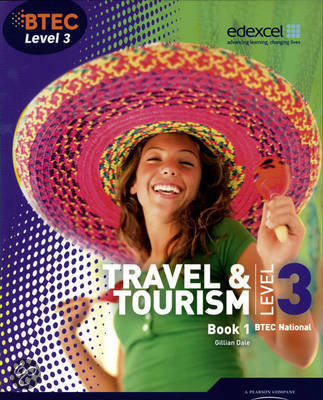
BTEC Travel and Tourism Level 3 - Unit 1 - Investigating the Travel and Tourism Sector. For P1, learners need to describe all of the travel and tourism component industries and identify one named organisation within each. Learners should ensure that they include all the items in brackets, eg transport provision (road, rail, sea, air). Learners should demonstrate knowledge of the nature of domestic, inbound and outbound tourism by ensuring that across all the named organisations they have included all three types of tourism. It is required that learners include a short definition of the different types of tourism within their evidence for P1. The examples they select, such as a named tour operator or a named travel agent, will need to be appropriate. Note that the criterion requires learners to ‘describe’ each of the component industries and ‘identify’ the organisations within them. Methods of assessment could involve learners in putting on a travel trade fair, making presentations, producing displays or an information file. It is not necessary to provide examples of each type of tourism for each of the component industries; it is sufficient to provide examples of each type of tourism across all the component industries. Edexcel BTEC Level 3 Nationals specification in Travel and Tourism – Issue 1 – June 2010 © Edexcel Limited 2010 10 Within P2, roles should be covered according to the unit content: to meet key organisational aims, to provide products and services, to be responsible to stakeholders, to be environmentally and ethically responsible, to contribute to international and UK economies. Learners should select three organisations each from a different component industry. At least one of these should be a medium to large organisation to enable learners to fully cover the range within the content. Descriptions should be comprehensive, covering all of the key roles of the organisations, summarised in the learner’s own words. For P3, learners need to review the different types of interrelationships, ie chains of distribution (how travel products are distributed through the levels), integration (including both horizontal and vertical) and interdependencies (how different organisations rely on each other, eg a tour operator has to contract rooms from a hotel). Learners can use a variety of diagrams to illustrate their review and should include relevant and up-to-date examples of each aspect of interrelation. To meet M1, the learner should select a minimum of two organisations, preferably each in a different component industry. The explanation needs to be detailed, showing a progression in understanding from the more basic description at pass level. Examples should be carefully selected for their relevance and in particular to provide sufficient coverage of all items in the range for roles and interrelationships; to do this it is expected that at least one of the organisations would be a medium to large company. Care should be taken if selecting one of the large integrated multinational companies, eg TUI Travel Group, as these organisations are complex. If learners select a large multinational company they should focus their evidence on the UK part of the company. For D1, learners can select one organisation. The work has to be analytical and it is important that the selected organisation will provide sufficient coverage of all aspects of interrelationships. For example, a large tour operator could have complex chains of distribution that may involve many levels, ie sales directly to the customer through their own call centres, via their own website, sales indirectly to customers via high street retail agents, via web-based agents. The tour operator may be integrated horizontally and vertically and they will have certain interdependencies such as retail travel agents, principals (flights and accommodation) and excursion providers. Learners will need to explore all these aspects of interrelationship and analyse their importance to the selected organisation and to the other organisations involved. All the criterias included.

Mostrar más Leer menos
Institución
Grado


Ups! No podemos cargar tu documento ahora. Inténtalo de nuevo o contacta con soporte.

Libro relacionado

Escuela, estudio y materia

Nivel de Estudio
Editores
Tema
Curso

Información del documento

Subido en
23 de febrero de 2017
Número de páginas
12
Escrito en
2016/2017
Tipo
Ensayo
Profesor(es)
Desconocido
Grado
Desconocido

Temas

Vista previa del contenido

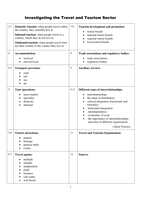
Investigating the Travel and Tourism Sector

2-3 Domestic tourism: when people travel within 7-8 Tourism development and promotion:
the country, they currently live at
 tourist boards
Inbound tourism: when people travel to a  national tourist boards
country, which they do not live in  regional tourist boards
Outbound tourism: when people travel from  local tourist boards
not their country to the country they live at

4 Accommodation: 8 Trade associations and regulatory bodies:
 serviced  trade associations
 non-serviced  regulatory bodies

4-5 Transport provision: 9 Ancillary services
 road
 rail
 sea
 air

5 Tour operations: 9-11 Different types of interrelationships:
 mass-market  interrelationships
 specialist  the chain of distribution
 domestic  vertical integration (backwards and
 inbound forwards)
 horizontal integration
 interdependency
 economies of scale
 the importance of interrelationships
and roles of different organisations
(Alton Towers)

5-6 Tourist attractions: 11 Travel and Tourism Organisations
 natural
 heritage
 purpose-built
 events

6-7 Travel agents: 12 Sources
 multiple
 miniple
 independent
 retail
 business
 call centre
 web-based

1
$13.39
Accede al documento completo:
Comprado por 16 estudiantes

100% de satisfacción garantizada
Inmediatamente disponible después del pago
Tanto en línea como en PDF
No estas atado a nada


Documento también disponible en un lote

Reseñas de compradores verificados

Se muestran 7 de 13 comentarios
4 año hace

this isnt was it says it was. this work will not help in any way. ive tried to file for a refund but it has failed

6 año hace

7 año hace

7 año hace

Thank you so much:)

7 año hace

7 año hace

7 año hace

Hey, this work has achieved all the criteria marked by real examiners. What was your problem?

7 año hace

7 año hace

Thank you so much for your positive feedback:)

7 año hace

7 año hace

Thank you for your feedback:)

3.2

13 reseñas

5
5
4
2
3
0
2
2
1
4
Reseñas confiables sobre Stuvia

Todas las reseñas las realizan usuarios reales de Stuvia después de compras verificadas.

Conoce al vendedor

Seller avatar
Los indicadores de reputación están sujetos a la cantidad de artículos vendidos por una tarifa y las reseñas que ha recibido por esos documentos. Hay tres niveles: Bronce, Plata y Oro. Cuanto mayor reputación, más podrás confiar en la calidad del trabajo del vendedor.
Lisa66 Pearson
Seguir Necesitas iniciar sesión para seguir a otros usuarios o asignaturas
Vendido
930
Miembro desde
8 año
Número de seguidores
516
Documentos
113
Última venta
1 año hace

3.5

365 reseñas

5
110
4
107
3
52
2
34
1
62

Por qué los estudiantes eligen Stuvia

Creado por compañeros estudiantes, verificado por reseñas

Calidad en la que puedes confiar: escrito por estudiantes que aprobaron y evaluado por otros que han usado estos resúmenes.

¿No estás satisfecho? Elige otro documento

¡No te preocupes! Puedes elegir directamente otro documento que se ajuste mejor a lo que buscas.

Paga como quieras, empieza a estudiar al instante

Sin suscripción, sin compromisos. Paga como estés acostumbrado con tarjeta de crédito y descarga tu documento PDF inmediatamente.

Student with book image

“Comprado, descargado y aprobado. Así de fácil puede ser.”

Alisha Student

Preguntas frecuentes