Topic 1.6: Bonding
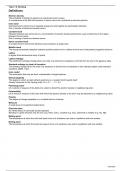
Definitions
Electron density
The probability of finding an electron at a particular point in space
A consequence of the fact that electrons in atoms cannot be considered as discrete particles
Ionic bond
Chemical bond in which ions of opposite charge are held together by electrostatic attraction
Due to transfer of electrons between atoms
Covalent bond
Attraction between two atoms due to a concentration of electron density (arising from a pair of electrons) in the region
between the two atoms
Due to sharing of electrons between atoms
Dative covalent bond
A covalent bond in which both electrons are provided by a single atom
Metallic bond
The strong electrostatic attraction between (positive) metal ions in a lattice and the sea of delocalised (negative) electrons
Lattice
A regular three-dimensional array of points
Lattice enthalpy
The exothermic enthalpy change when one mole of a solid (ionic) substance is formed from its ions in the gaseous state
Standard enthalpy (or heat) of formation
The enthalpy change when one mole of a substance is formed from its elements in their standard states under standard
conditions (298K, 1atm)
Ionic model
The assumption that ions are hard, unpolarisable, charged spheres
Electronegativity
The degree to which an atom attracts electrons in a covalent bond towards itself
Usually measured on the Pauling scale: Cs = 0.7 … F = 4.0
Polarising power
(of a cation) A measure of the ability of a cation to distort the electron density in neighbouring anion
Polarisability
(of an anion) A measure of the ease with which the electron density of an anion may be distorted by a neighbouring cation
Polarity
The degree of charge separation in a covalent bond or molecule
Molecule
A small group of covalently bonded atoms
Giant structure
An infinite lattice of chemically bonded particles
Bonding in a giant structure may be ionic (e.g. NaCl, CaF2), covalent (e.g. SiO2, diamond) or metallic (e.g. Na, Mg)
Melting point
The temperature at which the solid and liquid forms of a substance can exist in equilibrium with one another
Boiling point
The temperature at which the liquid and vapour forms of a substance can exist in equilibrium with one another
19/05/2009
Definitions
Electron density
The probability of finding an electron at a particular point in space
A consequence of the fact that electrons in atoms cannot be considered as discrete particles
Ionic bond
Chemical bond in which ions of opposite charge are held together by electrostatic attraction
Due to transfer of electrons between atoms
Covalent bond
Attraction between two atoms due to a concentration of electron density (arising from a pair of electrons) in the region
between the two atoms
Due to sharing of electrons between atoms
Dative covalent bond
A covalent bond in which both electrons are provided by a single atom
Metallic bond
The strong electrostatic attraction between (positive) metal ions in a lattice and the sea of delocalised (negative) electrons
Lattice
A regular three-dimensional array of points
Lattice enthalpy
The exothermic enthalpy change when one mole of a solid (ionic) substance is formed from its ions in the gaseous state
Standard enthalpy (or heat) of formation
The enthalpy change when one mole of a substance is formed from its elements in their standard states under standard
conditions (298K, 1atm)
Ionic model
The assumption that ions are hard, unpolarisable, charged spheres
Electronegativity
The degree to which an atom attracts electrons in a covalent bond towards itself
Usually measured on the Pauling scale: Cs = 0.7 … F = 4.0
Polarising power
(of a cation) A measure of the ability of a cation to distort the electron density in neighbouring anion
Polarisability
(of an anion) A measure of the ease with which the electron density of an anion may be distorted by a neighbouring cation
Polarity
The degree of charge separation in a covalent bond or molecule
Molecule
A small group of covalently bonded atoms
Giant structure
An infinite lattice of chemically bonded particles
Bonding in a giant structure may be ionic (e.g. NaCl, CaF2), covalent (e.g. SiO2, diamond) or metallic (e.g. Na, Mg)
Melting point
The temperature at which the solid and liquid forms of a substance can exist in equilibrium with one another
Boiling point
The temperature at which the liquid and vapour forms of a substance can exist in equilibrium with one another
19/05/2009