Furr, & Bacharach (2014) – Psychometrics An introduction
Chapter 4 – Test Dimensionality and Factor Analysis
Test dimensionality
- When measuring physical/psychological attribute, we intend to measure a single
attribute of object/person (e.g., just measuring weight shouldn’t be affected by hair
length).
- If not to single attribute: total score no clear reference, thus wouldn’t have clear
meaning.
- Composite scores: include different item responses reflecting the same psychological
attribute ideally reflects only 1 dimensions. BUT: test may include items that reflect
> 1 dimension.
- 3 dimensionality questions: have important implications for evaluating psychometric
properties of behavioural tests, for appropriately scoring on test + for proper
interpretation of test scores.
1. How many dimensions are reflected in test items?
2. If a test has >1 dimension, then are those dimensions correlated with each
other?
3. If a test has >1 dimension, then what are those dimensions? What psychological
attributes are reflected by test dimensions? Important to know psychological
meaning when interpreting dimension.
- Unidimensional tests: psychological test includes items that reflect only single
attribute of person responses to those items are driven only by that attribute (e.g.,
MC test measuring knowledge of geometry).
o Items have property of conceptual homogeneity: responses to each item are
function of same psychological attribute.
o All items are combined to form composite/total score.
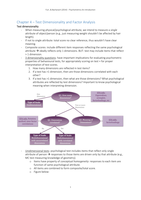
o Figure below:
1
Chapter 4 – Test Dimensionality and Factor Analysis
Test dimensionality
- When measuring physical/psychological attribute, we intend to measure a single
attribute of object/person (e.g., just measuring weight shouldn’t be affected by hair
length).
- If not to single attribute: total score no clear reference, thus wouldn’t have clear
meaning.
- Composite scores: include different item responses reflecting the same psychological
attribute ideally reflects only 1 dimensions. BUT: test may include items that reflect
> 1 dimension.
- 3 dimensionality questions: have important implications for evaluating psychometric
properties of behavioural tests, for appropriately scoring on test + for proper
interpretation of test scores.
1. How many dimensions are reflected in test items?
2. If a test has >1 dimension, then are those dimensions correlated with each
other?
3. If a test has >1 dimension, then what are those dimensions? What psychological
attributes are reflected by test dimensions? Important to know psychological
meaning when interpreting dimension.
- Unidimensional tests: psychological test includes items that reflect only single
attribute of person responses to those items are driven only by that attribute (e.g.,
MC test measuring knowledge of geometry).
o Items have property of conceptual homogeneity: responses to each item are
function of same psychological attribute.
o All items are combined to form composite/total score.
o Figure below:
1