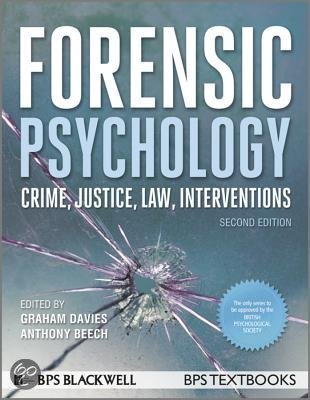
FORENSIC PSYCHOLOGY CRIME – JUSTICE – LAW – INTERVENTIONS
PART I THE CAUSES OF CRIME
1. PSYCHOLOGICAL APPROACHES TO UNDERSTANDING CRIME
There are a number of other disciplines that can contribute to our understanding of crime,
including sociology, philosophy, medicine, biological sciences, and law.
PSYCHOLOGICAL THEORIES
MORAL REASONING THEORY
Moral reasoning ; how individuals reason about and justify their behaviour with respect
to moral issues.
Most well-known approach is the cognitive-developmental approach initially
proposed by Piaget and subsequently developed by Kohlberg
Kohlberg’s theory is composed of six stages of moral reasoning through which
individuals progress, with reasoning becoming more abstract and complex
This theory has been revised by Gibbs into a theory of ‘sociomoral reasoning’
in which the roles of social perspective-taking and empathy are given a greater
emphasis
Gibbs’ stages of sociomoral reasoning :
1. Immature moral reasoning unilateral and physicalistic : powerful authority
figures and the physical consequences of behaviour
Offending is morally justified if punishment van be avoided
2. Immature moral reasoning exchanging and instrumental : a basic understanding
of social interaction
Offending is morally justified if the benefits to the individual outweigh the
costs
------ reasoning is superficial and egocentric
3. Mature moral reasoning mutual and prosocial : understanding of interpersonal
relationships and other people’s needs
Offending is morally justified if it maintains personal relationships
4. Mature moral reasoning systemic and standard : understanding of complex
social systems, basic rights and values
Offending is morally justified if it maintain society or is sanctioned by a social
institution
Although offending can be justified at all stages, the circumstances in which it usually occurs
reflects moral reasoning at the less mature stages.
Gibbs has also investigated the role of cognitive distortions in the relationship between moral
reasoning and offending. The main offence-supporting distortion is egocentric bias, which is
both characteristic of immature moral reasoning and the thinking styles of offenders.
Secondary cognitive distortions are:
Hostile attributional bias (by which ambiguous events or social interactions are
interpreted as hostile)
Blaming others or external factors
PART I THE CAUSES OF CRIME
1. PSYCHOLOGICAL APPROACHES TO UNDERSTANDING CRIME
There are a number of other disciplines that can contribute to our understanding of crime,
including sociology, philosophy, medicine, biological sciences, and law.
PSYCHOLOGICAL THEORIES
MORAL REASONING THEORY
Moral reasoning ; how individuals reason about and justify their behaviour with respect
to moral issues.
Most well-known approach is the cognitive-developmental approach initially
proposed by Piaget and subsequently developed by Kohlberg
Kohlberg’s theory is composed of six stages of moral reasoning through which
individuals progress, with reasoning becoming more abstract and complex
This theory has been revised by Gibbs into a theory of ‘sociomoral reasoning’
in which the roles of social perspective-taking and empathy are given a greater
emphasis
Gibbs’ stages of sociomoral reasoning :
1. Immature moral reasoning unilateral and physicalistic : powerful authority
figures and the physical consequences of behaviour
Offending is morally justified if punishment van be avoided
2. Immature moral reasoning exchanging and instrumental : a basic understanding
of social interaction
Offending is morally justified if the benefits to the individual outweigh the
costs
------ reasoning is superficial and egocentric
3. Mature moral reasoning mutual and prosocial : understanding of interpersonal
relationships and other people’s needs
Offending is morally justified if it maintains personal relationships
4. Mature moral reasoning systemic and standard : understanding of complex
social systems, basic rights and values
Offending is morally justified if it maintain society or is sanctioned by a social
institution
Although offending can be justified at all stages, the circumstances in which it usually occurs
reflects moral reasoning at the less mature stages.
Gibbs has also investigated the role of cognitive distortions in the relationship between moral
reasoning and offending. The main offence-supporting distortion is egocentric bias, which is
both characteristic of immature moral reasoning and the thinking styles of offenders.
Secondary cognitive distortions are:
Hostile attributional bias (by which ambiguous events or social interactions are
interpreted as hostile)
Blaming others or external factors