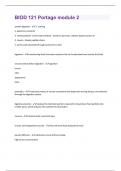
BIOD 121 Portage module 2 Questions and Answers with complete solution
BIOD 121 Portage module 2 protein digestion - 1. cooking 2. pepsin (in stomach) 3. cholecystokinin -CCK (small intestine) - travels to pancreas, releases trypsin back to SI 4. trypsin - breaks peptide chains 5. amino acids absorbed through portal vein to liver digestion - transforming food into basic nutrients that can be absorbed and used by the body sensory stimuli before digestion - cognition sound odor appearance taste peristalsis - Involuntary waves of muscle contraction that keep food moving along in one direction through the digestive system. digestive enzymes - catalyze the chemical reactions required to break down food particles into smaller parts, which prepares the nutrients for absorption mucosa - intestinal wall, innermost layer circular and longitudinal muscles - mix and move food along the GI tract passive diffusion - substances move without energy high to low concentrationfacilitated diffusion - special protein carrier is required to help substances cross in or out of the cell high to low concentration active transport - requires energy low to high concentration GI tract 6 main parts - 1 - mouth 2 - esophagus 3 - stomach 4 - small intestine 5 - large intestine 6 - rectum GI tract accessory organs - salivary glands, liver, gallbladder, pancreas mouth - alter food particles for swallowing mechanical and chemical digestion saliva - mucus plus digestive enzymes mucus - lubricates food particles for swallowing salivary amylase - Enzyme in saliva that breaks down starch lingual lipase - a fat-splitting enzyme secreted by cells at the base of the tongue esophagus - transports food to the stomachepiglottis - a flap of cartilage that covers the trachea while swallowing sphincter muscle - circular muscle at the end of esophagus, prevents backflow of food stomach - 4 cup capacity holds food 2-4 hrs until ready to pass into the small intestine store, mix, dissolve, and continue the digestion of food gastric juice - The acidic secretion of the stomach prepares proteins for digestion and activates enzymes pepsin - An enzyme present in gastric juice that breaks down proteins gastric lipase - enzyme to digest fat chyme - Partially digested, semiliquid food mixed with digestive enzymes and acids in the stomach moves to small intestine over 1-4 hrs gastrin - hormone secreted in the stomach controls acidity, counteracted by mucus produced when we think about eating and during ingestion Intrinsic factor - vital glycoprotein produced in the stomach. In order for vitamin B-12 to be absorbed, intrinsic factor must be present. pyloric sphincter - Controls passage of food from stomach to small intestine small intestine - vast majority of all digestion and absorption of nutrients occurs hereapprox 20 ft long villi - Fingerlike extensions of the intestinal mucosa folds that increase the surface area for absorption liver - secretes bile, stored in gallbladder gallbladder - stores bile until hormones indicate fat in sm int released into the duodenum through the common bile duct pancreas - releases a mixture of water, bicarbonate, and enzymes called pancreatic juice that breaks down carbohydrates, protein, and fat protects intestinal wall from acid also glucagon/insulin ileocecal sphincter - the ring-like muscle that controls the flow from the ileum of the small intestine into the cecum of the large intestine large intestine - remaining water and certain minerals (sodium, potassium, and chloride) can be absorbed in the large intestine 5 feet long, 4 sections - ascending, transverse, descending, sigmoid feces - solid wastes; stool remains in rectum until pushed out controlled by two anal sphincters role of mucus in colon - holds the feces together protects the intestine from digestive bacteria heartburn - acid refluxoccurs when the stomach acid comes up the esophagus primary cause: weak esophageal sphincter eating smaller meals that are low in fat, chewing food well, avoiding overeating, and limiting coffee, tea, alcohol, and certain spices constipation - (feces) are hard, dry, and infrequent, and it is a result of slow movement through the large intestine change in diet/medication - lower calcium, iron, increase fiber (grains, fruit, veg, nuts) w/ water diarrhea - loose, watery, and frequent stools, usually results from an infection or a disease increased fluid consumption to prevent dehydration. A diet of broth, tea, toast, and low fiber foods should be consumed, as tolerated. Diverticulosis - pouches push out through weak spots in the colon, if food trapped > infection > diverticulitis increase fiber to reduce straining IBS - bloating, abdominal pain, cramps, diarrhea, and/or constipation frequent small meals, low fat meals, high fiber intake, probiotics, and avoiding foods that trigger symptoms. ulcers - sores that can occur in the stomach, lower esophagus, or small intestine can be caused by certain bacteria (i.e. H. Pylori) or meds like NSAIDs fructose - fruit sugar galactose - milk sugar sucrose - glucose + fructoselactose - glucose + galactose maltose - glucose + glucose rare in foods complex carbohydrates - polysaccharides (starches and fibers) starches: sources include vegetables, beans, breads, pasta, and rice glycogen: storage form of glucose fiber: can't be digested insoluble fiber (non-fermentable) - Does not dissolve in water Not broken down by intestinal bacteria increases stool mass speeds passage through the large intestine soluble fiber (viscous) - Dissolves in water Broken down by intestinal bacteria Slows glucose absorption and can lower cholesterol Provides satiety to a meal functional fiber - Fiber that is added to a product Promotes intestinal health monosaccharide digestion - actively absorbed carrier protein as well as energy is required to absorb the nutrients from the small intestine into the cells fructose = facilitated absorption transported to the liver and either released as glucose into the blood stream, stored as glycogen for later use, or used for fat productionamylase - Enzyme in saliva that breaks the chemical bonds in polysaccharides to disaccharides carbohydrate functions - energy (brain/CNS can use fat too) protein sparing gluconeogenesis - The formation of glucose from noncarbohydrate sources, such as amino acids. optimal blood glucose - 70 to 100 mg/dl insulin action - decrease blood sugar Liver: increase glucose stored as glycogen. Muscle: muscles, adipose tissue, and various cells absorb the glucose into their cells glucagon action - increases blood glucose stimulating liver to release stored glycogen type 1 diabetes - disorder in which the body cannot produce enough insulin excessive thirst, excessive urination and hunger, weight loss, and ketosis insulin therapy, diet changes, exercise type 2 diabetes - progressive disorder in which body cells become less responsive to insulin Diet changes, exercise, and oral medications excessive sugar intake - T2D, cavities, obesity, metabolic syndrome Metabolic Syndrome (Syndrome X) - 3 of 5 criteria: (1) obesity, (2) poor glucose control, (3) hypertension, (4) increased blood triglycerides, and (5) low HDL cholesterol levelsprotein functions - 1. Body structure 2. Maintaining fluid balance 3. Contribute to acid base balance (pH buffer) 4. Hormones and enzymes 5. Contribute to immune function (antibodies) 6. Provide energy and satiety nonessential amino acids - 11 amino acids that the body can synthesize essential amino acids - 9 Amino acids that are needed, but cannot be made by the body; they must be eaten in foods protein requirements - 0.8g/kg 10-35% of intake protein equilibrium - a state in which protein intake is equal to related protein losses; the person is said to be in protein balance positive protein balance - take in more protein than we lose (pregnancy, childhood, illness) anabolic state - growth, muscle building negative protein balance - illness, trauma, inadequate intake catabolic state - muscle wasting high-quality protein (complete) - animal sources contains ample amount of all 9 essential amino acids low-quality protein (incomplete) - plant sourcesdeficient or low in one or more essential amino acids complementary proteins - consuming two incomplete proteins to make a complete proteins Protein-calorie malnutrition - inadequate consumption of protein and energy, resulting in a gradual body wasting and increased susceptibility to infection Kwashiorkor - a severe protein deficiency as well as moderate energy or calorie deficiencies Edema-retaining fluids in the legs and abdomen Mild to moderate weight loss Growth impairment Rapid onset that occurs when a child is weaned from breast milk Fatty liver Listlessness, tired, change in hair and skin marasmus - severe protein AND calorie malnutrition Means to waste away in Greek. The child slowly starves to death Develops gradually Severe weight loss Wasting of muscle and body fat, a result of famine or another illness in addition to lack of food Skin and bones appearance Severe growth impairment vegetarian diet - lowered fat, saturated fat, and cholesterol intake, increased fiber intake reduced risk for heart disease, obesity, hypertension, and cancer lipids - Fatty acids, triglycerides, phospholipids, and sterols chain of carbons linked together and surrounded by hydrogen molecules one end acid group, other methyl groupsaturated fatty acid - single carbon bonds primarily animal fats solid at room temp monounsaturated fats - two missing H, one double C bond sources include canola oil and olive oil polyunsaturated fats - more than one double bond sources include corn, soybean, sunflower oil Omega-3 and -6 omega-3 fatty acids - alpha-linoleic acid; a type of "good" polyunsaturated fat that may decrease cardiovascular diseases double bond is located on the third carbon from the left side, the methyl (-CH3) end soybean, canola oil, walnuts, flaxseed oil, salmon, tuna, and mackerel omega-6 fatty acid - linoleic acid closest double bond to the methyl (CH3) end of the carbon chain is six carbons away vegetable oils - much easier to get than omega-3 trans unsaturated fatty acids - hydrogen atoms added to an unsaturated fatty acid, incomplete reaction produces partially hydrogenated fats > TUFA negative health risk, higher impact on raising cholesterol levels than saturated fats Triglycerides - glycerol plus 3 fatty acid. stored form of energy in adipose tissue provide insulation and protection carry fat soluble vitaminsimprove the taste of food. Phospholipids - a lipid consisting of a glycerol bound to two fatty acids and a phosphate group formation of cell membranes, are used to transport lipoproteins, and also act as emulsifiers Egg yolks, peanuts, liver, and soybeans sterols - hormones and cholesterol no glycerol backbone only found in animal foods liver makes all the cholesterol our body requires digestion of lipids - Starts in the mouth (lingual lipase), moves to stomach (lipase), completed in the small intestine In intestine fat interacts with bile to become emulsified so that pancreatic enzymes can break the triglycerides into two fatty acids and a monoglyceride absorbed through intestinal wall Lipoproteins - Protein-and-lipid substances in the blood that carry fats and cholesterol; classified according to size, density, and chemical composition chylomicrons - made in sm int mostly triglyceride transport dietary fat from the intestine to the cells and dietary cholesterol to the liver VLDL - made in liver mostly triglyceride, some cholesterol deliver fat made in liver to cells LDL - delivers cholesterol into cells ("bad")remnant of VLDL that forms in blood as it delivers its triglycerides mostly cholesterol, some triglyceride HDL - made in liver mostly triglyceride, some cholesterol picks up cholesterol accumulating in blood vessels ("good"); delivers cholesterol to liver and steroidogenic tissues; transfers apolipoproteins to other lipoproteins high LDL - atherosclerosis treatment: lower saturated, trans, cholesterol intake, increase fiber and omega-3 recommended fat intake - less than 30% (AHA), 20-35% (FNB) <7% saturated fats, <1% trans fats, <300mg cholesterol lifestyle recommendations - 1. Maintain a healthy weight. 2. Eat a diet high in fruits and vegetables. 3. Increase intake of whole grains and high fiber foods. 4. Limit foods and drinks with added sugars. 5. Prepare foods with little or no salt. 6. If you consume alcohol, do so in moderation. Carb diseases - Obesity, type 2 diabetes, cavities, metabolic syndrome Fat diseases - Heart disease, metabolic syndrome, certain cancers
Escuela, estudio y materia
- Institución
- BIOD 121 Portage module 2
- Grado
- BIOD 121 Portage module 2
Información del documento
- Subido en
- 25 de junio de 2023
- Número de páginas
- 12
- Escrito en
- 2022/2023
- Tipo
- Examen
- Contiene
- Preguntas y respuestas
Temas
-
biod 121 portage module 2

Documento también disponible en un lote