Chapter 11: Glycolysis
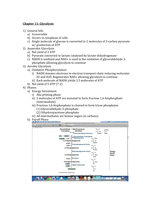
1) General Info
a) Irreversible
b) Occurs in cytoplasm of cells
c) Single molecule of glucose is converted to 2 molecules of 3-carbon pyruvate
w/ production of ATP
2) Anaerobic Glycolysis
a) Net yield of 2 ATP
b) Pyruvate converted to lactate catalyzed by lactate dehydrogenase
c) NADH is oxidized and NAD+ is used in the oxidation of glyceraldehyde 3-
phosphate allowing glycolysis to continue
3) Aerobic Glycolysis
a) Oxidative Phosphorylation
i) NADH donates electrons to electron transport chain reducing molecular
02 and H20. Regenerates NAD+ allowing glycolysis to continue
ii) Each molecule of NADH yields 2.5 molecules of ATP
b) Net yield of 5 ATP (7-2)
4) Phases
a) Energy Investment
i) Aka priming phase
ii) 2 molecules of ATP are invested to form fructose 1,6-bisphosphate
(intermediate)
iii) Fructose 1,6-bisphosphate is cleaved to form triose phosphates
(1) Glyceraldehyde-3-phosphate
(2) Dihydroxyacetone phosphate
iv) All intermediates are hexose sugars (6 carbons)
b) Payoff Phase
1) General Info
a) Irreversible
b) Occurs in cytoplasm of cells
c) Single molecule of glucose is converted to 2 molecules of 3-carbon pyruvate
w/ production of ATP
2) Anaerobic Glycolysis
a) Net yield of 2 ATP
b) Pyruvate converted to lactate catalyzed by lactate dehydrogenase
c) NADH is oxidized and NAD+ is used in the oxidation of glyceraldehyde 3-
phosphate allowing glycolysis to continue
3) Aerobic Glycolysis
a) Oxidative Phosphorylation
i) NADH donates electrons to electron transport chain reducing molecular
02 and H20. Regenerates NAD+ allowing glycolysis to continue
ii) Each molecule of NADH yields 2.5 molecules of ATP
b) Net yield of 5 ATP (7-2)
4) Phases
a) Energy Investment
i) Aka priming phase
ii) 2 molecules of ATP are invested to form fructose 1,6-bisphosphate
(intermediate)
iii) Fructose 1,6-bisphosphate is cleaved to form triose phosphates
(1) Glyceraldehyde-3-phosphate
(2) Dihydroxyacetone phosphate
iv) All intermediates are hexose sugars (6 carbons)
b) Payoff Phase