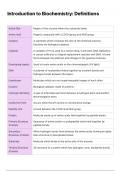
Introduction to Biochemistry: Definitions
Active Site Region of the enzyme where the substrate binds.
Amino Acid Organic compound with a COOH group and NH2 group.
Catalyst A substrate which increases the rate of the chemical reaction.
Enzymes are biological catalysts.
Cisplatin A complex of Pt (ii) used as a cancer drug. It prevents DNA replication
in cancer cells due to a ligand replacement reaction with DNA. A bond
forms between the platinum and nitrogen in the guanine molecule.
Developing Agents Used to locate amino acids on the chromatograph (UV light).
DNA A polymer of nucleotides linked together by covalent bonds and
hydrogen bonds between the bases.
Enantiomer Molecules which are non superimposable images of each other.
Enzyme Biological catalysts made of proteins.
Hydrogen Bonding A type of intermolecular force between a hydrogen atom and another
electronegative atom.
Isoelectric Point Occurs when the pH carries no net electrical charge.
Peptide Link A bond between the COOH and NH2 group.
Protein Molecule made up of amino acids held together by peptide bonds.
Primary Structure Sequence of amino acids in a polypeptide chain held together by
(Protein) peptide bonds.
Secondary When hydrogen bonds form between the amino acids forming an alpha
Structure (Protein) helix structure or beta pleated sheet.
Substrate Molecule which binds to the active site of the enzyme.
Tertiary Structure 3D structure of a protein which has hydrogen, ionic, disulphide bonds.
(Protein)
Active Site Region of the enzyme where the substrate binds.
Amino Acid Organic compound with a COOH group and NH2 group.
Catalyst A substrate which increases the rate of the chemical reaction.
Enzymes are biological catalysts.
Cisplatin A complex of Pt (ii) used as a cancer drug. It prevents DNA replication
in cancer cells due to a ligand replacement reaction with DNA. A bond
forms between the platinum and nitrogen in the guanine molecule.
Developing Agents Used to locate amino acids on the chromatograph (UV light).
DNA A polymer of nucleotides linked together by covalent bonds and
hydrogen bonds between the bases.
Enantiomer Molecules which are non superimposable images of each other.
Enzyme Biological catalysts made of proteins.
Hydrogen Bonding A type of intermolecular force between a hydrogen atom and another
electronegative atom.
Isoelectric Point Occurs when the pH carries no net electrical charge.
Peptide Link A bond between the COOH and NH2 group.
Protein Molecule made up of amino acids held together by peptide bonds.
Primary Structure Sequence of amino acids in a polypeptide chain held together by
(Protein) peptide bonds.
Secondary When hydrogen bonds form between the amino acids forming an alpha
Structure (Protein) helix structure or beta pleated sheet.
Substrate Molecule which binds to the active site of the enzyme.
Tertiary Structure 3D structure of a protein which has hydrogen, ionic, disulphide bonds.
(Protein)