Introduction to Acids/Bases and pH
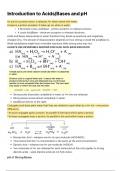
An acid is a proton donor. It releases H+ when mixed with water.
A base is a proton acceptor. It takes up H+ when in water.
A Bronsted-Lowry acid/base - proton acceptor or releases protons.
A Lewis Acid/Base - electrons acceptor or releases electrons.
Acids and bases disassociate in water therefore they break up positively and negatively
charged ions. The amount of disassociation depends on how strong or weak the acid/base is.
Weak acids/bases might have reversible reactions while strong ones may not.
ALWAYS USE REVERSIBLE ARROWS FOR EACH ACID-BASE EQUATION
Strong acids dissociate completely in water so H+ ions are released.
Strong bases ionise almost completely in water.
Equilibrium lies far to the right.
Conjugate acid-base pairs mean that they are related to each other by a H+ ion - one proton
difference.
The acid conjugate gains a proton. Its parallel is the base which gains a proton.
The base conjugate loses a proton. Its parallel is the acid which loses a proton.
Monoprotic Acid - releases one H+ ion per molecule (HCl/HNO3)
This means that the H+ concentration is the same as the acid concentration.
Diprotic Acid - releases two H+ per molecule (H2SO4)
Two molecules of H+ are released for each molecule but this only applies to strong
diprotic acids - weak diprotic acids do not fully ionise.
pH of Strong Bases
An acid is a proton donor. It releases H+ when mixed with water.
A base is a proton acceptor. It takes up H+ when in water.
A Bronsted-Lowry acid/base - proton acceptor or releases protons.
A Lewis Acid/Base - electrons acceptor or releases electrons.
Acids and bases disassociate in water therefore they break up positively and negatively
charged ions. The amount of disassociation depends on how strong or weak the acid/base is.
Weak acids/bases might have reversible reactions while strong ones may not.
ALWAYS USE REVERSIBLE ARROWS FOR EACH ACID-BASE EQUATION
Strong acids dissociate completely in water so H+ ions are released.
Strong bases ionise almost completely in water.
Equilibrium lies far to the right.
Conjugate acid-base pairs mean that they are related to each other by a H+ ion - one proton
difference.
The acid conjugate gains a proton. Its parallel is the base which gains a proton.
The base conjugate loses a proton. Its parallel is the acid which loses a proton.
Monoprotic Acid - releases one H+ ion per molecule (HCl/HNO3)
This means that the H+ concentration is the same as the acid concentration.
Diprotic Acid - releases two H+ per molecule (H2SO4)
Two molecules of H+ are released for each molecule but this only applies to strong
diprotic acids - weak diprotic acids do not fully ionise.
pH of Strong Bases