The Ionic Product of Water - Kw
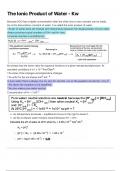
Because H2O has a higher concentration than the other ions a new constant can be made.
Kw is the dissociation constant of water. It is called the ionic product of water.
The pH of water does not change with temperature because the disassociation of pure water
always produces equal numbers of OH- and H+ ions.
Forwards reaction is endothermic.
Kw always has the same value for aqueous solutions at a given temperature/pressure. At
standard conditions it is 1 x 10-14mol2/dm6.
The value of Kw changes as temperature changes.
The units for Kw are always mol2 dm- 6.
In pure water there is always one H+ ions for one OH- ion so the equation can be Kw = [H+]2.
This allows the equation to be simplified.
This also makes pure water neutral.
Concentration of H+ = 1x10⁻⁷.
As temperature increases - equilibrium moves to the right to lower it.
As Kw increases water remains neutral because H+ = OH-.
Because H2O has a higher concentration than the other ions a new constant can be made.
Kw is the dissociation constant of water. It is called the ionic product of water.
The pH of water does not change with temperature because the disassociation of pure water
always produces equal numbers of OH- and H+ ions.
Forwards reaction is endothermic.
Kw always has the same value for aqueous solutions at a given temperature/pressure. At
standard conditions it is 1 x 10-14mol2/dm6.
The value of Kw changes as temperature changes.
The units for Kw are always mol2 dm- 6.
In pure water there is always one H+ ions for one OH- ion so the equation can be Kw = [H+]2.
This allows the equation to be simplified.
This also makes pure water neutral.
Concentration of H+ = 1x10⁻⁷.
As temperature increases - equilibrium moves to the right to lower it.
As Kw increases water remains neutral because H+ = OH-.