DNA and RNA
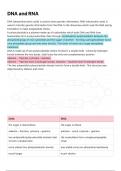
DNA (deoxyribonucleic-acid) is used to store genetic information, RNA (ribonucleic-acid) is
used to transfer genetic information from the DNA to the ribosomes which read the RNA during
translation to make polypeptide chains.
A polynucleotide is a polymer made up of nucleotides which both DNA and RNA form.
Nucleotides form a polynucleotide chain through condensation polymerisation between the
phosphate group of one nucleotide and the sugar of another - forming a phosphodiester bond
(one phosphate group and two ester bonds). This chain is known as a sugar phosphate
backbone.
DNA is made up of two polynucleotide chains formed in a double helix - joined by hydrogen
bonds between the two bases. Each base has only one complementary partner:
Adenine - Thymine, Cytosine - Guanine
Adenine - Thymine have 2 hydrogen bonds. Cytosine - Guanine have 3 hydrogen bonds.
The two antiparallel polynucleotide strands twist to form a double helix. This structure was
determined by Watson and Crick.
DNA RNA
the sugar is deoxyribose the sugar is ribose
adenine - thymine, cytosine - guanine adenine - uracil, cytosine - guanine
two antiparallel polynucleotide strands twist the nucleotides form a single polypeptide
to form a double helix chain
more stable (two phosphodiester bonds) less stable (only one phosphate backbone)
much longer much shorter
DNA (deoxyribonucleic-acid) is used to store genetic information, RNA (ribonucleic-acid) is
used to transfer genetic information from the DNA to the ribosomes which read the RNA during
translation to make polypeptide chains.
A polynucleotide is a polymer made up of nucleotides which both DNA and RNA form.
Nucleotides form a polynucleotide chain through condensation polymerisation between the
phosphate group of one nucleotide and the sugar of another - forming a phosphodiester bond
(one phosphate group and two ester bonds). This chain is known as a sugar phosphate
backbone.
DNA is made up of two polynucleotide chains formed in a double helix - joined by hydrogen
bonds between the two bases. Each base has only one complementary partner:
Adenine - Thymine, Cytosine - Guanine
Adenine - Thymine have 2 hydrogen bonds. Cytosine - Guanine have 3 hydrogen bonds.
The two antiparallel polynucleotide strands twist to form a double helix. This structure was
determined by Watson and Crick.
DNA RNA
the sugar is deoxyribose the sugar is ribose
adenine - thymine, cytosine - guanine adenine - uracil, cytosine - guanine
two antiparallel polynucleotide strands twist the nucleotides form a single polypeptide
to form a double helix chain
more stable (two phosphodiester bonds) less stable (only one phosphate backbone)
much longer much shorter