

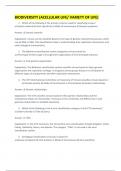
BIODIVERSITY (ACELLULAR LIFE/ VARIETY OF LIFE) 1. Which of the following is the primary criterion used for classifying viruses? a) Genetic material b) Host specificity c) Mode of transmission d) Disease symptoms Answer: a) Genetic material Explanation: Viruses can be classified based on the type of genetic material they possess, which can be DNA or RNA. This classification helps in understanding their replication mechanisms and other biological characteristics. 2. The Baltimore classification s ystem categorizes viruses based on: a) Viral shape b) Host range c) Viral genome organization d) Viral envelope presence Answer: c) Viral genome organization Explanation: The Baltimore classification system classifies viruses based on their genome organiz ation and replication strategy. It recognizes seven groups (Classes I to VII) based on different types of viral genomes and their replication mechanisms. 3. The ICTV (International Committee on Taxonomy of Viruses) classifies viruses based on: a) Disease seve rity b) Mode of transmission c) Viral proteins d) Genetic relationships Answer: d) Genetic relationships Explanation: The ICTV classifies viruses based on their genetic relationships and the evolutionary history of viral families. It focuses on the similar ities and differences in viral genomes and proteins to establish taxonomy. 4. Which of the following is not a virus classification category in the ICTV taxonomy? a) Order b) Family c) Tribe d) Genus Answer: c) Tribe Explanation: In the ICTV taxonomy, the hie rarchical virus classification includes Kingdom, Order, Family, Subfamily, Genus, and Species. The category "Tribe" is not used in the virus classification system. 5. Serological classification of viruses is based on: a) Disease symptoms b) Viral proteins c) Mode of transmission d) Host specificity Answer: b) Viral proteins Explanation: Serological classification of viruses involves analyzing the antigens present on the viral surface or within the viral particles. This classification relies on the specific im mune response generated by individuals infected with different viruses. 6. Which of the following is an example of a DNA virus? a) Influenza virus b) Measles virus c) Rhinovirus d) Herpes simplex virus Answer: d) Herpes simplex virus Explanation: Herpes simp lex virus is an example of a DNA virus. It belongs to the family Herpesviridae and has a double -stranded DNA genome. 7. The capsid of a virus is composed of: a) Lipids b) Proteins c) Nucleic acids d) Carbohydrates Answer: b) Proteins Explanation: The capsid of a virus is the protein shell that encloses the viral genetic material. It provides protection and structural integrity to the virus. 8. Which of the following is a characteristic of the Retroviridae family? a) Single -stranded DNA genome b) Double -stranded RNA genome c) Single -stranded RNA genome d) Double -stranded DNA genome Answer: c) Single -stranded RNA genome Explanation: Retroviridae is a family of RNA viruses that have a single -stranded RNA genome. Thes e viruses use reverse transcriptase to convert their RNA genome into DNA during replication. 9. The classification of viruses into families is primarily based on: a) Size of the virus particle b) Mode of transmission c) Disease symptoms caused d) Genetic relationships Answer: d) Genetic relationships Explanation: The classification of viruses into families is primarily based on genetic relationships, considering similarities and differences in their genomes, replication strategies, and other molecular charact eristics.
Vista previa 2 fuera de 5 páginas
Notas de lectura
Acellular life mcqs
Vista previa 2 fuera de 5 páginas
Boost your knowledge of acellular life with our MCQs! Test your understanding and ace your exams. Click here for a comprehensive quiz now! acellular life acellular life mcqs acellular life mcqs with answers acellular life mcqs mdcat acellular life class 11 notes acellular loife mcqs toppr acellular life mcqs test online acellular life mcqs sindh board acellular life mdcat notes acellular life short questions
Vista previa del contenido
Información del documento
- Subido en
- 23 de junio de 2023
- Número de páginas
- 5
- Escrito en
- 2022/2023
- Tipo
- Notas de lectura
- Profesor(es)
- Wahab ali
- Contiene
- Todas las clases
$3.49
¿Documento equivocado? Cámbialo gratis
Dentro de los 14 días posteriores a la compra y antes de descargarlo, puedes elegir otro documento. Puedes gastar el importe de nuevo.
Escrito por estudiantes que aprobaron
Inmediatamente disponible después del pago
Leer en línea o como PDF

Los indicadores de reputación están sujetos a la cantidad de artículos vendidos por una tarifa y las reseñas que ha recibido por esos documentos. Hay tres niveles: Bronce, Plata y Oro. Cuanto mayor reputación, más podrás confiar en la calidad del trabajo del vendedor.
Disponible en paquete
Package deal
Acellular Life complete practice exams ( Quiz )
