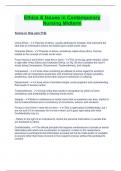
Ethics & Issues in Contemporary Nursing Midterm
Ethics & Issues in Contemporary Nursing Midterm Terms in this set (116) Virtue Ethics - Theories of ethics, usually attributed to Aristotle, that represent the idea that an individual's actions are based upon innate moral virtue Character Ethics - Theories of ethics, sometimes called virtue ethics, that are related to the concept of innate moral virtue Focal Virtues (I don't think I need this in here) - This is the big, green header, which is right after Virtue Ethics and Character Ethics, on Pg. 49 and it contains the next 4 words being Compassion, Discernment, Trustworthiness, and Integrity Compassion - A focal virtue combining an attitude of active regard for another's welfare with an imaginative awareness and emotional response of deep sympathy, tenderness, and discomfort at the other person's misfortune or suffering Discernment - A focal virtue of sensitive insight, acute judgment and understanding that results in decisive action Trustworthiness - A focal virtue that results in recognition by others of one's consistency and predictability in following moral norms Integrity - Refers to adherence to moral norms that is sustained over time. Implicit in this is trustworthiness and a consistency of convictions, actions, and emotions Privacy (I don't think I need this in here) - (This is right before Confidentiality, but I am not sure if it is necessary for it to be in there, yet it goes right along with what Confidentiality truly is) - Refers to the right of an individual to control the personal information or secrets that are disclosed to others Confidentiality - The ethical principle that requires nondisclosure of private or secret information with which one is entrusted. In research, it refers to the researcher's assurance to participants that information provided will not be made public or available to anyone other than those involved in the research process without the participant's consent Limits of Confidentiality - - There are arguments that favor questioning the absolute obligation of confidentiality in certain situations --> these arguments include theories related to the principles of harm and vulnerability ~~> The harm principle can be applied when the nurse or other professional recognizes that maintaining confidentiality will result in preventable wrongful hard to innocent others ==> Ex: Mandatory premarital testing for syphilis, for example, is intended to prevent the spread of a serious communicable disease to innocent babies and spouses ++> In this instance, society chooses to override the privacy of the individual to protect the health of the innocent ~~> The harm principle is strengthened when one considers the vulnerability of the innocent. The duty to protect others from harm is stronger t=when the third party is dependent on others or is in some way especially vulnerable. This duty is called the Vulnerability Principle Vulnerability implies risk or susceptibility to harm when vulnerable individuals have a relative inability to protect themselves --> Ex: For example, nurses have an absolute duty to report child abuse. Because children are dependent and vulnerable, they are at greater risk of harm. - Coupling of the harm principle with the Vulnerability Principle produces a rather strong argument for abandoning the principle of Confidentiality in certain instances - Actions that are considered ethical are not always found to be legal. Though there is an ethical basis for subsuming the principle of Confidentiality in special circumstances, and there is some legal precedent for doing so, there is legal risk to disclosing sensitive information. There is dynamic tension between the patient's right to Confidentiality and the duty to warn innocent others. Nurses need to recognize that careful consideration of the ethical implications of actions will not always be supported in bureaucratic and legal systems - The U.S. federal legislation made the delicate balance between ethical principles more complex when Confidentiality of patient information became a legal mandate--> (Public Health Law 104-199, the Health Insurance Portability and Accountability Act (HIPAA) ) --> In response to public concerns related to a more mobile society, the need for health insurance, and the rising administrative costs of health care, federal legislators set out to create and protect a universal databank of medical information using standardized coding systems ~~> Because of a growing number of criminal violations of electronic records, Congress inserted a provision that enjoined the U.S. Department of Health and Human Services to create medical privacy rules. ==> Even though the original intent of HIPAA was never realized, the privacy guidelines went into effect. ++> Known widely as HIPAA, these privacy rules made Confidentiality a legal requirement. Whereas other ethical principles do not carry the weight of law, per se, Confidentiality stands alone. Today, a breach of Confidentiality may result in criminal conviction or other penalties - Though directing nurses to maintain confidentiality, the ANA Code of Ethics for Nurses recognizes that duties of confidentiality are not absolute and may need to be modified to
Escuela, estudio y materia
- Institución
- HSA - Health Service Administration
- Grado
- HSA - Health Service Administration
Información del documento
- Subido en
- 23 de junio de 2023
- Número de páginas
- 17
- Escrito en
- 2022/2023
- Tipo
- Examen
- Contiene
- Preguntas y respuestas
Temas
-
terms in this set 116
-
ethics amp issues in contemporary nursing midterm

Documento también disponible en un lote