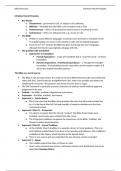
Civil Liberties and Human Rights
Human Rights in the UK
No single definition.
Wesley Hohfeld: Divided rights into 'privileges', 'claims', 'powers' and 'immunities'.
Civil liberties we normally think of - Claims.
We have a claim against state to uphold our 'rights'.
Three stages considering development of human rights protection in UK:
Traditional 'freedoms' model under unwritten constitution.
Position under European Convention on Human Rights.
Current position following implementation of Human Rights Act 1998.
Traditional 'Freedoms' Model
Think of a 'right' as something we are able to do and the state cannot take away - Unwritten con
little protection for 'rights'.
One of the key differences between unwritten constitution of UK and written of other countr
fundamental rights, also a 'higher' source of law which cannot be easily changed by Govern
Government.
UK - No written constitution to form higher source.
Parliamentary sovereignty - No area where Parliament cannot legislate.
Any right can be taken away by an Act of Parliament.
Firearms (Amendment) Act 1997
Prior to Dunblane school massacre in 1996, members of gun clubs had been allow
guns.
Aftermath - Banned most handguns; removal of 'right' to own guns.
Hunting Act 2004, s1
A person commits an offence if he hunts a wild mammal with a dog, unless his hun
Vigorous lobbying - 2004 Act removed 'right' to hunt.
Rather than having 'rights', citizens have enjoyed the 'freedom' to do anything the state has
N.B. Distinction between rights and freedom.
, 5. Right to Liberty and Security.
6. Right to a Fair Trial.
7. Right not to be Punished Except for Breach of the Law.
8. Right to Respect for Private Life.
9. Right to Freedom of Conscience, Thought and Religion.
10. Right to Freedom of Expression.
11. Right to Freedom of Assembly and Association.
12. Right to Marry.
13. Right to an Effective Remedy.
14. Prohibition on Discrimination (in relation to the Convention Rights).
Cases alleging breaches of Convention rights are heard by the European Court of Human Righ
N.B. Human rights cases are heard by European Court of Human Rights (ECtHR), whereas Eu
European Court of Justice (ECJ).
The European Convention and the UK
Convention not incorporated into UK law until passage of Human Rights Act 1998.
Doesn't mean that Convention didn't affect the law and people.
Signatories - UK Government bound by terms as international law - Did not confer rights on
N.B. In order to uphold Convention rights, UK citizens had to take case to Strasbourg Cour
had 'exhausted all domestic remedies' - Been through the entire UK legal system, up to and
(now Supreme Court).
Malone v Metropolitan Police Commissioner (No. 2) [1979] Ch 344 (CH)
Claimant argued telephone had been bugged by the police without lawful authority, breachi
HELD: Court refused to recognise such a right existed and no such right could be imported
Not unlawful under current legislation.
Malone v United Kingdom (1984) 7 EHRR 14 (ECtHR)
Malone took case to European Court of Human Rights and argued facts as above.
HELD: Telephone tapping did contravene Article 8. Parliament passed Interception of Com
statutory authority for telephone tapping.
s2 of the Act stated it's an offence unless under warrant under Secretary of State or be
Human Rights in the UK
No single definition.
Wesley Hohfeld: Divided rights into 'privileges', 'claims', 'powers' and 'immunities'.
Civil liberties we normally think of - Claims.
We have a claim against state to uphold our 'rights'.
Three stages considering development of human rights protection in UK:
Traditional 'freedoms' model under unwritten constitution.
Position under European Convention on Human Rights.
Current position following implementation of Human Rights Act 1998.
Traditional 'Freedoms' Model
Think of a 'right' as something we are able to do and the state cannot take away - Unwritten con
little protection for 'rights'.
One of the key differences between unwritten constitution of UK and written of other countr
fundamental rights, also a 'higher' source of law which cannot be easily changed by Govern
Government.
UK - No written constitution to form higher source.
Parliamentary sovereignty - No area where Parliament cannot legislate.
Any right can be taken away by an Act of Parliament.
Firearms (Amendment) Act 1997
Prior to Dunblane school massacre in 1996, members of gun clubs had been allow
guns.
Aftermath - Banned most handguns; removal of 'right' to own guns.
Hunting Act 2004, s1
A person commits an offence if he hunts a wild mammal with a dog, unless his hun
Vigorous lobbying - 2004 Act removed 'right' to hunt.
Rather than having 'rights', citizens have enjoyed the 'freedom' to do anything the state has
N.B. Distinction between rights and freedom.
, 5. Right to Liberty and Security.
6. Right to a Fair Trial.
7. Right not to be Punished Except for Breach of the Law.
8. Right to Respect for Private Life.
9. Right to Freedom of Conscience, Thought and Religion.
10. Right to Freedom of Expression.
11. Right to Freedom of Assembly and Association.
12. Right to Marry.
13. Right to an Effective Remedy.
14. Prohibition on Discrimination (in relation to the Convention Rights).
Cases alleging breaches of Convention rights are heard by the European Court of Human Righ
N.B. Human rights cases are heard by European Court of Human Rights (ECtHR), whereas Eu
European Court of Justice (ECJ).
The European Convention and the UK
Convention not incorporated into UK law until passage of Human Rights Act 1998.
Doesn't mean that Convention didn't affect the law and people.
Signatories - UK Government bound by terms as international law - Did not confer rights on
N.B. In order to uphold Convention rights, UK citizens had to take case to Strasbourg Cour
had 'exhausted all domestic remedies' - Been through the entire UK legal system, up to and
(now Supreme Court).
Malone v Metropolitan Police Commissioner (No. 2) [1979] Ch 344 (CH)
Claimant argued telephone had been bugged by the police without lawful authority, breachi
HELD: Court refused to recognise such a right existed and no such right could be imported
Not unlawful under current legislation.
Malone v United Kingdom (1984) 7 EHRR 14 (ECtHR)
Malone took case to European Court of Human Rights and argued facts as above.
HELD: Telephone tapping did contravene Article 8. Parliament passed Interception of Com
statutory authority for telephone tapping.
s2 of the Act stated it's an offence unless under warrant under Secretary of State or be