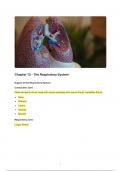
Chapter 13 - The Respiratory System
Organs of the Respiratory System
Conduction Zone
Clean and purify the air, lined with mucus secreting cells, warms the air, humidifies the air
Nose
Pharynx
Larynx
Trachea
Bronchi
Respiratory Zone
Lungs: Alveoli
1
,Functional Anatomy of the Respiratory System
Gas exchanges between the blood and external environment occur only in the alveoli of the
lungs
Upper respiratory tract includes passageways from the nose to larynx
Lower respiratory tract includes passageways from trachea to alveoli
Passageways to the lungs purify, humidify, and warm the incoming air
The only externally visible part of the respiratory system
Nostrils (nares) are the route through which air enters the nose
Nasal cavity is the interior of the nose
Nasal septum divides the nasal cavity
2
,The hard and soft palate separate the nasal and oral cavity
Paranasal air sinuses
Air filled cavities in the skull that open into the nasal cavity
Cavities within the frontal, sphenoid, ethmoid, and maxillary bones surrounding the nasal
cavity
Maxillary air sinus (in the maxillary bone)
Frontal air sinus (in the frontal bone)
Ethmoid air sinus (between the eyes)
Sphenoid air sinus (in the sphenoid bone)
Functions of the Sinuses
Reduce the weight of the skull
Increase the surface area of the nasal cavity (respiratory epithelium) and produce
mucus
Act as resonance chambers for speech
They're filled with inflammatory fluid when inflamed (sinusitis)
That's why the head feels heavier and the voice changes
3
, Nose
Conchae are projections from the lateral walls · Increase surface area · Increase air turbulence withi
Pharynx (throat)
Serves the digestive and respiratory system · Muscular passageway from nasal cavity to larynx · Co
Larynx (Voice Box)
Functions · Routes air and food into proper channels · Plays a role in speech · Located inferior to the
4
Organs of the Respiratory System
Conduction Zone
Clean and purify the air, lined with mucus secreting cells, warms the air, humidifies the air
Nose
Pharynx
Larynx
Trachea
Bronchi
Respiratory Zone
Lungs: Alveoli
1
,Functional Anatomy of the Respiratory System
Gas exchanges between the blood and external environment occur only in the alveoli of the
lungs
Upper respiratory tract includes passageways from the nose to larynx
Lower respiratory tract includes passageways from trachea to alveoli
Passageways to the lungs purify, humidify, and warm the incoming air
The only externally visible part of the respiratory system
Nostrils (nares) are the route through which air enters the nose
Nasal cavity is the interior of the nose
Nasal septum divides the nasal cavity
2
,The hard and soft palate separate the nasal and oral cavity
Paranasal air sinuses
Air filled cavities in the skull that open into the nasal cavity
Cavities within the frontal, sphenoid, ethmoid, and maxillary bones surrounding the nasal
cavity
Maxillary air sinus (in the maxillary bone)
Frontal air sinus (in the frontal bone)
Ethmoid air sinus (between the eyes)
Sphenoid air sinus (in the sphenoid bone)
Functions of the Sinuses
Reduce the weight of the skull
Increase the surface area of the nasal cavity (respiratory epithelium) and produce
mucus
Act as resonance chambers for speech
They're filled with inflammatory fluid when inflamed (sinusitis)
That's why the head feels heavier and the voice changes
3
, Nose
Conchae are projections from the lateral walls · Increase surface area · Increase air turbulence withi
Pharynx (throat)
Serves the digestive and respiratory system · Muscular passageway from nasal cavity to larynx · Co
Larynx (Voice Box)
Functions · Routes air and food into proper channels · Plays a role in speech · Located inferior to the
4