Cells, Tissues and Organs
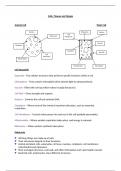
Animal Cell Plant Cell
Nucleus Ribosomes Nucleus
Cell
Ribosomes Membrane
Vacuole
Cytoplasm
Cytoplasm
Cell Wall
Cell
Membrane
Mitochondria
Mitochondria Chloroplasts
Cell Organelle
Organelle - Tiny cellular structures that performs specific functions within a cell.
Chloroplasts – They contain chlorophyll which absorbs light for photosynthesis.
Vacuole - Filled with cell sap which makes it turgid (structure).
Cell Wall – Gives strength and support.
Nucleus – Controls the cell and contains DNA.
Cytoplasm – Where most of the chemical reactions take place, such as anaerobic
respiration.
Cell Membrane – Controls what passes into and out of the cell (partially permeable).
Mitochondria – Where aerobic respiration takes place, and energy is released.
Ribosomes – Where protein synthesis takes place.
Eukaryote
All living things are made up of cells.
Their structures depend on their functions.
Animal and plant cells, eukaryotes, all have a nucleus, cytoplasm, cell membrane,
mitochondria and ribosomes.
Plant and algal cells have a cell wall, and often chloroplasts and a permeable vacuole.
Bacterial cells, prokaryotes, have different structures.
, Dissolved substances pass in and out through diffusion.
A eukaryote is any organism whose cells contain a nucleus and other organelles enclosed
within membranes. All plant and animal cells are eukaryotic cells because they have a cell
membrane, cytoplasm and genetic material enclosed within a nucleus.
Prokaryote
They do not have a nucleus.
DNA floats around in the cell, but clumped together.
Most prokaryotes are bacteria.
They are very simple organisms but found everywhere on Earth and possibly Mars.
Bacteria can be found in intestines, yoghurts and a bakery.
They don’t usually have organelles
They are bigger than a virus but smaller than amoeba
Bacteria Cell
Pili Plasmids
Capsule
Cell Membrane
Cell Wall
Capsule
Flagellum
Cell Membrane
Ribosomes Cell Wall
Loose Genetics
Info (DNA)
Cell Organelle
Capsule – Helps protect bacteria from white blood cells.
Plasmids – Small loops of DNA.
Flagellum – Helps the cell locomote (move).
Pili – Allows bacteria to attach to other surfaces.
Scale
1m = 1000mm
1mm = 1000Mm
1Mm = 1000nm
Animal Cell Plant Cell
Nucleus Ribosomes Nucleus
Cell
Ribosomes Membrane
Vacuole
Cytoplasm
Cytoplasm
Cell Wall
Cell
Membrane
Mitochondria
Mitochondria Chloroplasts
Cell Organelle
Organelle - Tiny cellular structures that performs specific functions within a cell.
Chloroplasts – They contain chlorophyll which absorbs light for photosynthesis.
Vacuole - Filled with cell sap which makes it turgid (structure).
Cell Wall – Gives strength and support.
Nucleus – Controls the cell and contains DNA.
Cytoplasm – Where most of the chemical reactions take place, such as anaerobic
respiration.
Cell Membrane – Controls what passes into and out of the cell (partially permeable).
Mitochondria – Where aerobic respiration takes place, and energy is released.
Ribosomes – Where protein synthesis takes place.
Eukaryote
All living things are made up of cells.
Their structures depend on their functions.
Animal and plant cells, eukaryotes, all have a nucleus, cytoplasm, cell membrane,
mitochondria and ribosomes.
Plant and algal cells have a cell wall, and often chloroplasts and a permeable vacuole.
Bacterial cells, prokaryotes, have different structures.
, Dissolved substances pass in and out through diffusion.
A eukaryote is any organism whose cells contain a nucleus and other organelles enclosed
within membranes. All plant and animal cells are eukaryotic cells because they have a cell
membrane, cytoplasm and genetic material enclosed within a nucleus.
Prokaryote
They do not have a nucleus.
DNA floats around in the cell, but clumped together.
Most prokaryotes are bacteria.
They are very simple organisms but found everywhere on Earth and possibly Mars.
Bacteria can be found in intestines, yoghurts and a bakery.
They don’t usually have organelles
They are bigger than a virus but smaller than amoeba
Bacteria Cell
Pili Plasmids
Capsule
Cell Membrane
Cell Wall
Capsule
Flagellum
Cell Membrane
Ribosomes Cell Wall
Loose Genetics
Info (DNA)
Cell Organelle
Capsule – Helps protect bacteria from white blood cells.
Plasmids – Small loops of DNA.
Flagellum – Helps the cell locomote (move).
Pili – Allows bacteria to attach to other surfaces.
Scale
1m = 1000mm
1mm = 1000Mm
1Mm = 1000nm