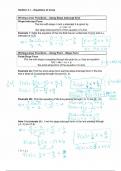
point-slope form
Point-Slope Form: The point-slope form is an algebraic representation of a linear function that expresses the relationship between a point on the graph and the slope of the line. It is written as y - y1 = m(x - x1), where (x1, y1) represents a point on the line, and 'm' is the slope. This form is particularly useful for determining the equation of a line when given a point and its slope. Intercepts: Intercepts are points where a line intersects either the x-axis or the y-axis. In linear functions, the x-intercept is the point where the line crosses the x-axis, and its y-coordinate is always zero. Similarly, the y-intercept is the point where the line crosses the y-axis, and its x-coordinate is always zero. Intercepts provide valuable information about the behavior and characteristics of a linear function. Modeling Applications of Linear Functions: Linear functions have numerous practical applications in various fields. They can be used to model and analyze real-world situations involving rates of change, such as distance versus time, cost versus quantity, or temperature versus time. For example, linear functions can be utilized to predict future trends, make forecasts, optimize processes, estimate costs, and interpret data in fields like physics, economics, engineering, and social sciences. By creating mathematical models using linear functions, we can gain insights into the relationships and patterns present in the data and make informed decisions based on the analysis.
Escuela, estudio y materia
- Institución
- Austin Community College
- Grado
- College algebra (64088)
Información del documento
- Subido en
- 16 de junio de 2023
- Número de páginas
- 6
- Escrito en
- 2022/2023
- Tipo
- NOTAS DE LECTURA
- Profesor(es)
- Carmen mccullough
- Contiene
- Todas las clases
Temas
-
point slope form
-
intercepts
-
horizontal line
-
parallel line
-
modeling applications
-
linear functions

Documento también disponible en un lote