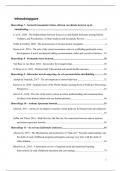
Inhoudsopgave
Hoorcollege 7 - Sociaal Economische Status, effecten van distale factoren op de
ontwikkeling..............................................................................................................................2
Li et al., 2020 - The Relationships between Screen Use and Health Indicators among Infants,
Toddlers, and Preschoolers: A Meta-Analysis and Systematic Review..................................2
Noble & Giebler, 2020 - The neuroscience of socioeconomic inequality....................................4
Rosen et al., 2019 - The role of the visual association cortex in scaffolding prefrontal cortex
development: A novel mechanism linking socioeconomic status and executive function....10
Hoorcollege 8 - Perinatale risico factoren...................................................................................20
Van Baar en van Hout, 2016 - Intoxicaties bij zwangerschap....................................................20
O’Nions et al., 2021 - Preterm birth: Educational and mental health outcomes.........................29
Hoorcollege 9 - Interacties met de omgeving, de rol van motorische ontwikkeling................32
Adolph & Franchak, 2017 - The development of motor behaviour............................................32
Köster et al., 2020 - Making Sense of the World: Infant Learning From a Predictive Processing
Perspective............................................................................................................................43
Salo et al., 2018 - The role of the motor system in action understanding and communication:
Evidence from human infants and non-human primates.......................................................48
Hoorcollege 10 – Autisme Spectrum Stoornis............................................................................53
Johnson, 2017 - Autism as an adaptive common variant pathway for human brain development
...............................................................................................................................................53
Saffin and Tohid, 2016 - Walk like me, talk like me: the connection between mirror neurons
and autism spectrum disorder...............................................................................................58
Hoorcollege 11 – de rol van (in)formele contexten.....................................................................63
Abenavoli, 2019 - The Mechanisms and moderators of “fade-out”: Towards understanding why
the skills of early childhood program participants converge over time with the skills of
other children........................................................................................................................63
Blewitt et al., 2019 - A Systematic review of targeted social and emotional learning
interventions in early childhood education and care settings................................................74
1
, Savina, 2021 - Self-regulation in Preschool and Early elementary classrooms: Why is it
important and how to promote it...........................................................................................78
Hoorcollege 12 – Zelfregulatie en executieve functies...............................................................85
Fiske & Holmboe, 2019 - Neural Substrates of early executive function development.............85
Hendry et al., 2016 - Executive function in the first three years of life: Precursors, predictors
and patterns...........................................................................................................................97
Jones et al., 2015 - Early Social-Emotional Functioning and Public Health: The Relationship
Between Kindergarten Social Competence and Future Wellness.......................................112
Hoorcollege 7 - Sociaal Economische Status, effecten van distale
factoren op de ontwikkeling
Li et al., 2020 - The Relationships between Screen Use and Health
Indicators among Infants, Toddlers, and Preschoolers: A Meta-
Analysis and Systematic Review
Methode & resultatensectie zijn niet meegenomen in de samenvatting
Abstract
Excessive screen time in early childhood is linked to physical and mental health issues
in children.
The study aimed to review the relationship between screen media use and health
indicators in infants, toddlers, and preschoolers.
A systematic search was conducted to identify relevant studies, published in English
and meeting specific criteria.
Eighty studies (23 used for meta-analysis) were included in the systematic review.
The meta-analysis provided strong evidence that excessive screen time is associated
with overweight/obesity and shorter sleep duration in toddlers and preschoolers.
Excessive screen use was found to affect various aspects of health, including physical,
behavioral, and psychosocial indicators.
There is a need for better-quality research on newer media devices, different types of
content, and the dose-response relationship between excessive screen use and health
indicators.
These findings suggest the need to update recommendations for screen use in young
children.
2
,1. Introduction
Children are exposed to media in the digital age, and screen media use has become an
integral part of their lives.
Recommendations from organizations like AAP and WHO suggest limited screen time
for young children, but many children exceed these recommendations.
Excessive screen media use has become a public health issue, and its impacts on
children's physical and mental health need attention.
Excessive screen time can have positive effects, such as improving attention and
learning abilities, but it can also have negative effects, including overweight/obesity,
short sleep duration, language delay, and injuries.
Previous reviews focused on factors influencing screen use and interventions to reduce
screen time but did not provide a comprehensive overview of the associations between
screen time and various health indicators in infants, toddlers, and preschoolers.
It is important to study the younger age group as early childhood development has
long-term effects, and there is a need to understand the associations between screen
time and health outcomes in this age group.
Existing studies have focused on individual health outcomes, and a summary of the
associations between screen time and multiple health indicators in young children
would be valuable for informing recommendations and identifying future research
needs.
4. Discussion
This systematic review and meta-analysis examined 80 studies on the relationship
between screen time and health indicators in infants, toddlers, and preschoolers.
Excessive screen time was associated with higher adiposity, sleep problems,
aggressive behaviors, musculoskeletal pain, bullying, unhealthy dietary behavior,
poorer executive function and motor development, less physical activity, and worse
behavioral and emotional outcomes.
The meta-analysis showed a positive association between excessive screen time and
overweight/obesity, and a negative association with sleep duration.
The evidence for cognitive development and emotional/social skills was mixed.
Recommendations for screen use should focus on reducing screen time, improving the
quality and content of media exposure, and considering the type of media devices
used.
3
, Limitations of the study include reliance on parental reports of screen time, language
bias, varying numbers of articles for different health indicators, and the inclusion of a
broad age range.
Recommendations include encouraging children to meet screen time guidelines,
improving the quality of media exposure, conducting more studies on new devices and
content, and standardizing measurement of screen-based activities.
5. Conclusion
This systematic review and meta-analysis focused on the association between screen
time and various health indicators in infants, toddlers, and preschoolers.
Excessive screen time was found to be associated with physical, behavioral, and
psychosocial health indicators.
Strong evidence supported the association between excessive screen time and
overweight/obesity, as well as shorter sleep duration in toddlers and preschoolers.
The evidence regarding cognitive development and the development of emotional and
social skills was inconclusive.
The reliance on parental-reported screen time and the inclusion of a broad age range
were limitations of the study.
Improvements in measuring screen time and conducting studies on newer devices and
different content are needed.
Screen time guidelines should be based on expert consensus and the best available
evidence, considering feasibility, resources, and equity.
Further studies are necessary to better understand the effects of screen media use on
children's growth and development.
Noble & Giebler, 2020 - The neuroscience of socioeconomic
inequality
Abstract and introduction
There is a growing body of research exploring the relationship between socioeconomic
inequality and the development of the brain.
Disparities in brain structure and function have been found to exist from as early as the
first year of life.
Differences in neural structure have been observed in both cortical and subcortical
gray matter, as well as in white matter.
4
Hoorcollege 7 - Sociaal Economische Status, effecten van distale factoren op de
ontwikkeling..............................................................................................................................2
Li et al., 2020 - The Relationships between Screen Use and Health Indicators among Infants,
Toddlers, and Preschoolers: A Meta-Analysis and Systematic Review..................................2
Noble & Giebler, 2020 - The neuroscience of socioeconomic inequality....................................4
Rosen et al., 2019 - The role of the visual association cortex in scaffolding prefrontal cortex
development: A novel mechanism linking socioeconomic status and executive function....10
Hoorcollege 8 - Perinatale risico factoren...................................................................................20
Van Baar en van Hout, 2016 - Intoxicaties bij zwangerschap....................................................20
O’Nions et al., 2021 - Preterm birth: Educational and mental health outcomes.........................29
Hoorcollege 9 - Interacties met de omgeving, de rol van motorische ontwikkeling................32
Adolph & Franchak, 2017 - The development of motor behaviour............................................32
Köster et al., 2020 - Making Sense of the World: Infant Learning From a Predictive Processing
Perspective............................................................................................................................43
Salo et al., 2018 - The role of the motor system in action understanding and communication:
Evidence from human infants and non-human primates.......................................................48
Hoorcollege 10 – Autisme Spectrum Stoornis............................................................................53
Johnson, 2017 - Autism as an adaptive common variant pathway for human brain development
...............................................................................................................................................53
Saffin and Tohid, 2016 - Walk like me, talk like me: the connection between mirror neurons
and autism spectrum disorder...............................................................................................58
Hoorcollege 11 – de rol van (in)formele contexten.....................................................................63
Abenavoli, 2019 - The Mechanisms and moderators of “fade-out”: Towards understanding why
the skills of early childhood program participants converge over time with the skills of
other children........................................................................................................................63
Blewitt et al., 2019 - A Systematic review of targeted social and emotional learning
interventions in early childhood education and care settings................................................74
1
, Savina, 2021 - Self-regulation in Preschool and Early elementary classrooms: Why is it
important and how to promote it...........................................................................................78
Hoorcollege 12 – Zelfregulatie en executieve functies...............................................................85
Fiske & Holmboe, 2019 - Neural Substrates of early executive function development.............85
Hendry et al., 2016 - Executive function in the first three years of life: Precursors, predictors
and patterns...........................................................................................................................97
Jones et al., 2015 - Early Social-Emotional Functioning and Public Health: The Relationship
Between Kindergarten Social Competence and Future Wellness.......................................112
Hoorcollege 7 - Sociaal Economische Status, effecten van distale
factoren op de ontwikkeling
Li et al., 2020 - The Relationships between Screen Use and Health
Indicators among Infants, Toddlers, and Preschoolers: A Meta-
Analysis and Systematic Review
Methode & resultatensectie zijn niet meegenomen in de samenvatting
Abstract
Excessive screen time in early childhood is linked to physical and mental health issues
in children.
The study aimed to review the relationship between screen media use and health
indicators in infants, toddlers, and preschoolers.
A systematic search was conducted to identify relevant studies, published in English
and meeting specific criteria.
Eighty studies (23 used for meta-analysis) were included in the systematic review.
The meta-analysis provided strong evidence that excessive screen time is associated
with overweight/obesity and shorter sleep duration in toddlers and preschoolers.
Excessive screen use was found to affect various aspects of health, including physical,
behavioral, and psychosocial indicators.
There is a need for better-quality research on newer media devices, different types of
content, and the dose-response relationship between excessive screen use and health
indicators.
These findings suggest the need to update recommendations for screen use in young
children.
2
,1. Introduction
Children are exposed to media in the digital age, and screen media use has become an
integral part of their lives.
Recommendations from organizations like AAP and WHO suggest limited screen time
for young children, but many children exceed these recommendations.
Excessive screen media use has become a public health issue, and its impacts on
children's physical and mental health need attention.
Excessive screen time can have positive effects, such as improving attention and
learning abilities, but it can also have negative effects, including overweight/obesity,
short sleep duration, language delay, and injuries.
Previous reviews focused on factors influencing screen use and interventions to reduce
screen time but did not provide a comprehensive overview of the associations between
screen time and various health indicators in infants, toddlers, and preschoolers.
It is important to study the younger age group as early childhood development has
long-term effects, and there is a need to understand the associations between screen
time and health outcomes in this age group.
Existing studies have focused on individual health outcomes, and a summary of the
associations between screen time and multiple health indicators in young children
would be valuable for informing recommendations and identifying future research
needs.
4. Discussion
This systematic review and meta-analysis examined 80 studies on the relationship
between screen time and health indicators in infants, toddlers, and preschoolers.
Excessive screen time was associated with higher adiposity, sleep problems,
aggressive behaviors, musculoskeletal pain, bullying, unhealthy dietary behavior,
poorer executive function and motor development, less physical activity, and worse
behavioral and emotional outcomes.
The meta-analysis showed a positive association between excessive screen time and
overweight/obesity, and a negative association with sleep duration.
The evidence for cognitive development and emotional/social skills was mixed.
Recommendations for screen use should focus on reducing screen time, improving the
quality and content of media exposure, and considering the type of media devices
used.
3
, Limitations of the study include reliance on parental reports of screen time, language
bias, varying numbers of articles for different health indicators, and the inclusion of a
broad age range.
Recommendations include encouraging children to meet screen time guidelines,
improving the quality of media exposure, conducting more studies on new devices and
content, and standardizing measurement of screen-based activities.
5. Conclusion
This systematic review and meta-analysis focused on the association between screen
time and various health indicators in infants, toddlers, and preschoolers.
Excessive screen time was found to be associated with physical, behavioral, and
psychosocial health indicators.
Strong evidence supported the association between excessive screen time and
overweight/obesity, as well as shorter sleep duration in toddlers and preschoolers.
The evidence regarding cognitive development and the development of emotional and
social skills was inconclusive.
The reliance on parental-reported screen time and the inclusion of a broad age range
were limitations of the study.
Improvements in measuring screen time and conducting studies on newer devices and
different content are needed.
Screen time guidelines should be based on expert consensus and the best available
evidence, considering feasibility, resources, and equity.
Further studies are necessary to better understand the effects of screen media use on
children's growth and development.
Noble & Giebler, 2020 - The neuroscience of socioeconomic
inequality
Abstract and introduction
There is a growing body of research exploring the relationship between socioeconomic
inequality and the development of the brain.
Disparities in brain structure and function have been found to exist from as early as the
first year of life.
Differences in neural structure have been observed in both cortical and subcortical
gray matter, as well as in white matter.
4