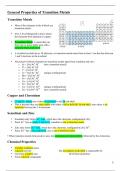
General Properties of Transition Metals
Transition Metals
• Most of the elements in the d-block are
transition metals.
• (For A level) Required to know about
the elements from titanium to copper.
• Transition Metal: A metal that can
form one or more stable ions with a
partially filled d sub-level.
• A d-orbital can hold up to 10 electrons, so transition metals must form at least 1 ion that has between
1 and 9 electrons in the d-orbital.
• All period 4 d-block elements are transition metals apart from scandium and zinc:
o Sc = [Ar] 4s2 3d1 (not a transition metal)
o Ti = [Ar] 4s2 3d2
o V = [Ar] 4s2 3d3
o Cr = [Ar] 4s1 3d5 (unique configuration)
2 5
o Mn = [Ar] 4s 3d
o Fe = [Ar] 4s2 3d6
o Co = [Ar] 4s2 3d7
o Ni = [Ar] 4s2 3d8
o Cu = [Ar] 4s1 3d10 (unique configuration)
2 10
o Zn = [Ar] 4s 3d (not a transition metal)
Copper and Chromium
• Cr and Cu donate one of their 4s electrons to the 3d sub-shell.
• This is because they are more stable with either a full or half-full 3d sub-shell, since there is no
repulsion between the 2 4s electrons.
Scandium and Zinc
• Scandium only forms Sc3+ ions, which have the electronic configuration [Ar].
• Since Sc3+ has an empty d sub-level, scandium is not a transition metal.
• Zinc only forms Zn2+ ions, which have the electronic configuration [Ar] 3d10.
• Since Zn2+ has a full d sub-level, zinc is not a transition metal.
! When transition metals form positive ions, the s electrons are removed first, followed by the d electrons.
Chemical Properties
• Variable oxidation states
• Catalytic activity The incomplete d sub-shell is responsible for
• Can form complex ions all of these properties
• Form coloured compounds
5
, Complex Ions
• Complex: A central metal atom or ion surrounded by co-ordinately bonded ligands.
• Coordinate Bond / Dative Covalent Bond: A covalent bond in which both electrons in the shared
pair come from the same atom.
• In a complex, both electrons come from the ligands.
• Ligand: An atom, ion or molecule that contains at least one lone pair that can act as a Lewis base
(electron donor).
• They can donate a pair of electrons to a central transition metal ion to form a coordinate bond.
• Coordination Number: The number of coordinate bonds that are formed with the central metal ion.
o Small ligands, e.g. H2O and NH3, can form 6 coordinate bonds.
o Large ligands, e.g. Cl– , can only form 4 coordinate bonds.
Naming Complexes
• The name is written as one word.
• A prefix is used to show the number of ligands (di, tri, etc).
• The ligand is written first, followed by the metal and its oxidation state.
Naming the Ligands:
Ligand Formula Name Ligand Formula Name
Chloride Cl– Chloro Oxide O2– Oxo
Cyanide NC– Cyano Water H2 O Aqua
Hydroxide HO– Hydroxo Ammonia NH3 Ammine
• If there are multiple ligands, name alphabetically.
Naming the Metals:
• If the complex ion is positively charged, use the metal’s normal name.
• If the complex ion is negatively charged, the name changes:
Metal Name Metal Name
Chromium Chromate Aluminium Aluminate
Cobalt Cobaltate Vanadium Vanadate
Copper Cuprate Silver Argentate
Iron Ferrate Manganese Manganate
Nickel Nicketate Platinum Plantinate
E.g. [Fe(H2O)6]2+ = Hexaaquairon(II)
[Ag(CN)2] – = Dicyanoargentate(I)
[Fe(H2O)4(OH)2]+ = Tetraaquadihydroxoiron(III)
6
Transition Metals
• Most of the elements in the d-block are
transition metals.
• (For A level) Required to know about
the elements from titanium to copper.
• Transition Metal: A metal that can
form one or more stable ions with a
partially filled d sub-level.
• A d-orbital can hold up to 10 electrons, so transition metals must form at least 1 ion that has between
1 and 9 electrons in the d-orbital.
• All period 4 d-block elements are transition metals apart from scandium and zinc:
o Sc = [Ar] 4s2 3d1 (not a transition metal)
o Ti = [Ar] 4s2 3d2
o V = [Ar] 4s2 3d3
o Cr = [Ar] 4s1 3d5 (unique configuration)
2 5
o Mn = [Ar] 4s 3d
o Fe = [Ar] 4s2 3d6
o Co = [Ar] 4s2 3d7
o Ni = [Ar] 4s2 3d8
o Cu = [Ar] 4s1 3d10 (unique configuration)
2 10
o Zn = [Ar] 4s 3d (not a transition metal)
Copper and Chromium
• Cr and Cu donate one of their 4s electrons to the 3d sub-shell.
• This is because they are more stable with either a full or half-full 3d sub-shell, since there is no
repulsion between the 2 4s electrons.
Scandium and Zinc
• Scandium only forms Sc3+ ions, which have the electronic configuration [Ar].
• Since Sc3+ has an empty d sub-level, scandium is not a transition metal.
• Zinc only forms Zn2+ ions, which have the electronic configuration [Ar] 3d10.
• Since Zn2+ has a full d sub-level, zinc is not a transition metal.
! When transition metals form positive ions, the s electrons are removed first, followed by the d electrons.
Chemical Properties
• Variable oxidation states
• Catalytic activity The incomplete d sub-shell is responsible for
• Can form complex ions all of these properties
• Form coloured compounds
5
, Complex Ions
• Complex: A central metal atom or ion surrounded by co-ordinately bonded ligands.
• Coordinate Bond / Dative Covalent Bond: A covalent bond in which both electrons in the shared
pair come from the same atom.
• In a complex, both electrons come from the ligands.
• Ligand: An atom, ion or molecule that contains at least one lone pair that can act as a Lewis base
(electron donor).
• They can donate a pair of electrons to a central transition metal ion to form a coordinate bond.
• Coordination Number: The number of coordinate bonds that are formed with the central metal ion.
o Small ligands, e.g. H2O and NH3, can form 6 coordinate bonds.
o Large ligands, e.g. Cl– , can only form 4 coordinate bonds.
Naming Complexes
• The name is written as one word.
• A prefix is used to show the number of ligands (di, tri, etc).
• The ligand is written first, followed by the metal and its oxidation state.
Naming the Ligands:
Ligand Formula Name Ligand Formula Name
Chloride Cl– Chloro Oxide O2– Oxo
Cyanide NC– Cyano Water H2 O Aqua
Hydroxide HO– Hydroxo Ammonia NH3 Ammine
• If there are multiple ligands, name alphabetically.
Naming the Metals:
• If the complex ion is positively charged, use the metal’s normal name.
• If the complex ion is negatively charged, the name changes:
Metal Name Metal Name
Chromium Chromate Aluminium Aluminate
Cobalt Cobaltate Vanadium Vanadate
Copper Cuprate Silver Argentate
Iron Ferrate Manganese Manganate
Nickel Nicketate Platinum Plantinate
E.g. [Fe(H2O)6]2+ = Hexaaquairon(II)
[Ag(CN)2] – = Dicyanoargentate(I)
[Fe(H2O)4(OH)2]+ = Tetraaquadihydroxoiron(III)
6