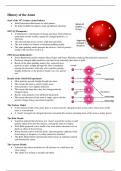
History of the Atom
Start of the 19th Century (John Dalton):
• John Dalton described atoms as solid spheres.
• He believed different spheres made up different elements.
1897 (JJ Thompson):
• JJ Thompson’s experiments of charge and mass showed that an
atom must contain smaller, negatively charged particles, i.e.
electrons.
• This showed that atoms weren’t solid and indivisible.
• The new model was known as the plum pudding model.
• The plum pudding model presents the atom as a ball of positive
charge with electrons stuck in it.
1909 (Ernest Rutherford):
• Ernest Rutherford and his students Hans Geiger and Ernest Marsden conducted the gold foil experiment.
• Positively charged alpha particles were fired at an extremely thin sheet of gold.
• Based on the plum pudding model, they expected most
particles to pass straight through the sheet (completely
missing the electrons) with only a few particles getting
slightly deflected, as the positive charge was very spread
out.
Results of the Gold Foil Experiment
• Most particles passed straight through the sheet.
• This means the atom is mostly empty space.
• Some particles were slightly deflected.
• This means the atom has a tiny but strong positively
charged region.
• Rarely, some particles were deflected backwards.
• This meant that most of the atom is empty space with the
positive charge being concentrated together.
The Nuclear Model
• In the nuclear model of the atom, there is a tiny positively charged nucleus at the centre, where most of the
mass is concentrated.
• A ‘cloud’ of negatively charged electrons surrounds this nucleus (meaning most of the atom is empty space).
The Bohr Model:
• Scientists realised that electrons in a ‘cloud’ around the nucleus would
quickly spiral down into the nucleus, causing the atom to collapse.
• Niels Bohr proposed a new model of an atom where electrons exist in
shells or orbits of fixed energy.
• When electrons move between shells, electromagnetic radiation (with
fixed energy or frequency) is either emitted or absorbed.
• The Bohr Model fitted experimental observations of radiation emitted
and absorbed by atoms.
The Current Model:
• Scientists later discovered that not all electrons in a shell have the
same energy.
• The model was refined to include sub-shells.
, Atomic Structure
Sub-Atomic Particle Relative Mass Relative Charge
Proton 1 1+
Neutron 1 0
Electron 1/1836 1-
Isotopes
Isotopes: Atoms with the same number of protons but a different number of neutrons. This means they are atoms of
the same element with the same atomic number but a different mass number.
Relative Atomic Mass
Relative Atomic Mass (Ar): The average mass of an atom of an element (taking into account all of its isotopes)
relative to 1/12 of the mass of a 12C atom.
Ar = Σ (Isotopic Abundance x Isotopic Mass Number)
Σ Isotopic Abundance
Example 1: Calculate the RAM of chromium given the data below:
m/z 50 52 53 54
Relative Abundance 4.3 83.8 9.5 2.4
Ar (Cr) = (4.3% x 50) + (83.8% x 52) + (9.5% x 53) + (2.4% x 54)
= 52.1 (1dp)
Example 2: The relative atomic mass of gallium is 69.72. It consists of two isotopes; 69Ga and 71Ga. Find the
percentage composition by mass of these two isotopes in gallium.
1. 69x + 71y = 69.72 2. x + y = 100
100 69x + 69y = 6900
69x +71y = 6972
3. 69x + 71y = 6972 4. x + y = 100
– 69x + 69y = 6900 x + 36 = 100
2y = 72 x = 74
y = 36
69 71
Ga = 74% Ga = 36%
Start of the 19th Century (John Dalton):
• John Dalton described atoms as solid spheres.
• He believed different spheres made up different elements.
1897 (JJ Thompson):
• JJ Thompson’s experiments of charge and mass showed that an
atom must contain smaller, negatively charged particles, i.e.
electrons.
• This showed that atoms weren’t solid and indivisible.
• The new model was known as the plum pudding model.
• The plum pudding model presents the atom as a ball of positive
charge with electrons stuck in it.
1909 (Ernest Rutherford):
• Ernest Rutherford and his students Hans Geiger and Ernest Marsden conducted the gold foil experiment.
• Positively charged alpha particles were fired at an extremely thin sheet of gold.
• Based on the plum pudding model, they expected most
particles to pass straight through the sheet (completely
missing the electrons) with only a few particles getting
slightly deflected, as the positive charge was very spread
out.
Results of the Gold Foil Experiment
• Most particles passed straight through the sheet.
• This means the atom is mostly empty space.
• Some particles were slightly deflected.
• This means the atom has a tiny but strong positively
charged region.
• Rarely, some particles were deflected backwards.
• This meant that most of the atom is empty space with the
positive charge being concentrated together.
The Nuclear Model
• In the nuclear model of the atom, there is a tiny positively charged nucleus at the centre, where most of the
mass is concentrated.
• A ‘cloud’ of negatively charged electrons surrounds this nucleus (meaning most of the atom is empty space).
The Bohr Model:
• Scientists realised that electrons in a ‘cloud’ around the nucleus would
quickly spiral down into the nucleus, causing the atom to collapse.
• Niels Bohr proposed a new model of an atom where electrons exist in
shells or orbits of fixed energy.
• When electrons move between shells, electromagnetic radiation (with
fixed energy or frequency) is either emitted or absorbed.
• The Bohr Model fitted experimental observations of radiation emitted
and absorbed by atoms.
The Current Model:
• Scientists later discovered that not all electrons in a shell have the
same energy.
• The model was refined to include sub-shells.
, Atomic Structure
Sub-Atomic Particle Relative Mass Relative Charge
Proton 1 1+
Neutron 1 0
Electron 1/1836 1-
Isotopes
Isotopes: Atoms with the same number of protons but a different number of neutrons. This means they are atoms of
the same element with the same atomic number but a different mass number.
Relative Atomic Mass
Relative Atomic Mass (Ar): The average mass of an atom of an element (taking into account all of its isotopes)
relative to 1/12 of the mass of a 12C atom.
Ar = Σ (Isotopic Abundance x Isotopic Mass Number)
Σ Isotopic Abundance
Example 1: Calculate the RAM of chromium given the data below:
m/z 50 52 53 54
Relative Abundance 4.3 83.8 9.5 2.4
Ar (Cr) = (4.3% x 50) + (83.8% x 52) + (9.5% x 53) + (2.4% x 54)
= 52.1 (1dp)
Example 2: The relative atomic mass of gallium is 69.72. It consists of two isotopes; 69Ga and 71Ga. Find the
percentage composition by mass of these two isotopes in gallium.
1. 69x + 71y = 69.72 2. x + y = 100
100 69x + 69y = 6900
69x +71y = 6972
3. 69x + 71y = 6972 4. x + y = 100
– 69x + 69y = 6900 x + 36 = 100
2y = 72 x = 74
y = 36
69 71
Ga = 74% Ga = 36%