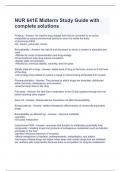
NUR 641E Midterm Study Guide with complete solutions
Prodrug - Answer- An inactive drug dosage form that is converted to an active metabolite by various biochemical reactions once it is inside the body. -Cytochrome P450 -Ex. Aspirin, psilocybin, heroin Bioavailability - Answer- the rate at and the extent to which a nutrient is absorbed and used -Affected by route of administration and drug dosage -Drug clearance (rate drug leaves circulation) -Steady state concentration -Affected by chemical stability, solubility, and first pass Steady state (of a drug) - Answer- stable level of drug in the body, occurs in 5 half lives of the drug -rate of drug being added to system is equal to amount being eliminated from system Pharmacokinetics - Answer- The process by which drugs are absorbed, distributed within the body, metabolized, and excreted. -what the body does to the drug First pass - Answer- the fact that a medication in the GI tract passes through the liver before entering other organs does not - Answer- bioequivalence does/does not affect bioavailability Bioequivalence - Answer- relative therapeutic effectiveness of chemically equivalent drugs. Bioavailability (is affected by) - Answer- -chemical instability -solubility -first pass metabolism Cytochrome P450 - Answer- -enzymes that function to metabolize potentially toxic compounds, including drugs and products of endogenous metabolism such as bilirubin, principally in the liver. -genetics influence presence of enzymes -affects metabolism of warfarin, antidepressants, antiepileptics, and statins. -the levels of these drugs are higher when taken with certain drugs that are inhibitors (ex. warfarin with omeprazole) because there is competition for enzyme metabolism. -inducers lead to decreased plasma concentration of drug. cytochrome p450 inducer - Answer- An inducer increases the metabolism of a substrate resulting in a decreased level or effect of the substrate cytochrome p450 inhibitor - Answer- An inhibitor decreases the metabolism of a substrate resulting in an increased level or effect of the substrate. Clopidogrel - Answer- prodrug that must be activated by hepatic CYP2C19 metabolism; individuals who are poor metabolizers may not form the active metabolite and have reduced antiplatelet response half-life (determines) - Answer- how often a drug is administered 4-5 - Answer- steady state is reached in _-_ times the half-life Warfarin (MOA) - Answer- -Vitamin K antagonist -Factors II, VII, IX, X -takes several days to take effect -monitor INR Vitamin K - Answer- warfarin antidote Heparin (MOA) - Answer- -rapid anticoagulation by binding with antithrombin III and inhibits factors IXa, Xa, XIIa, and XIII -aPTT monitoring (low dose SQ does not require monitoring) Apixaban (MOA) - Answer- direct factor Xa inhibitor parenteral administration - Answer- -directly into systemic circulation -poor absorption or unstable in GI tract (ex. heparin, insulin), rapid absorption, unable to take meds PO -IV, IM, SQ, ID IV - Answer- -into the vein -can be given through bolus (rapid peak) or infusion (lower peak, longer duration) -ex. rocuronium (neuromuscular blocker) IM - Answer- -aqua solutions absorbed rapidly -depot absorbed slowly in a nonaqueous solution such as polyethene glycol (simple diffusion) SQ - Answer- -absorption via simple diffusion -constant, slow, and sustained effects -not for drugs that cause tissue irritation d/t pain and necrosis ID - Answer- -diagnostic determination and allergy sensitivity inhalation - Answer- -drug effects as rapid as IV bolus -minimizes systemic side effects of respiratory drugs oral - Answer- -antidotes may be provided -most common, convenient, and economical method of drug administration -most complicated drug pathway -low gastric pH inactivates some drugs -20-60 minutes for effects -enteric, extended-release enteric-coated - Answer- -protects the drug from stomach acid -delivers to less acidic intestine -useful for drugs that are acid labile or irritating to stomach (ex. omeprazole, aspirin) extended-release - Answer- -control drug release -maintain therapeutic range over longer period -good for drugs with short half-life (i.e. morphine with half-life of 2-4 hours) aPTT - Answer- activated partial thromboplastin time 30-40 seconds - Answer- Normal activated partial thromboplastin time (APTT) 1.5-2.5 - Answer- therapeutic aPTT is x more than normal
Escuela, estudio y materia
- Institución
- NUR 641E
- Grado
- NUR 641E
Información del documento
- Subido en
- 11 de junio de 2023
- Número de páginas
- 10
- Escrito en
- 2022/2023
- Tipo
- Examen
- Contiene
- Preguntas y respuestas
Temas
-
nur 641e midterm study guide with complete solutio

Documento también disponible en un lote