LESSON 2
1.1.2 Market research
Why do markets need competition?
- To improve their quality and product standards
- To innovate products
.Product and market orientation
Production orientation
↳ Business develops products based on what it is good at doing. It focuses on
the
production process and the product itself.
E.g.:Gillette
Marketing orientation
↳ Business responds to customers needs and wants- designs products
accordingly.
E.g.: Amazon
Apple is a product orientation, but it’s presented as market orientation
↳ It’s crucial to marketing success because
⇒ Markets are much more dynamic
E.g.: Impact of technological change which is shortening product life cycles
⇒ Customers are becoming much more demanding
E.g.: Expecting much more higher level of customer service and able to share
experiences via social media
⇒ Barriers to market entry getting lower
E.g.: Many new entrants to consumer markets utilising online and mobile
technology
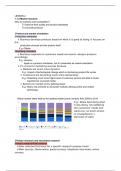
Global market share held by the leading mobile phone vendors from 2009 to 2014
E.g.: Nokia kept doing what
it was doing, not satisfying
the customers’ needs and
wants (so, no touch-screen
or smartphones) ⇒
Decrease of sales
.Primary research and secondary research
Primary research/Field research
↳Data collected first-hand for a specific research purpose (new)
↳Main sources: Observation, postal surveys, telephone interviews, online
surveys,
, focus groups, face-to-face surveys, test marketing and experiments
Benefits: Drawbacks:
- Directly focused to research objectives - Time-consuming
- Kept private, no publicly available - Expensive
- More detailed insights, particularly - Risk of survey bias
into customer views - Sampling may not be representative
- Efficient and specific info gathered - Can be slow
Secondary research/Desk research
↳Data that already exists and which has been collected for a different purpose
(old)
E.g.: On the internet
↳Main sources
Benefits: Drawbacks:
- Often free and easy to obtain - Can quickly become out of data
- Good source of market insights - Not tailored to business needs
- Quick access and use - Specialist reports often quite expensive
- Fast and efficient - Not always reliable ( fake information)
.Quantitative and qualitative research → Based on opinions, attitudes, beliefs and
↓ intentions. Answer questions such
as “Why?,
Concerned with data and addresses Would?, or How?”
questions such as “How many? How ↓
Often?, Who?, When?, Where?” Aims to understand why customers behave in
1.1.2 Market research
Why do markets need competition?
- To improve their quality and product standards
- To innovate products
.Product and market orientation
Production orientation
↳ Business develops products based on what it is good at doing. It focuses on
the
production process and the product itself.
E.g.:Gillette
Marketing orientation
↳ Business responds to customers needs and wants- designs products
accordingly.
E.g.: Amazon
Apple is a product orientation, but it’s presented as market orientation
↳ It’s crucial to marketing success because
⇒ Markets are much more dynamic
E.g.: Impact of technological change which is shortening product life cycles
⇒ Customers are becoming much more demanding
E.g.: Expecting much more higher level of customer service and able to share
experiences via social media
⇒ Barriers to market entry getting lower
E.g.: Many new entrants to consumer markets utilising online and mobile
technology
Global market share held by the leading mobile phone vendors from 2009 to 2014
E.g.: Nokia kept doing what
it was doing, not satisfying
the customers’ needs and
wants (so, no touch-screen
or smartphones) ⇒
Decrease of sales
.Primary research and secondary research
Primary research/Field research
↳Data collected first-hand for a specific research purpose (new)
↳Main sources: Observation, postal surveys, telephone interviews, online
surveys,
, focus groups, face-to-face surveys, test marketing and experiments
Benefits: Drawbacks:
- Directly focused to research objectives - Time-consuming
- Kept private, no publicly available - Expensive
- More detailed insights, particularly - Risk of survey bias
into customer views - Sampling may not be representative
- Efficient and specific info gathered - Can be slow
Secondary research/Desk research
↳Data that already exists and which has been collected for a different purpose
(old)
E.g.: On the internet
↳Main sources
Benefits: Drawbacks:
- Often free and easy to obtain - Can quickly become out of data
- Good source of market insights - Not tailored to business needs
- Quick access and use - Specialist reports often quite expensive
- Fast and efficient - Not always reliable ( fake information)
.Quantitative and qualitative research → Based on opinions, attitudes, beliefs and
↓ intentions. Answer questions such
as “Why?,
Concerned with data and addresses Would?, or How?”
questions such as “How many? How ↓
Often?, Who?, When?, Where?” Aims to understand why customers behave in