What is business valuation?
You may need to know a current and reliable value as a company owner or investor for financing,
selling/buying shares, acquisition by another company or harvesting.
Competitive strategies – Porter
1. Low Cost Strategy: become cost leader in an industry
2. Differentiation Strategy: become unique in an industry
SWOT- Analysis
- Strenghts
- Weaknesses
- Opportunities
- Threats
Financial decisions in three key areas:
- Finance: what sources should funds be raised?
- Dividends: how should cash funds be allocated to shareholders and how will the value of the business
be affected by this?
- Investment: both long-term investment in non-current assets and short-term investment in working
capital.
Business related factors
- Macro: interest, inflation, employment rate
- Meso (industry): competition, innovation
- Micro (firm specific): strategy, skills, etc.
Two branches of accounting
1. Financial accounting
o Performed for the owners and stakeholders like banks or shareholders.
o Used to show how the business has done, profits and value.
2. Management accounting
o Performed for/by managers.
o Used to help make decisions and plan future activities.
Key financial statements
1. Balance sheet: Assets and liabilities.
2. Income statement: Income and Expenses
3. Cash flow statement: Cash inflow and -outflow
o There are 3 types of cash flow statements.
CF from operating activities: source of money from normal operations
CF from investing: change in plant and equipment + change in investing acc.
CF from financing activities: financing sources minus financing uses
Financial state analysis - allows managers to assess the health of a company.
- Financial ratio analysis: firm’s ability to raise funds on reasonable terms.
- Vertical analysis (common size analysis): based on comparing parts of the same statement as a
percentage. Like % of total sales
- Horizontal analysis (trend analysis): compares ratios between two or more periods.
Overview of valuation techniques
- Market/book value of assets: relevant for businesses that are ‘asset rich’
- Cash flow valuation: value of the business as the PV of future cash flows
- Valuation using comparable: compare ratios, like P/E ratios.
,Market capitalization (market value of equity) = number of shares * share price.
Net asset valuation determine value of a mutual fund.
What assets should be in the valuation?
- Monetary items -> book values
- Non-monetary items -> replacement costs & realizable values
2 examples: Assume the company has 8 million shares and the price is $3 per share.
- To get the share price according to NAV:
Equity and liabilities / amount of shares
19,200,000 by 8,000,000 = $2.40.
So, the shares are overvalued.
- Non-current assets are worth 40 million instead of 23.6 million (also called
replacement costs). Then the value of the total assets would increase to:
(Non-current assets – current assets – unsecured bond – current liabilities) /
amount of shares
(40m + 8.4m – 8m – 4.8m) / 8m = $4.5
So, the share price is undervalued.
Context of asset based valuation
When companies are in financial trouble, shareholders/lenders may use asset-based valuation to determine
the minimum value of the company's assets, known as the "break-up value", to decide what to do next.
There are downsides to NAV:
- Future profitability is ignored.
- Balance sheet valuation is based on accounting conventions.
- No accounting for intellectual capital or other intangible assets.
Which company from the two below is more suitable for NAV? (A)
- Company A: manufacturing company with a long history. Earnings have been highly volatile over time
and last year their net profit turned negative. Most of the asset value of the company is in machinery.
- Company B: The new tech start-up has intangible assets in the form of employees and patents on high
tech gadgets. They had a successful year with a positive net profit.
Based on the information provided, Company A with long history and volatile earnings, and where most of the
asset value is tied up in machinery, would be more suitable for net asset valuation.
Profitability ratios
ROCE stands for Return on Capital Employed. It is a = operating profit / capital employed
financial ratio used to measure the profitability of - Operating profit = earnings before interest
a company in relation to the capital invested in the and tax (PBIT)
business. - Capital employed = non-current assets +
(current assets – current liabilities)
ROE stands for Return on Equity. It is a financial = profit (after tax) / equity
ratio used to measure the profitability of a - Profit = net income
company in relation to the equity invested in the - Equity = given most of the time
company.
Profit margin is a financial ratio used to measure a = profit / revenue
company's profitability. It indicates the percentage
of sales achieved as profit.
Asset turnover is a financial ratio that measures a = revenue / net assets
company's efficiency in using its assets to generate - Net assets = totale active – totale passive
revenue. The ratio shows how much turnover a
company generates per unit of its total assets.
Working capital is the difference between a = current assets – current liabilities
company's current assets and current liabilities. It - Current assets = cash + accounts receivable +
represents the amount available to finance a inventories (short term activa).
company's day-to-day operations. - Current liabilities = accounts payable + short
, term debt. (short term debt).
The current ratio is a financial ratio that represents = current assets / current liabilities
the ratio of a company's current assets to current - Good ratio = 2:1, but it depends on the
liabilities. It indicates the extent to which a industry and strategy
company can meet its liabilities and finance its - Current assets = cash + accounts receivable +
day-to-day operations in the short term. inventories (short term activa).
- Current liabilities = accounts payable + short
term debt. (short term debt).
The quick ratio is a financial ratio that measures a = (current assets – inventory) / current liabilities
company's liquidity to pay off its short-term - Good ratio = 1:1
obligation by taking the most liquid current assets. - Current assets = cash + accounts receivable +
inventories (short term activa).
- Current liabilities = accounts payable + short
term debt. (short term debt).
Solvability ratios
Solvency indicates the proportion of a company’s Gearing ratio: long debt / capital employed
finance that comes from external providers. Gearing ratio: long debt / (total assets – current
liabilities)
Debt-to equity ratio = total debt / total equity
Above 50% debt/equity is a warning sign.
Liquidity
Current ratio Current assets / current liabilities x 100%
Quick ratio (Current assets – inventory) / current liabilities x 100%
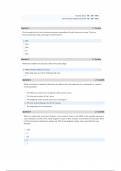
Choose the correct value of the mean days, in which accounts receivables will pay the invoices.
(Accounts receivables / revenues) * 365 = (6..000) * 365 = 73 days.
Operating profit = Net operating income + interest expense
You may need to know a current and reliable value as a company owner or investor for financing,
selling/buying shares, acquisition by another company or harvesting.
Competitive strategies – Porter
1. Low Cost Strategy: become cost leader in an industry
2. Differentiation Strategy: become unique in an industry
SWOT- Analysis
- Strenghts
- Weaknesses
- Opportunities
- Threats
Financial decisions in three key areas:
- Finance: what sources should funds be raised?
- Dividends: how should cash funds be allocated to shareholders and how will the value of the business
be affected by this?
- Investment: both long-term investment in non-current assets and short-term investment in working
capital.
Business related factors
- Macro: interest, inflation, employment rate
- Meso (industry): competition, innovation
- Micro (firm specific): strategy, skills, etc.
Two branches of accounting
1. Financial accounting
o Performed for the owners and stakeholders like banks or shareholders.
o Used to show how the business has done, profits and value.
2. Management accounting
o Performed for/by managers.
o Used to help make decisions and plan future activities.
Key financial statements
1. Balance sheet: Assets and liabilities.
2. Income statement: Income and Expenses
3. Cash flow statement: Cash inflow and -outflow
o There are 3 types of cash flow statements.
CF from operating activities: source of money from normal operations
CF from investing: change in plant and equipment + change in investing acc.
CF from financing activities: financing sources minus financing uses
Financial state analysis - allows managers to assess the health of a company.
- Financial ratio analysis: firm’s ability to raise funds on reasonable terms.
- Vertical analysis (common size analysis): based on comparing parts of the same statement as a
percentage. Like % of total sales
- Horizontal analysis (trend analysis): compares ratios between two or more periods.
Overview of valuation techniques
- Market/book value of assets: relevant for businesses that are ‘asset rich’
- Cash flow valuation: value of the business as the PV of future cash flows
- Valuation using comparable: compare ratios, like P/E ratios.
,Market capitalization (market value of equity) = number of shares * share price.
Net asset valuation determine value of a mutual fund.
What assets should be in the valuation?
- Monetary items -> book values
- Non-monetary items -> replacement costs & realizable values
2 examples: Assume the company has 8 million shares and the price is $3 per share.
- To get the share price according to NAV:
Equity and liabilities / amount of shares
19,200,000 by 8,000,000 = $2.40.
So, the shares are overvalued.
- Non-current assets are worth 40 million instead of 23.6 million (also called
replacement costs). Then the value of the total assets would increase to:
(Non-current assets – current assets – unsecured bond – current liabilities) /
amount of shares
(40m + 8.4m – 8m – 4.8m) / 8m = $4.5
So, the share price is undervalued.
Context of asset based valuation
When companies are in financial trouble, shareholders/lenders may use asset-based valuation to determine
the minimum value of the company's assets, known as the "break-up value", to decide what to do next.
There are downsides to NAV:
- Future profitability is ignored.
- Balance sheet valuation is based on accounting conventions.
- No accounting for intellectual capital or other intangible assets.
Which company from the two below is more suitable for NAV? (A)
- Company A: manufacturing company with a long history. Earnings have been highly volatile over time
and last year their net profit turned negative. Most of the asset value of the company is in machinery.
- Company B: The new tech start-up has intangible assets in the form of employees and patents on high
tech gadgets. They had a successful year with a positive net profit.
Based on the information provided, Company A with long history and volatile earnings, and where most of the
asset value is tied up in machinery, would be more suitable for net asset valuation.
Profitability ratios
ROCE stands for Return on Capital Employed. It is a = operating profit / capital employed
financial ratio used to measure the profitability of - Operating profit = earnings before interest
a company in relation to the capital invested in the and tax (PBIT)
business. - Capital employed = non-current assets +
(current assets – current liabilities)
ROE stands for Return on Equity. It is a financial = profit (after tax) / equity
ratio used to measure the profitability of a - Profit = net income
company in relation to the equity invested in the - Equity = given most of the time
company.
Profit margin is a financial ratio used to measure a = profit / revenue
company's profitability. It indicates the percentage
of sales achieved as profit.
Asset turnover is a financial ratio that measures a = revenue / net assets
company's efficiency in using its assets to generate - Net assets = totale active – totale passive
revenue. The ratio shows how much turnover a
company generates per unit of its total assets.
Working capital is the difference between a = current assets – current liabilities
company's current assets and current liabilities. It - Current assets = cash + accounts receivable +
represents the amount available to finance a inventories (short term activa).
company's day-to-day operations. - Current liabilities = accounts payable + short
, term debt. (short term debt).
The current ratio is a financial ratio that represents = current assets / current liabilities
the ratio of a company's current assets to current - Good ratio = 2:1, but it depends on the
liabilities. It indicates the extent to which a industry and strategy
company can meet its liabilities and finance its - Current assets = cash + accounts receivable +
day-to-day operations in the short term. inventories (short term activa).
- Current liabilities = accounts payable + short
term debt. (short term debt).
The quick ratio is a financial ratio that measures a = (current assets – inventory) / current liabilities
company's liquidity to pay off its short-term - Good ratio = 1:1
obligation by taking the most liquid current assets. - Current assets = cash + accounts receivable +
inventories (short term activa).
- Current liabilities = accounts payable + short
term debt. (short term debt).
Solvability ratios
Solvency indicates the proportion of a company’s Gearing ratio: long debt / capital employed
finance that comes from external providers. Gearing ratio: long debt / (total assets – current
liabilities)
Debt-to equity ratio = total debt / total equity
Above 50% debt/equity is a warning sign.
Liquidity
Current ratio Current assets / current liabilities x 100%
Quick ratio (Current assets – inventory) / current liabilities x 100%
Choose the correct value of the mean days, in which accounts receivables will pay the invoices.
(Accounts receivables / revenues) * 365 = (6..000) * 365 = 73 days.
Operating profit = Net operating income + interest expense