WATER TREATMENT
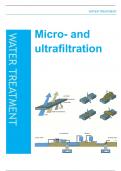
Micro- and
WATER TREATMENT
ultrafiltration
permeate
membrane
concentrate
colloïds
dissolved substances
water
pre-treatment filtration
surface water drinking water
2 1
2. ultrafiltration of surface water 1. ultrafiltration of drinking water
- ultrafiltration as a barrier for - ultrafiltration as a barrier for
bacils and viruses bacils and viruses
- change of filter phases - already a high quality of the raw water
before ultrafiltration
- adaptation of treatment neccesary
,micro- and ultrafiltration water treatment
Framework
This module explains micro- and ultrafiltration.
Contents
This module has the following contents:
1. Introduction
2. Principle
2.1 Membrane material
2.2 Membrane module
2.3 Dead-end filtration mode
2.4 Inside-out filtration
3 Theory
3.1 Mass balance
3.2 Kinetics
3.3 Membrane fouling
3.4 Cleaning
4 Practice
4.1 Module design
4.2 Choosing a module design
5 Operation
5.1 Constant pressure or constant flux mode
5.2 Cross-flow filtration
5.3 Fouling prevention
174
, water treatment micro- and ultrafiltration
1 Introduction In Figure 1 an overview is given of the different fil-
tration processes and the sizes of the compounds
Membrane filtration is a treatment process based removed. Also, an indication of the applied pres-
on the physical separation of compounds from sure needed for the filtration process is given.
the water phase with the use of a semi-permeable
membrane. Until recently membrane filtration was Microfiltration removes bacteria and the larger
regarded as a futuristic, expensive and complica viruses (down to a size of 0.05 µm).
ted treatment process. Because of the develop- Ultrafiltration also removes bacteria, but because
ment of the technique during the past years, the of the smaller pore size all the larger viruses
process can be regarded as proven technology. are removed. Also, all the colloidal particles are
The quality of the permeate of a membrane filtra- removed by UF as long as the membrane is not
tion installation is excellent. damaged.
The costs of membrane filtration have strongly The removal of suspended solids (measured as a
decreased over the past ten years because of the percentage of the feed concentration) of MF and
decreased costs of membrane elements. UF is at least 99%.
Membrane filtration can be divided into two catego- The removal of microorganisms is referred to in
ries based on the pore sizes of the membrane: log units. A removal of one log unit corresponds
- micro- and ultrafiltration (MF and UF) remove to a 90% removal. The removal of 4 log units cor-
colloidal substances and microorganisms responds to a 99.99% removal.
- nanofiltration and reverse osmosis (NF and In Table 1 the log removal capacity of MF and UF
RO) remove colloidal substances and microor- is shown for different microorganisms.
ganisms but also dissolved substances like
micropollutants and ions. The so-called molecular weight cut-off (MWCO)
can also be used as an indication of the ability
Micro- and ultrafiltration remove substances from of membranes to reject compounds. MWCO is
the water phase by a sieve mechanism. defined as the molecular weight of spherical mol-
size, µm
0.001 0.01 0.1 1.0 10 100 1,000
approximate
molecular 100 200 1000 10,000 20,000 100,000 500,000
weight
viruses bacils
relative
size of dissolved salts algae
materials
in water metal ions humic acids cysten sand
clay
silt
∆P (bar)
conventional filtration processes 0.01
microfiltration 0.05
treatment ultrafiltration 0.1
nanofiltration 5
reverse osmosis 30
ED and EDR
metal ions dissolved salts viruses humic acids bacils cysten
arsenic calcium salts contagious trihalomethane salmonella protozoa
nitrate sulfate salts hepatitis precursors shigella giardia
nitrite magnesium salts vibrio cholerae cryptosporidium
cyanide aluminum salts
Figure 1 - Overview of different filtration processes and sizes of compounds removed
175
Micro- and
WATER TREATMENT
ultrafiltration
permeate
membrane
concentrate
colloïds
dissolved substances
water
pre-treatment filtration
surface water drinking water
2 1
2. ultrafiltration of surface water 1. ultrafiltration of drinking water
- ultrafiltration as a barrier for - ultrafiltration as a barrier for
bacils and viruses bacils and viruses
- change of filter phases - already a high quality of the raw water
before ultrafiltration
- adaptation of treatment neccesary
,micro- and ultrafiltration water treatment
Framework
This module explains micro- and ultrafiltration.
Contents
This module has the following contents:
1. Introduction
2. Principle
2.1 Membrane material
2.2 Membrane module
2.3 Dead-end filtration mode
2.4 Inside-out filtration
3 Theory
3.1 Mass balance
3.2 Kinetics
3.3 Membrane fouling
3.4 Cleaning
4 Practice
4.1 Module design
4.2 Choosing a module design
5 Operation
5.1 Constant pressure or constant flux mode
5.2 Cross-flow filtration
5.3 Fouling prevention
174
, water treatment micro- and ultrafiltration
1 Introduction In Figure 1 an overview is given of the different fil-
tration processes and the sizes of the compounds
Membrane filtration is a treatment process based removed. Also, an indication of the applied pres-
on the physical separation of compounds from sure needed for the filtration process is given.
the water phase with the use of a semi-permeable
membrane. Until recently membrane filtration was Microfiltration removes bacteria and the larger
regarded as a futuristic, expensive and complica viruses (down to a size of 0.05 µm).
ted treatment process. Because of the develop- Ultrafiltration also removes bacteria, but because
ment of the technique during the past years, the of the smaller pore size all the larger viruses
process can be regarded as proven technology. are removed. Also, all the colloidal particles are
The quality of the permeate of a membrane filtra- removed by UF as long as the membrane is not
tion installation is excellent. damaged.
The costs of membrane filtration have strongly The removal of suspended solids (measured as a
decreased over the past ten years because of the percentage of the feed concentration) of MF and
decreased costs of membrane elements. UF is at least 99%.
Membrane filtration can be divided into two catego- The removal of microorganisms is referred to in
ries based on the pore sizes of the membrane: log units. A removal of one log unit corresponds
- micro- and ultrafiltration (MF and UF) remove to a 90% removal. The removal of 4 log units cor-
colloidal substances and microorganisms responds to a 99.99% removal.
- nanofiltration and reverse osmosis (NF and In Table 1 the log removal capacity of MF and UF
RO) remove colloidal substances and microor- is shown for different microorganisms.
ganisms but also dissolved substances like
micropollutants and ions. The so-called molecular weight cut-off (MWCO)
can also be used as an indication of the ability
Micro- and ultrafiltration remove substances from of membranes to reject compounds. MWCO is
the water phase by a sieve mechanism. defined as the molecular weight of spherical mol-
size, µm
0.001 0.01 0.1 1.0 10 100 1,000
approximate
molecular 100 200 1000 10,000 20,000 100,000 500,000
weight
viruses bacils
relative
size of dissolved salts algae
materials
in water metal ions humic acids cysten sand
clay
silt
∆P (bar)
conventional filtration processes 0.01
microfiltration 0.05
treatment ultrafiltration 0.1
nanofiltration 5
reverse osmosis 30
ED and EDR
metal ions dissolved salts viruses humic acids bacils cysten
arsenic calcium salts contagious trihalomethane salmonella protozoa
nitrate sulfate salts hepatitis precursors shigella giardia
nitrite magnesium salts vibrio cholerae cryptosporidium
cyanide aluminum salts
Figure 1 - Overview of different filtration processes and sizes of compounds removed
175