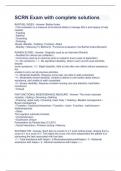
SCRN Exam with complete solutions
BARTHEL INDEX - Answer- Barthel Index • This evaluation is a measure of functional ability to manage ADL's and degree of help needed. - Feeding - Bathing - Grooming - Dressing -Bowel -Bladder -Toileting -Transfers -Stairs - Mobility • Mahoney FI, Barthel D. "Functional evaluation: the Barthel Index.Maryland RANKIN SCORE - Answer- Originally used as an interview (Rankin) • Modified for clinical use (mRankin) • Commonly used as an outcome point in research due to ease of application • 0 - No symptoms. • 1 - No significant disability. Able to carry out all usual activities, despite some symptoms. • 2 - Slight disability. Able to look after own affairs without assistance, but unable to carry out all previous activities. • 3 - Moderate disability. Requires some help, but able to walk unassisted. • 4 - Moderately severe disability. Unable to attend to own bodily needs without assistance, and unable to walk unassisted. • 5 - Severe disability. Requires constant nursing care and attention, bedridden, incontinent. • 6-Dead FIM FUNCTIONAL INDEPENDANCE MEASURE - Answer- The motor subscale includes: • Eating • Grooming • Bathing • Dressing, upper body • Dressing, lower body • Toileting • Bladder management • Bowel management • Transfers - bed/chair/wheelchair • Transfers - toilet • Transfers - bath/shower • Walk/wheelchair • Stairs The cognition subscale includes: • Comprehension • Expression Unique Presentation by Pamela Nye (C) 2015 • Social interaction • Problem solving • Memory SOCRING FIM - Answer- Each item is scored on a 7 point ordinal scale, ranging from a score of 1 to a score of 7. The higher the score, the more independent the patient is in performing the task associated with that item. • 1 - Total assistance with helper • 2-Maximalassistancewithhelper • 3 - Moderate assistance with helper • 4 - Minimal assistance with helper • • • 5 - Supervision or setup with helper 6 - Modified independence with no helper 7 - Complete independence with no helper GCS SCALE - Answer- BEST EYE RESPONSE 4 SPONTANEOUS TO BLINKING 3 OPENS TO VERBAL COMMNAD SHOUTING 2 OPENS TO PAIN 1 NONE BEST VERBAL 1ORIENTED 2CONFUSED 3INAPPROTIRATE SLURRED 4INCOMPREHENSAB;E 5NONE BEST MOTOR 1 OBEYS COMMANDS 2 PURPOUSEFUL MOTOR MOVEMENTS 3WITHDRAWS FROM STIMULI 4ABNORMAL FLEXION , POSTURING 6RIGID DECERABATE POSTURE 6NONE NIH SCORE - Answer- Level of Conscious • Orientation (age/month) • Vision • Best Motor (4 limbs) • Sensory • Best Language Follows Commands Best Gaze Facial Palsy Limb Ataxia Neglect/Extinction Dysarthria WORST 42 BEST 0 LAPAS - Answer- Los Angeles Pre Hospital Stroke Screen • Has elements of the Cincinnati PreHospital Stroke Scale + Blood glucose. • Takes 3-4 minutes to perform. • Useful for paramedics • Study result: 91% sensitivity and 97% specificity for identification of stroke in the field. (K Hunt & Hess Classification of Subarachnoid Hemorrhage - Answer- Mild Headache, Alert and Oriented, Minimal (if any) Nuchal Rigidity (H&H =1) • Full Nuchal Rigidity, Moderate-Severe Headache, Alert and Oriented, No Neuro Deficit (Besides CN Palsy) (H&H=2) • Lethargy or Confusion, Mild Focal Neurological Deficits+3 (H&H=3) • Stuporous, More Severe Focal Deficit (H&H=4) • Comatose, showing signs of severe neurological impairment (ex: posturing) (H&H=5) (MDCalc website, 2014) Presentation by Pamela Nye (C) 2015 FAST - Answer- FACE ARM SPEECH TIME OPTHALMIC ARTERY - Answer- Ophthalmic artery is a branch of the Internal Carotid Artery (ICA) which then branches off to several arteries serving the lacrimal ducts and surrounding structures. Amaurosis fugax is the result of episodic interruption of flow. AMARAUROSIS FUGAX - Answer- EPOSODIC INTERRUPTION OF BLOOD FLOW - OPTHALMIC ARTERY THROMBOTIC ISCHEMIC - Answer- Thrombotic - Associated with atherosclerotic heart disease, causing arterial narrowing. - Associated with excessive clotting (ex: hyper-coagulable states) EMBOLIC STROKE - Answer- Associated commonly with heart disease • Atrial fib/flutter • Patent foramen ovale • Endocarditisw/vegetation May be related to peri- pheral clot formation (example DVT) PENUMBRA - Answer- Stroke penumbra: the fragile, but salvageable area surrounding the dying tissue. VASCLAR INFLAMMATION - Answer- Vascular inflammatory response • Endothelial roughening - Purpose: semi-permeable membrane to surrounding tissue, smooth lining - Atherosclerotic coating ↓permeability - Prolonged inflammation = endothelial roughening • Increased platelet aggregation - Thrombocytes cling to roughened endothelium • Clot formation (Roberts, 2009; Hickey 2010) SMALL VESSEL OCCLUSION - Answer- SmallVesselOcclusion (Lacunar Infarction) - Small clots lodged in small branches. - Location may be biggest negative factor (i.e. Pons vs. parietal lobe vessels) • SmallVesselDisease - Associated with long term HTN or amyloid angiopathy. (protein) - Leading cause of dementia.
Escuela, estudio y materia
- Institución
- SCRN
- Grado
- SCRN
Información del documento
- Subido en
- 4 de junio de 2023
- Número de páginas
- 28
- Escrito en
- 2022/2023
- Tipo
- Examen
- Contiene
- Preguntas y respuestas
Temas
-
scrn exam with complete solutions

Documento también disponible en un lote