NUR 599: MIDTERM STUDY GUIDE.
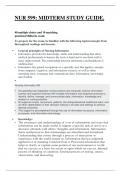
NUR 599: MIDTERM STUDY GUIDE. 40 multiple choice and 10 matching questions Midterm exam: To prepare for the exam, be familiar with the following topics/concepts from the required readings and lessons: • General principles of Nursing Informatics • Informatics provides the knowledge, skills, and understanding that allow medical professionals to harness the tools at hand and to use them well to enact improvement. The relationship between informatics and healthcare is multifaceted. • Informatics has gained recognition as a specialty area that applies concepts from computer, cognitive, and information sciences, as well as other emerging areas, to manage and communicate data, information, knowledge, and wisdom. • • Knowledge: • The awareness and understanding of a set of information and ways that information can be made useful to support a specific task or arrive at a decision; abounds with others’ thoughts and information. Information that is synthesized so that relationships are identified and formalized. Understanding that comes through a process of interaction or experience with the world around us. Information that has judgment applied to it or meaning extracted from it. Processed information that helps to clarify or explain some portion of our environment or world that we can use as a basis for action or upon which we can act. Internal process of thinking or cognition. External process of testing, senses, observation, and interacting. • Knowledge acquisition • The act of getting knowledge. • Knowledge brokers • People who know where to find information and knowledge. They generate some knowledge but are mainly known for their ability to find what is needed. More experienced nurses and nursing students become knowledge brokers out of necessity—needing to know. • Knowledge builder • Person who examines, interprets, and compares clinical data and trends with an eye toward improving clinical practice based on the available evidence. • Knowledge-centric • Knowledge is the central focus. • Knowledge consumers • Users of knowledge who do not have the expertise to provide the knowledge they need for themselves. • Knowledge dissemination • Distribution and sharing of knowledge. • Knowledge domain process (KDP) model • Model that represents knowledge construction and dissemination in an organization. • Knowledge exchange • The product of collaboration when sharing an understanding of information promotes learning to make better decisions in the future. • Knowledge generation • The creation of new knowledge by changing and evolving knowledge based on one’s experience, education, and input from others. • Knowledge generators • Nursing researchers and nursing experts—the people who know; they are able to answer questions, craft theories, find solutions to nursing problems or concerns, and innovate practice. • Knowledge management systems (KMSs) • Repositories of information that contain the latest collective expertise based on experience and research. The knowledge is typically stored in a computerized system that promotes easy access for use. • Knowledge processing • The activity or process of gathering or collecting, perceiving, analyzing, synthesizing, saving or storing, manipulating, conveying, and transmitting knowledge. • Knowledge repositories • Collections of information made available to an organization’s workers to support and inform their work. • Knowledge user • Individual or group who benefits from valuable, viable knowledge. • Knowledge workers • Those who work with information and generate information and knowledge as a product. • Wisdom: • Wisdom is the application of knowledge to an appropriate situation. In the practice of nursing science, one expects actions to be directed by wisdom. Wisdom uses knowledge and experience to heighten common sense and insight to exercise sound judgment in practical matters. It is developed 40 multiple choice and 10 matching questions Midterm exam: To prepare for the exam, be familiar with the following topics/concepts from the required readings and lessons: • General principles of Nursing Informatics • Informatics provides the knowledge, skills, and understanding that allow medical professionals to harness the tools at hand and to use them well to enact improvement. The relationship between informatics and healthcare is multifaceted. • Informatics has gained recognition as a specialty area that applies concepts from computer, cognitive, and information sciences, as well as other emerging areas, to manage and communicate data, information, knowledge, and wisdom. • • Knowledge: • The awareness and understanding of a set of information and ways that information can be made useful to support a specific task or arrive at a decision; abounds with others’ thoughts and information. Information that is synthesized so that relationships are identified and formalized. Understanding that comes through a process of interaction or experience with the world around us. Information that has judgment applied to it or meaning extracted from it. Processed information that helps to clarify or explain some portion of our environment or world that we can use as a basis for action or upon which we can act. Internal process of thinking or cognition. External process of testing, senses, observation, and interacting. • Knowledge acquisition • The act of getting knowledge. • Knowledge brokers • People who know where to find information and knowledge. They generate some knowledge but are mainly known for their ability to find what is needed. More experienced nurses and nursing students become knowledge brokers out of necessity—needing to know. • Knowledge builder • Person who examines, interprets, and compares clinical data and trends with an eye toward improving clinical practice based on the available evidence. • Knowledge-centric • Knowledge is the central focus. • Knowledge consumers • Users of knowledge who do not have the expertise to provide the knowledge they need for themselves. • Knowledge dissemination • Distribution and sharing of knowledge. • Knowledge domain process (KDP) model • Model that represents knowledge construction and dissemination in an organization. • Knowledge exchange • The product of collaboration when sharing an understanding of information promotes learning to make better decisions in the future. • Knowledge generation • The creation of new knowledge by changing and evolving knowledge based on one’s experience, education, and input from others. • Knowledge generators • Nursing researchers and nursing experts—the people who know; they are able to answer questions, craft theories, find solutions to nursing problems or concerns, and innovate practice. • Knowledge management systems (KMSs) • Repositories of information that contain the latest collective expertise based on experience and research. The knowledge is typically stored in a computerized system that promotes easy access for use. • Knowledge processing • The activity or process of gathering or collecting, perceiving, analyzing, synthesizing, saving or storing, manipulating, conveying, and transmitting knowledge. • Knowledge repositories • Collections of information made available to an organization’s workers to support and inform their work. • Knowledge user • Individual or group who benefits from valuable, viable knowledge. • Knowledge workers • Those who work with information and generate information and knowledge as a product. • Wisdom: • Wisdom is the application of knowledge to an appropriate situation. In the practice of nursing science, one expects actions to be directed by wisdom. Wisdom uses knowledge and experience to heighten common sense and insight to exercise sound judgment in practical matters. It is developed
Escuela, estudio y materia
- Institución
- NUR599
- Grado
- NUR599
Información del documento
- Subido en
- 4 de junio de 2023
- Número de páginas
- 35
- Escrito en
- 2022/2023
- Tipo
- OTRO
- Personaje
- Desconocido
Temas
-
nur 599 midterm study guide

Documento también disponible en un lote