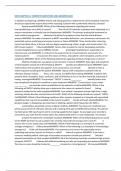
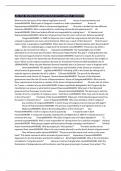
NCLEX Comprehensive Exam Questions and answers. Rationale Provided. Graded A+
NCLEX Comprehensive Exam Questions and answers. Rationale Provided. Graded A+ Document Content and Description Below Enalapril maleate is prescribed for a hospitalized client. Which assessment does the nurse perform as a priority before administering the medication? - Ans-Checking the client's blood pressure Rat ionale: Enalapril maleate is an angiotensin-converting enzyme (ACE) inhibitor used to treat hypertension. One common side effect is postural hypotension. Therefore the nurse would check the client's blood pressure immediately before administering each dose. Checking the client's peripheral pulses, the results of the most recent potassium level, and the intake and output for the previous 24 hours are not specifically associated with this mediation. A client is scheduled to undergo an upper gastrointestinal (GI) series, and the nurse provides instructions to the client about the test. Which statement by the client indicates a need for further instruction? - Ans-"I need to drink citrate of magnesia the night before the test and give myself a Fleet enema on the morning of the test." Rationale: An upper GI series involves visualization of the esophagus, duodenum, and upper jejunum by means of the use of a contrast medium. It involves swallowing a contrast medium (usually barium), which is administered in a flavored milkshake. Films are taken at intervals during the test, which takes about 30 minutes. No special preparation is necessary before a GI series, except that NPO status must be maintained for 8 hours before the test. After an upper GI series, the client is prescribed a laxative to hasten elimination of the barium. Barium that remains in the colon may become hard and difficult to expel, leading to fecal impaction. A nurse on the evening shift checks a health care provider's prescriptions and notes that the dose of a prescribed medication is higher than the normal dose. The nurse calls the health care provider's answering service and is told that the health care provider is off for the night and will be available in the morning. The nurse should: - Ans-Ask the answering service to contact the on-call health care provider Rationale: The nurse has a duty to protect the client from harm. A nurse who believes that a health care provider's prescription may be in error is responsible for clarifying the prescription before carrying it out. Therefore the nurse would not administer the medication; instead, the nurse would withhold the medication until the dose can be clarified. The nurse would not wait until the next morning to obtain clarification. It is premature to call the nursing supervisor. An emergency department (ED) nurse is monitoring a client with suspected acute myocardial infarction (MI) who is awaiting transfer to the coronary intensive care unit. The nurse notes the sudden onset of premature ventricular contractions (PVCs) on the monitor, checks the client's carotid pulse, and determines that the PVCs are not resulting in perfusion. The appropriate action by the nurse is: - Ans-Asking the ED health care provider to check the client Rationale: PVCs are a result of increased irritability of ventricular cells. Peripheral pulses may be absent or diminished with the PVCs themselves because the decreased stroke volume of the premature beats may in turn decrease peripheral perfusion. Because other rhythms also cause widened QRS complexes, it is essential that the nurse determine whether the premature beats are resulting in perfusion of the extremities. This is done by palpating the carotid, brachial, or femoral artery while observing the monitor for widened complexes or by auscultating for apical heart sounds. In the situation of acute MI, PVCs may be considered warning dysrhythmias, possibly heralding the onset of ventricular tachycardia or ventricular fibrillation. Therefore the nurse would not tell the client that the PVCs are expected. Although the nurse will continue to monitor the client and document the findings, these are not the most appropriate actions of those provided. The most appropriate action would be to ask the ED health care provider to check the client. NPO status is imposed 8 hours before the procedure on a client scheduled to undergo electroconvulsive therapy (ECT) at 1 p.m. On the morning of the procedure, the nurse checks the client's record and notes that the client routinely takes an oral antihypertensive medication each morning. The nurse should: - Ans-Administer the antihypertensive with a small sip of water Rationale: General anesthesia is required for ECT, so NPO status is imposed for 6 to 8 hours before treatment to help prevent aspiration. Exceptions include clients who routinely receive cardiac medications, antihypertensive agents, or histamine (H2) blockers, which should be administered several hours before treatment with a small sip of water. Withholding the antihypertensive and administering it at bedtime and withholding the antihypertensive and resuming administration on the day after the ECT are incorrect actions, because antihypertensives must be administered on time; otherwise, the risk for rebound hypertension exists. The nurse would not administer a medication by way of a route that has not been prescribed. A client who recently underwent coronary artery bypass graft surgery comes to the health care provider's office for a follow-up visit. On assessment, the client tells the nurse that he is feeling depressed. Which response by the nurse is therapeutic? - Ans-"Tell me more about what you're feeling." Rationale: When a client expresses feelings of depression, it is extremely important for the nurse to further explore these feelings with the client. In stating, "This is a normal response after this type of surgery" the nurse provides false reassurance and avoids addressing the client's feelings. "It will take time, but, I promise you, you will get over the depression" is also a false reassurance, and it does not encourage the expression of feelings. "Every client who has this surgery feels the same way for about a month" is a generalization that avoids the client's feelings. A client in labor experiences spontaneous rupture of the membranes. The nurse immediately counts the fetal heart rate (FHR) for 1 full minute and then checks the amniotic fluid. The nurse notes that the fluid is yellow and has a strong odor. Which action should be the nurse's priority? - Ans-Contacting the health care provider Rationale: The FHR is assessed for at least 1 minute when the membranes rupture. The nurse also checks the quantity, color, and odor of the amniotic fluid. The fluid should be clear (often with bits of vernix) and have a mild odor. Fluid with a foul or strong odor, cloudy appearance, or yellow coloration suggests chorioamnionitis and warrants notifying the health care provider. A large amount of vernix in the fluid suggests that the fetus is preterm. Greenish, meconium-stained fluid may be seen in cases of postterm gestation or placental insufficiency. Checking the fluid for protein is not associated with the data in the question. Although the nurse would continue to monitor the client and the FHR and would document the findings, contacting the health care provider is the priority. A nurse has assisted a health care provider in inserting a central venous access device into a client with a diagnosis of severe malnutrition who will be receiving parenteral nutrition (PN). After insertion of the catheter, the nurse immediately plans to: - Ans-Call the radiography department to obtain a chest x-ray Rationale: One major complication associated with central venous catheter placement is pneumothorax, which may result from accidental puncture of the lung. After the catheter has been placed but before it is used for infusions, its placement must be checked with an x-ray. Hanging the prescribed bag of PN and starting the infusion at the prescribed rate and infusing normal saline solution through the catheter at a rate of 100 mL/hr to maintain patency are all incorrect because they could result in the infusion of solution into a lung if a pneumothorax is present. Although the nurse may obtain a blood glucose measurement to serve as a baseline, this action is not the priority. A rape victim being treated in the emergency department says to the nurse, "I'm really worried that I've got HIV now." What is the appropriate response by the nurse? - Ans-"Let's talk about the information that you need to determine your risk of contracting HIV." Rationale: HIV is a concern of rape victims. Such concern should always be addressed, and the victim should be given the information needed to evaluate his or her risk. Pregnancy may occur as a result of rape, and pregnancy prophylaxis can be offered in the emergency department or during follow-up, once the results of a pregnancy test have been obtained. However, stating, "You're more likely to get pregnant than to contract HIV" avoids the client's concern. Similarly, "HIV is rarely an issue in rape victims" and "Every rape victim is concerned about HIV" are generalized responses that avoid the client's concern. A client is taking prescribed ibuprofen, 300 mg orally four times daily, to relieve joint pain resulting from rheumatoid arthritis. The client tells the nurse that the medication is causing nausea and indigestion. The nurse should tell the client to: - Ans-Take the medication with food Rationale: Ibuprofen is a nonsteroidal antiinflammatory medication. Side effects include nausea (with or without vomiting) and dyspepsia (heartburn, indigestion, or epigastric pain). If gastrointestinal distress occurs, the client should be instructed to take the medication with milk or food. The nurse would not instruct the client to stop the medication or instruct the client to adjust the dosage of a prescribed medication; these actions are not within the legal scope of the role of the nurse. Contacting the health care provider is premature, because the client's complaints are side effects that occasionally occur and can be relieved by taking the medication with milk or food. Lorazepam 1 mg by way of intravenous (IV) injection (IV push) is prescribed for a client for the management of anxiety. The nurse prepares the medication as prescribed and administers the medication over a period of: - Ans-3 minutes Rationale: Lorazepam is a benzodiazepine. When administered by IV injection, each 2 mg or fraction thereof is administered over a period of 1 to 5 minutes. Ten seconds and 30 seconds are brief periods. Thirty minutes is a lengthy period. A nurse, conducting an assessment of a client being seen in the clinic for symptoms of a sinus infection, asks the client about medications that he is taking. The client tells the nurse that he is taking nefazodone hydrochloride . On the basis of this information, the nurse determines that the client most likely has a history of: - Ans-Depression Rationale: Nefazodone hydrochloride is an antidepressant used as maintenance therapy to prevent relapse of an acute depression. Diabetes mellitus, hypethyroidism, and coronary artery disease are not treated with this medication. Phenelzine sulfate is prescribed for a client with depression. The nurse provides information to the client about the adverse effects of the medication and tells the client to contact the health care provider immediately if she experiences: - Ans-Neck stiffness or soreness Rationale: Phenelzine sulfate, a monoamine oxidase inhibitor (MAOI), is an antidepressant and is used to treat depression. Hypertensive crisis, an adverse effect of this medication, is characterized by hypertension, frontally radiating occipital headache, neck stiffness and soreness, nausea, vomiting, sweating, fever and chills, clammy skin, dilated pupils, and palpitations. Tachycardia, bradycardia, and constricting chest pain may also be present. The client is taught to be alert to any occipital headache radiating frontally and neck stiffness or soreness, which could be the first signs of a hypertensive crisis. Dry mouth and restlessness are common side effects of the medication. Risperidone is prescribed for a client hospitalized in the mental health unit for the treatment of a psychotic disorder. Which finding in the client's medical record would prompt the nurse to contact the prescribing health care provider before administering the medication? - Ans-The client takes a prescribed antihypertensive. Rationale: Risperidone is an antipsychotic medication. Contraindications to the use of risperidone include cardiac disorders, cerebrovascular disease, dehydration, hypovolemia, and therapy with antihypertensive agents. Risperidone is used with caution in clients with a history of seizures. History of cataracts, hypothyroidism, or allergy to aspirin does not affect the administration of this medication. A client who has been undergoing long-term therapy with an antipsychotic medication is admitted to the inpatient mental health unit. Which finding does the nurse, knowing that long-term use of an antipsychotic medication can cause tardive dyskinesia, monitor in the client? - Ans-Tongue protrusion Rationale: Tardive dyskinesia is a severe reaction associated with long-term use of antipsychotic medications. The clinical manifestations include abnormal movements (dyskinesia) and involuntary movements of the mouth, tongue ("flycatcher tongue"), and face. In its most severe form, tardive dyskinesia involves the fingers, arms, trunk, and respiratory muscles. When this occurs, the medication is discontinued. Fever, diarrhea, and hypertension are not characteristics of tardive dyskinesia. A nurse is reviewing the record of a client scheduled for electroconvulsive therapy (ECT). Which diagnosis, if noted on the client's record, would indicate a need to contact the health care provider who is scheduled to perform the ECT? - Ans-Recent stroke Rationale: Several conditions pose risks in the client scheduled for ECT. Among them are recent myocardial infarction or stroke and cerebrovascular malformations or intracranial lesions. Hypothyroidism, glaucoma, and peripheral vascular disease are not contraindications to this treatment. A client scheduled for suprapubic prostatectomy has listened to the surgeon's explanation of the surgery. The client later asks the nurse to explain again how the prostate is going to be removed.
Escuela, estudio y materia
- Institución
- NCLEX
- Grado
- NCLEX
Información del documento
- Subido en
- 4 de junio de 2023
- Número de páginas
- 52
- Escrito en
- 2022/2023
- Tipo
- Examen
- Contiene
- Preguntas y respuestas
Temas
-
nclex comprehensive exam questions and answers ra

Documento también disponible en un lote